
Three quotes for canning equipment can sit $40,000 apart and describe the same job. The cheapest one reads like a bargain until the first season of downtime, the missed seam checks, and the service invoice that never showed up in the vendor’s email. The expensive one may be overbuilt for an order book that cannot fill it. Between those two mistakes sits most of the money small producers waste on packaging equipment.
This guide sorts the price bands first, then puts real transaction prices next to each automation tier. It walks through the costs that arrive after the invoice and closes with the budgeting method experienced operators actually use. The examples lean on canning and rigid containers, the most common entry point for food and beverage producers, though the same logic prices pouch and bottle lines.
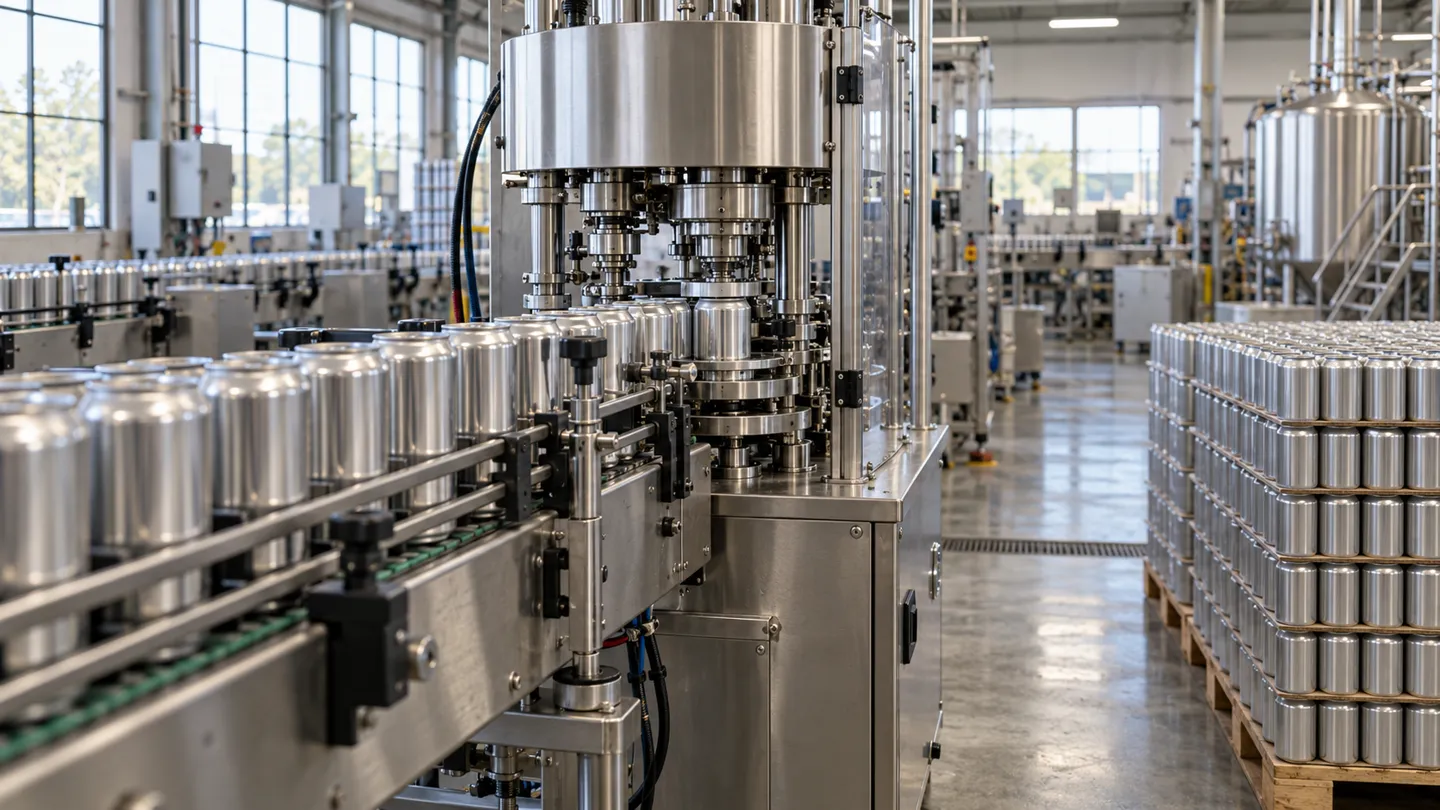
What Determines the Price of a Packaging Machine
The first shock of researching this topic is the range. One listing shows a handheld sealer for $100. Another shows an integrated line at more than a million dollars (Soontact pricing guide, 2025). Both are “packaging machines.” Comparing them is the first error, and it happens because search results mix machine types the way a furniture store mixes chairs and kitchens.
Three levers set most of the price. The first is automation level. A manual machine needs hands on every cycle, a semi-automatic needs an operator feeding it, and a fully automatic machine runs a conveyor with monitoring only. The second is speed, measured in cans per minute (cpm), which drives motor size, tooling precision, and control systems. The third is build quality: food-grade 304 or 316 stainless steel costs more than painted carbon steel, and it is not optional for food, beverage, or pharmaceutical products (Soontact pricing guide, 2025).
| Tier | Typical range | What you get | Who it fits |
|---|---|---|---|
| Entry / manual and tabletop | $100 to $10,000 | Hand sealers, small fillers, batch work | Startups testing a market |
| Mid-range / semi-automatic | $10,000 to $65,000 | Meaningful automation, operator-fed | Small and growing producers |
| High-end / automatic and lines | $65,000 to $1.2M+ | Conveyor-fed systems, integrated lines | Steady volume, multi-shift plants |
A note on boundaries: the numbers above describe general packaging equipment. Canning machines have their own price logic, and the rest of this article stays inside that category, because cross-category price comparison is where budgets go wrong first.
Real Price Points by Automation Tier
Published guides give wide bands. Buyer discussions give numbers that survived contact with purchase orders, and they are more useful for budgeting.
Semi-Automatic: The Entry Point Around $20k to $55k
This is where most small producers land, and the real numbers cluster tighter than the guides suggest. In one brewer discussion on equipment budgets, a 500-barrel-a-year producer floated a $130k line. The reply was blunt: the budget was oversized for the volume. The same thread cites a micro-canner line at $55k running 23 cans per minute, used lines listed between $30k and $60k at 20 to 60 cpm, and a used line advertised at $47,750 (r/TheBrewery discussion, 2025). Two people can run a 20 to 30 cpm line; above that, plan for a third (r/TheBrewery discussion, 2025).
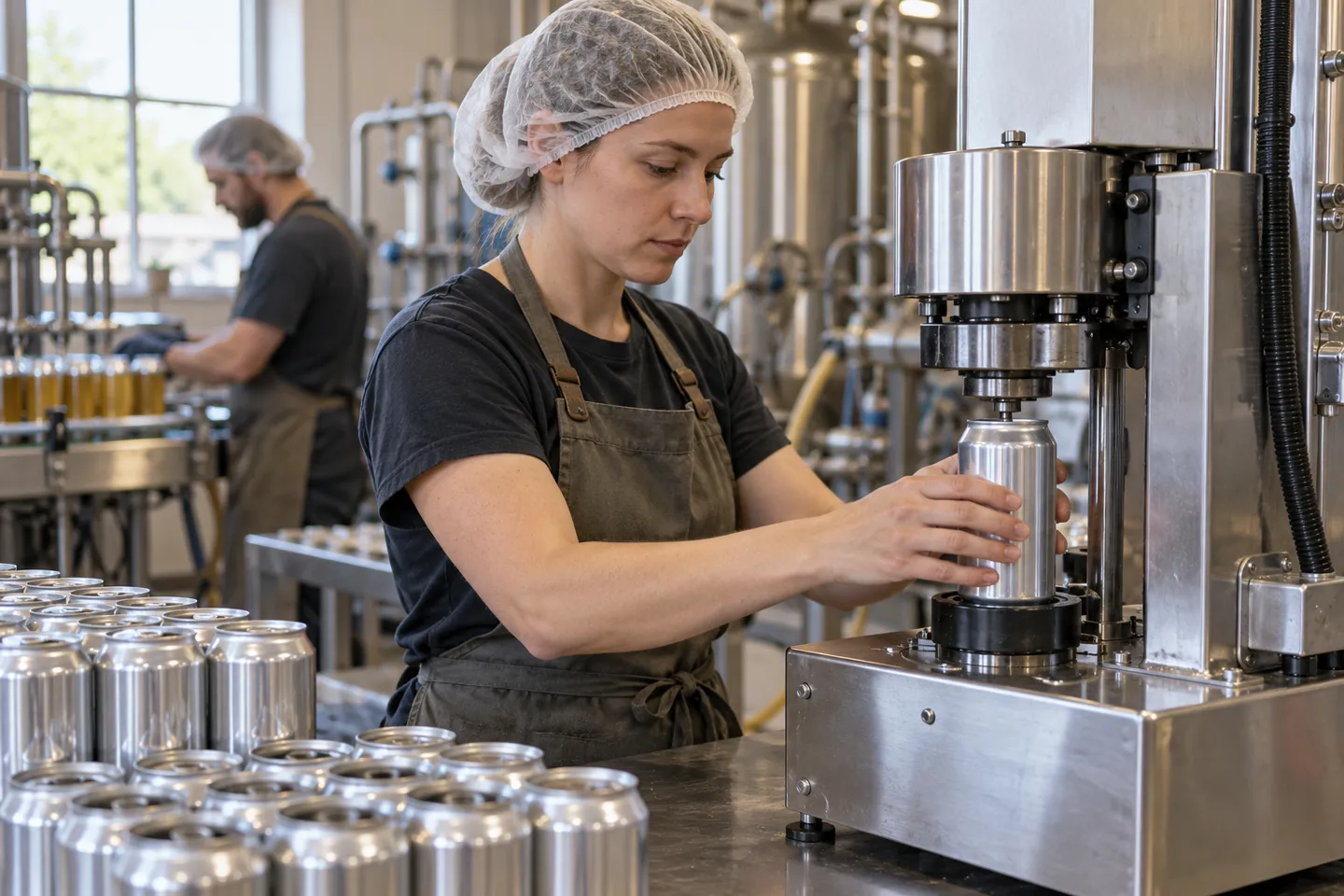
Be suspicious of anything advertised as semi-automatic under roughly $5,000. Brewers reviewing the used market put it plainly: that is a crazily low number for almost any real semi-automated packaging equipment (r/TheBrewery discussion, 2025). Machines in that range exist, but they are tabletop adjuncts, not production tools, and budgeting them as such leads to a repurchase within two years.
| Tier | Real-world price anchor | Speed | Crew |
|---|---|---|---|
| Tabletop adjunct | under $5k | batch only | 1 |
| Semi-auto single machine | $20k to $55k | 20 to 30 cpm | 2 |
| Used small line | $30k to $60k | 20 to 60 cpm | 2 to 3 |
| Fully auto single machine | $65k+ | 30 to 50+ cpm | 1 to 2 plus a technician |
Fully Automatic Single Machines: What the Premium Buys
Crossing $65k buys specific engineering, and it helps to know what it is. Servo-driven can handling replaces pneumatics for positioning accuracy, which matters when a seamer has to land a lid on a moving can hundreds of times a minute. Higher speeds come from parallelism: a six-nozzle volumetric filler running about 30 cpm, or a double-head powder filler rated 25 to 40 cpm depending on container and fill weight (automatic powder filling machine, 2026). At the sealing station, four rollers form the double seam in two operations. That design pushes a high-volume round-can sealer to 50 cpm with a maximum can diameter of 130 mm (automatic can sealing machine, 2026).
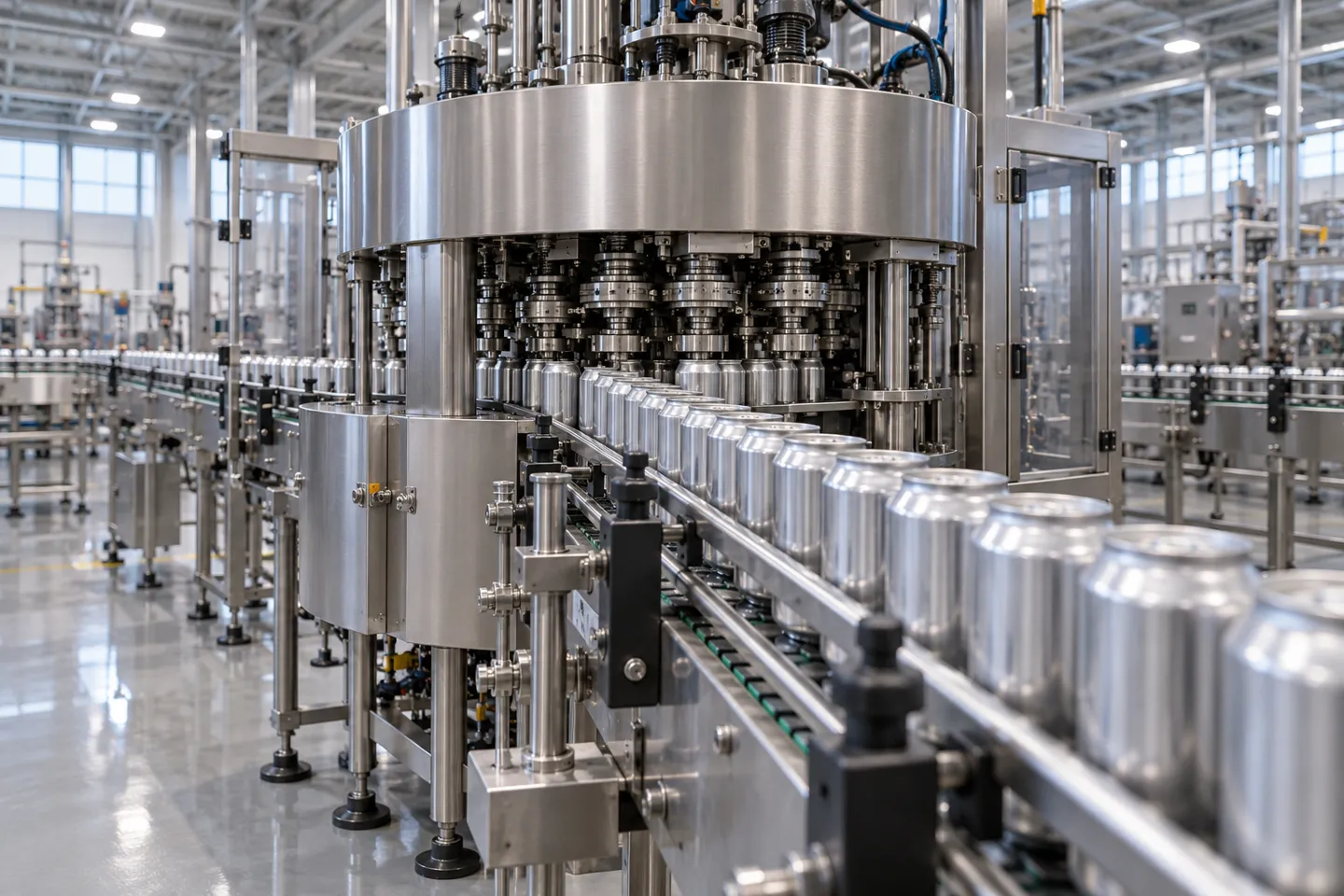
The premium also buys shelf-life hardware. Nitrogen-flush vacuum sealers pull a vacuum, replace the headspace with nitrogen, and seal, holding residual oxygen below 3% (automatic can sealing machine, 2026). For coffee, nuts, or any oxidation-sensitive product, that feature changes what the machine is for, not just what it costs.
What the $65k+ premium actually buys
50 cpm
Four-roller double-seam head, cans up to 130 mm
30 cpm
Six-nozzle volumetric filling, servo can handling
under 3%
Residual O2 with nitrogen-flush vacuum sealing
None of this runs without infrastructure. The same buyer thread that priced the lines lists what a line assumes you already have: adequate power, dry compressed air, and stable regulated CO2 (r/TheBrewery discussion, 2025). A $65k machine bolted into a building with a marginal air compressor will not behave like a $65k machine.
The Support Equipment Nobody Quotes You
A filler and a seamer do not make a line. Labeling, date coding, can rinsing, and the accumulation tables that feed them turn two machines into production. Experienced buyers warn that these “support” pieces are what make life miserable, not the headline machines (r/TheBrewery discussion, 2025). When comparing quotes, put every station on the same list before comparing prices, because one vendor’s “complete” and another’s are rarely the same list.
Matching the Machine to Your Order Volume
The question is not “which machine is best” but “which machine fits the order book.” Operators work it out in four steps.
Four steps to your tier
- 1Write down monthly can volume today, and expected volume 18 months out.
- 2Divide by production days and effective hours to get cans per hour needed.
- 3Add 30 to 50% headroom for growth and changeover time, then convert to cpm.
- 4Match that cpm to a tier, and price the tier, not the dream.
A worked example: a producer canning 11,000 to 20,000 cans a month, spread over four canning days, needs roughly 350 to 625 cans an hour. A 20 to 30 cpm line covers that in two to four hours of actual running. It is why brewers at that scale keep repeating that 20 to 30 cpm is plenty (r/TheBrewery discussion, 2025).
There is a cost curve that makes this worth doing carefully. Manual packaging runs about $0.24 per unit, semi-automatic about $0.127, fully automatic about $0.107. At 500,000 units a year, the gap between manual and automatic is roughly $66,500 a year (Soontact pricing guide, 2025). Below some volume, though, the curve has not bent yet, and the honest answer is not to buy. If orders are still volatile, contract packing or renting time on equipment keeps the option open without the capital at risk. Buying a fast machine for tomorrow’s volume is only rational if tomorrow’s volume is contracted, not hoped for.
Before you shortlist vendors, send us your monthly can count and your current packing routine, and we will tell you which tier your volume actually supports.
Get a sizing recommendationThe Total Cost Behind the Quote
Two machines with identical speed ratings can differ by 2x in what they actually cost to own. The quote covers the machine. The rest arrives on its own schedule.
One-Time Costs That Land After the Invoice
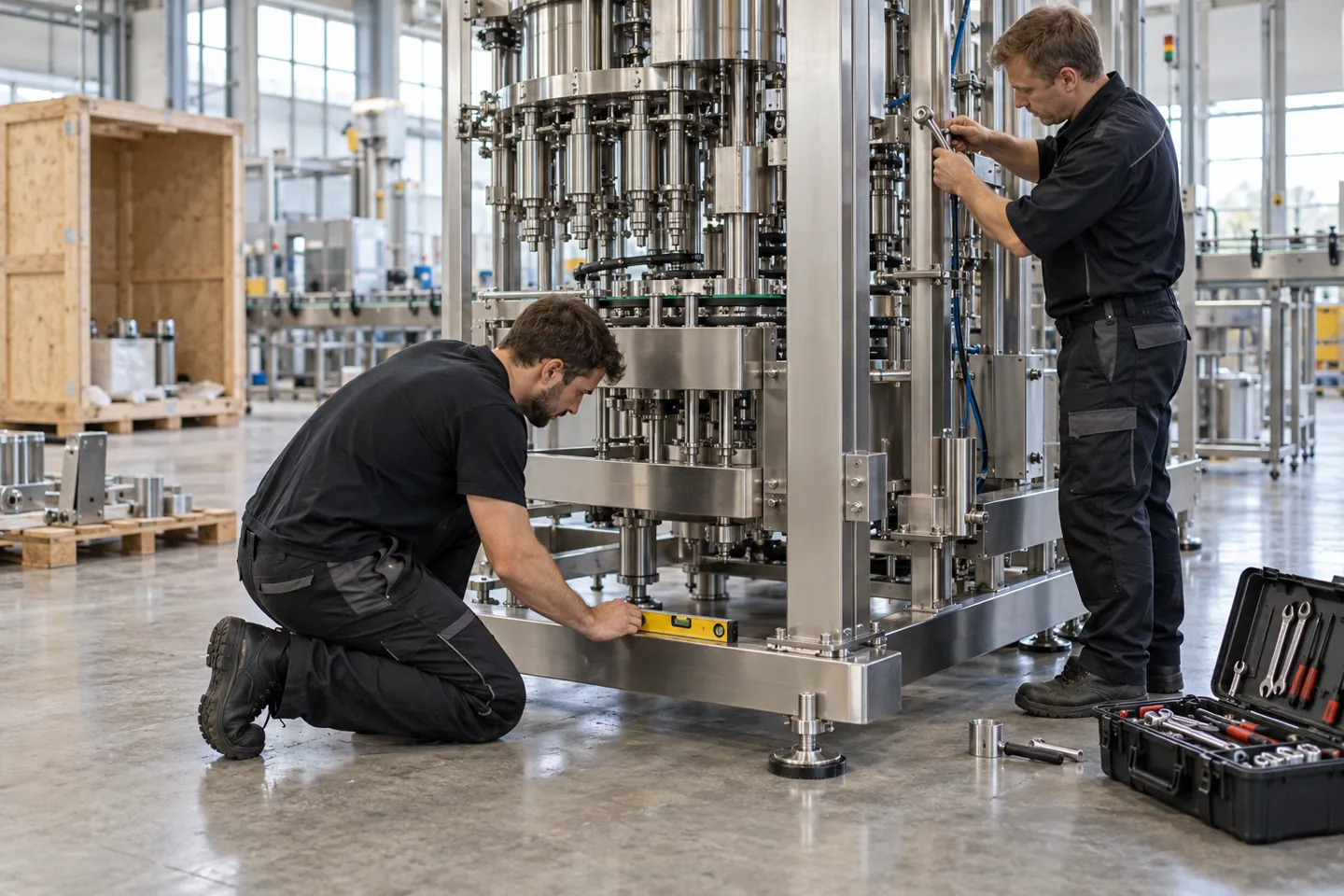
Installation and integration typically run 5 to 15% of the machine price (Soontact pricing guide, 2025). Facility work catches buyers off guard: upgraded electrical service, a compressed air system at $2,000 to $8,000, sometimes ventilation (Soontact pricing guide, 2025). Operator training runs $2,000 to $10,000, and skipping it is false economy, because poorly trained operators cause more downtime than any mechanical fault. A first spare parts kit, belts, seals, and sensors with long lead times, budgets another $3,000 to $10,000 (Soontact pricing guide, 2025).
Running Costs That Never Stop
Maintenance contracts typically cost 3 to 8% of the purchase price per year, and unplanned repairs run 3 to 5 times what scheduled maintenance costs (Soontact pricing guide, 2025). Sealing strips and gaskets need replacement every 6 to 12 months, belts and bearings every 12 to 24 (Soontact pricing guide, 2025). When something does break, rush-shipped parts cost 3 to 5 times standard freight, and an outside technician bills $150 to $300 an hour plus travel (Soontact pricing guide, 2025).
Same speed class, same production hall.
$30,000
scrapped after 4 years
$45,000
still sealing at year 15
Five Ways to Spend the Budget, and When Each One Fails
| Option | Fits when | Real price anchor | Watch out for | Switch when |
|---|---|---|---|---|
| Semi-auto single machine | Orders steady, one shift, local sales | $20k to $55k, 20-30 cpm | Overtime eating the savings at sustained full runs | Two shifts become routine |
| Fully auto single machine | Contracted volume, quality-critical product | $65k+, 30-50+ cpm | Infrastructure gaps (power, dry air) | Volume drops and it idles |
| Complete line | Multi-SKU output, staff available | $100k+ | Support equipment gaps; integration fees | Better to add stations one at a time |
| Used or refurbished | Capital tight, mechanical skill in-house | $30k-$60k used (20-60 cpm) | Unknown seamer wear; vanished vendor | No service history exists |
| Contract packing first | Volume unproven, market testing | Per-can fee | MOQs, setup fees, rush premiums | Same SKU ships steadily 6+ months |
Put the installation quote, the first parts kit, and training in the contract as line items, not verbal promises. A vendor who will not price them has already told you something.
Buying Channel: New Direct, Used, or Refurbished
New from the manufacturer buys you a warranty, factory support, and someone to call when the seam drifts. That is exactly what the premium over used is for. Buying direct from a manufacturer, rather than through a distribution layer, is where much of the price difference sits. It also shifts the verification work onto you: certificates, references, and acceptance testing are your job now.
The used market is real and, in an industry downturn, buyer-friendly. Verify three things before wiring money: the maintenance records, the machine running with your product, and the seamer’s service history. Seamer rebuild history is the single best predictor of seam quality (r/TheBrewery discussion, 2025). Skip anything from a failed operation with no records; a bargain line from a dying business carries its ghosts. Refurbished sits between: a dealer has inspected it, some warranty attaches, and pricing runs 40 to 60% under new (Soontact pricing guide, 2025).
Before sending the inquiry
- Certificates CE / CSA / ISO 9001
- Named-brand electrical components (PLC, touch screen, motors, pneumatics)
- Trial run on YOUR sample cans before shipment
- Warranty term and what it excludes, in writing
- Spare parts availability and lead times
- Delivery term and installation scope
Electrical brand names deserve their own line on that list. When the PLC, motor, and pneumatic components are international brands available from any distributor, your local technician can service the machine even if the builder is an ocean away. Proprietary parts turn every breakdown into a conversation with one supplier’s shipping department.
What Failure Costs: Seam Defects, Dead Vendors, Cheap Builds
The three expensive failures in canning equipment are not random. Each has a signature, and each can be screened before money moves.
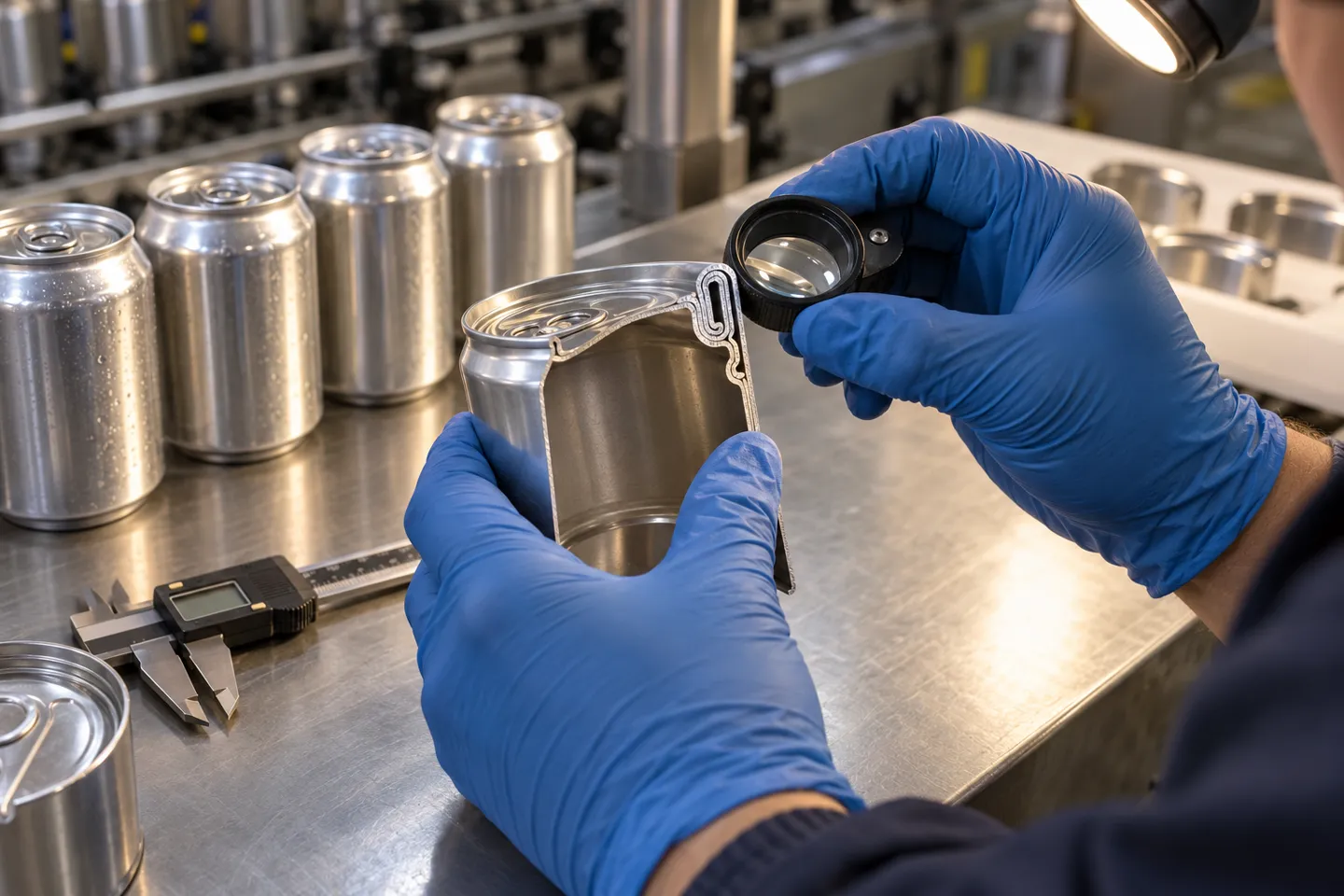
Seam defects head the list. A drifting or wandering seam leaks. Leaked cans get returned, and a retail account can disappear over one bad batch. Brewers living with marginal sealers describe the worry as constant (r/TheBrewery discussion, 2025). The screening action: require a seam teardown inspection and a vacuum or pressure test as part of factory acceptance, run on your cans, not the vendor’s. Dented cans upstream cause the same failures, so can inspection belongs in the line design, not in the complaint file.
Acceptance rule: final payment follows a trial run on your own sample cans. If the vendor will not run your cans through an extended live test before shipment, the risk you are being asked to carry is the answer.
Vendor death is quieter. When a builder exits the market, support ends and the line slowly orphanizes, as one brewery documented when their line’s maker stopped supporting it (r/TheBrewery, 2025). The screening action: confirm spare parts availability terms in the contract, and weight machines built on named-brand electrical components, because generic parts keep a line alive without the original builder.
Cheap builds collect both risks. A low-priced machine that needs replacement in 4 years costs more per year than a well-built one that runs 15 (Soontact pricing guide, 2025). Weld quality, steel thickness, and hand-assembly discipline show up in year three, which is exactly why the acceptance trial and the parts promise matter more than the brochure.
Three failures, and the screen for each
Seam drift. One leaking batch can end a retail account. Screen: seam teardown plus a vacuum or pressure test at factory acceptance, run on your cans.
Vendor death. Support ends and the line slowly orphanizes. Screen: spare-parts terms in the contract, weighted toward named-brand electricals.
Cheap builds. Weld quality and steel thickness show up in year three. Screen: the acceptance trial and the parts promise, weighed before the brochure.
How to Budget the Investment Like an Operator
Swap the unit. A quote is a price for a machine; an operator budgets a cost per can. Start with machine price divided by cans over its life. Add the 15 to 25% landing factor, yearly maintenance at 3 to 8%, and the downtime you did not prevent. The result is a number that can actually be compared across vendors. Published payback estimates for automation run 6 to 24 months, but that range assumes steady volume. With volatile orders the payback formula quietly stops working. It is the same boundary from the sizing section, seen from the ledger side (Soontact pricing guide, 2025).
Cost per can = (machine price x 1.2 + first-year maintenance) / cans over life. If two quotes differ 20% in price but one lands twice the spare-parts commitment, the cheaper quote loses.
At Levapack, we build both single machines and complete canning lines, and the sizing conversation matters more to us than the invoice. We would rather size a semi-automatic seamer to a real order book than sell a line that idles. Our engineers customize production speed, machine footprint, and configuration around the customer’s containers. That runs from a complete canning line that fills, seams, caps and labels up to 30 cans per minute (canning lines, 2026) down to single fillers and seamers. Every machine is trial-run on the buyer’s own sample cans for more than 100 consecutive operations before it ships. Part tolerances are verified to 2 micrometers, and a 48-hour no-load test runs before packing (quality control, 2026). Send us your can samples and your monthly volume, and we will tell you honestly which tier fits, including the tier below the one you asked about.
Sizing the machine to the order book, reserving the landing budget, and testing on your own cans: those three habits separate operators who buy once from operators who buy twice. The first habit matters most. Choose the tier for the volume you will actually have in 18 months, not the one you wish for, and the rest of the arithmetic gets easier. When you are ready to compare a specific configuration, we keep the catalog and the spec sheets online at our catalog.
Size It Once, Buy Once
Trial runs on your own cans for 100+ consecutive cycles, tolerances verified to 2 micrometers, a 48-hour no-load test before packing, and a quote that names every landing cost.
Send your can samplesReferences
- Soontact Intelligent Equipment. “How Much Does A Packaging Machine Cost.” 2025, updated 2026. https://soontact.com/how-much-does-a-packaging-machine-cost/
- r/TheBrewery (Reddit). “New canning line vs used canning line.” 2025. https://www.reddit.com/r/TheBrewery/comments/1ifzolp/new_canning_line_vs_used_canning_line/
- r/TheBrewery (Reddit). “RIP Alpha Canning Line Support.” 2025. https://www.reddit.com/r/TheBrewery/comments/1ks2s9a/rip_alpha_canning_line_support/


 EN
 RU
 ES
 FR
 DE
 NL
 IT
 JA
 ID
 PT
 KO
 AR
 TH
 VI
 TR
 PL