
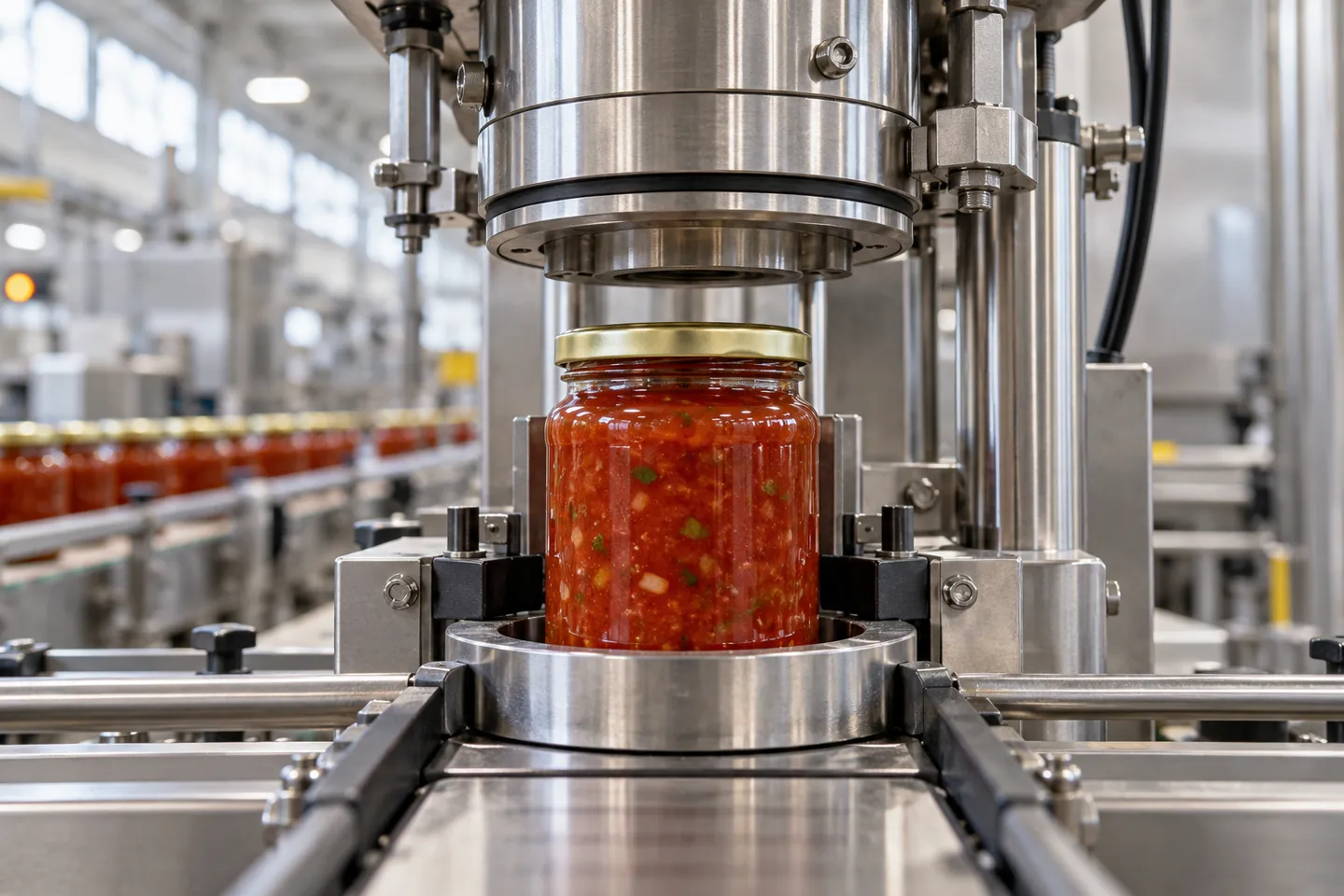
A jar of hot salsa rolls off the filler with its lid sitting loose on the glass. The next station closes a chamber around it, pulls the air out of the headspace, and the lid drops with a click you can hear across the room. That click is vacuum capping doing its job: outside air pressure now clamps the closure against the jar finish harder than any torque wrench could.
What Vacuum Capping Actually Does
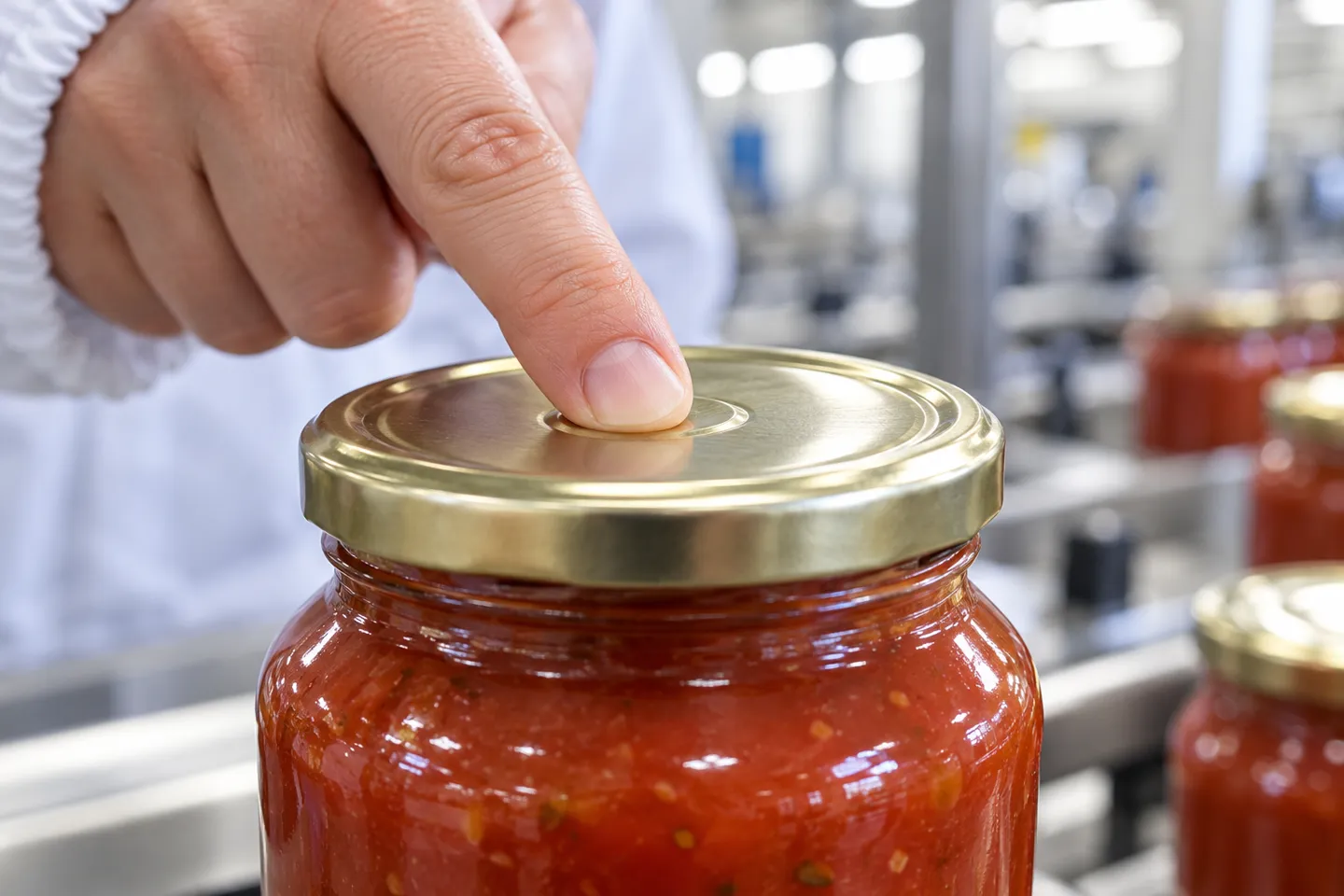
Vacuum capping removes air from the space between the product and the lid, then closes the container while that negative pressure is held. Atmospheric pressure does the final tightening. On a glass jar with a metal lid, the evidence is visible. The button or dome at the center of the lid stays pressed down while the seal holds, and it pops upward the moment you break the seal. That dome is the single most useful inspection feature in this whole field. It turns an invisible pressure condition into something a packer, a retailer, or a customs officer can check with a fingertip.
One term needs untangling before it costs you money. Home users seal mason jars with handheld vacuum accessories, and the word “sealing” gets used for both worlds. The physics rhyme; the stakes do not. A handheld sealer is a storage tool. A vacuum capper on a production line is a closure operation with a specification, a tolerance, and a customer at the end of it. If your question is the home one, the first tier in the next section answers it; this article spends most of its length on the production question.
And one boundary needs planting early, because whole forum threads collapse over it: vacuum capping closes a container. It does not sterilize the contents. Food safety agencies are direct about this. Low-acid foods, meaning foods with a pH above 4.6, need pressure processing to be safe (CDC, 2024). A lid that stays down proves nothing about what is inside it. Section three turns that line into a purchasing rule.
The Three Scales of Vacuum Capping Equipment
Same physics, three very different machines. The scale you enter at should be decided by your daily count and your SKU count, not by the machine that looks most impressive in a trade-show video.
Handheld and countertop sealers
At the bottom of the scale sit the handheld jar sealers and countertop chamber machines that home preservers and small test kitchens use. They pull a real vacuum on a glass jar and they hold it. What they do not do is compliance. A lid pressed down by a countertop machine tells you the pantry is protected from air, not that the contents can sit on a store shelf at ambient temperature. For retail sales of anything low-acid, no tier in this section replaces a validated thermal process, no matter how convincing the dome looks.
Semi-automatic benchtop cappers ⭐
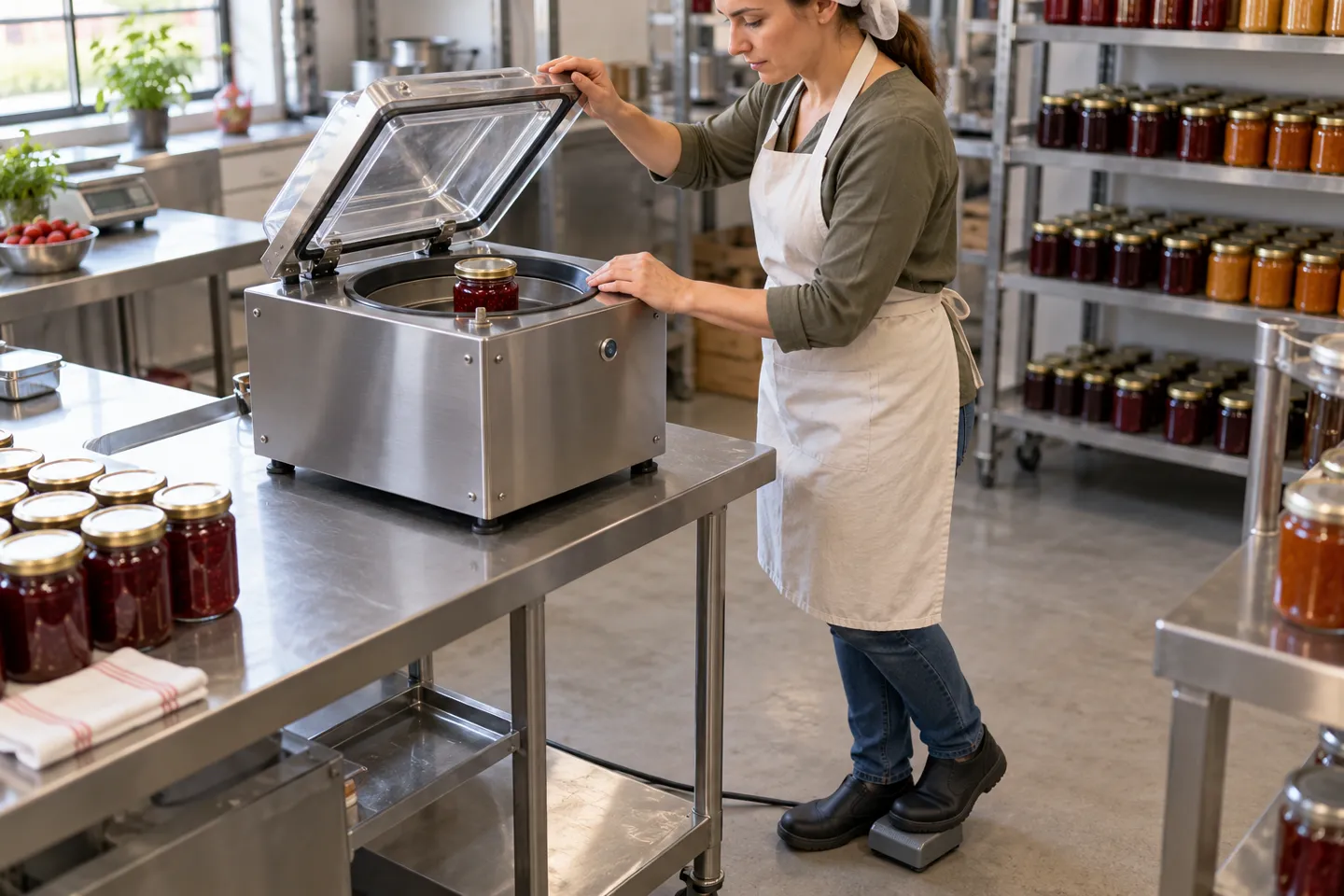
The first true production tier is the single-station benchtop capper. One operator, a foot pedal or a two-hand cycle, and a published working range that tells you exactly what you are buying. A representative public specification sheet lists 5 to 15 bottles per minute depending on container and vacuum time. The same sheet quotes a maximum vacuum around 0.09 MPa below atmospheric (98.66 kPa absolute) and a mould matched to one cap diameter (Neostarpack, n.d.). That last detail deserves a pause: these machines are built around a mould, and the mould is sized to a neck finish. Change your jar size and you are buying tooling, not adjusting a dial.
This is the tier where most sauce, jam, salsa, and beverage startups land, and the fit is honest. If your whole day produces somewhere between a few hundred and three or four thousand filled jars, a benchtop capper keeps up. Its price sits in the range a first commercial machine should sit in. Benchtop machines show up in public listings with published prices. Inline systems, as you will see, do not publish prices at all, and the reason is the tooling math.
Automatic inline and rotary systems ⭐
At the top of the scale, machines stop being single stations and become sections of a line. Rotary vacuum cappers run roughly 30 to 50 or more containers per minute. They synchronize with fillers and labelers and hold tooling for every container format in your rotation. They earn their cost in one specific situation: one or a few container specifications, running steadily, filling real orders. Spread that machine across a dozen SKUs and the changeover time eats the speed you paid for, because every SKU change is a mould and parameter change.
Two structural variants complete the map without needing their own sections. Linear and tracking cappers split the difference between benchtop and rotary, and pharmaceutical-grade machines operate in a regulated world of their own.
The matrix below is the practical summary of this section. Read the last column before you fall in love with any row.
Equipment tiers by container fit and failure edge
| Tier | Container and closure fit | Typical products | Failure edge |
|---|---|---|---|
| Handheld / countertop | Glass jars with two-piece lids | Pantry storage, R&D samples | False seals; fridge dependence; no compliance story |
| Semi-automatic benchtop | Glass twist-off and lug; tin cans via a seamer; stiff rigid plastic only | Sauce, jam, salsa, small beverage runs | Mould cost per SKU; worn chamber seals quietly kill vacuum |
| Automatic inline / rotary | Glass lug caps, tinplate, aluminum; stiff-wall PET with care | Beverages, nut and powder cans at scale | Idle capacity and tooling cost across many SKUs; one worn chuck scrapes batches |
Choosing the Process: Chamber Vacuum, Steam, Hot-Fill, or Nitrogen Flush
Machine tiers matter less than the process decision, because the process decides what you are legally and technically allowed to sell. Four paths dominate commercial vacuum capping, and they are not interchangeable.
Four vacuum processes at a glance
| Process | Mechanism | Fits best | Boundary |
|---|---|---|---|
| Mechanical chamber vacuum | Pump draws down the headspace, closure applied under vacuum | Benchtop and inline cappers on rigid containers | Needs verifiable vacuum readings; thin-wall plastic absorbs the draw |
| Steam vacuum | Hot product or injected steam condenses after capping, pulling the lid down | High-speed glass lug lines for sauces | Rigid containers only; the effect is real but secondary to a validated fill (Packaging Digest, n.d.) |
| Hot-fill self-vacuum | Fill hot, cap, and let the cooling product create the pull | Jams, sauces, high-acid products | Only a thermal process if it is a validated one; vacuum is the bonus, not the kill step |
| Vacuum + nitrogen flush | Vacuum first, then inert nitrogen before closure | Nuts, coffee, powders, oxidation-sensitive fills | Needs a gas supply and an oxygen number in writing, not adjectives |
The rigid-container boundary deserves its own paragraph, because it surprises buyers who already have a container in mind. A vacuum chamber pulls on the container, not just the headspace. Glass and tinplate shrug. Thin-wall plastic collapses, and a collapsing container swallows the vacuum that was supposed to pull the lid down, so the machine reports success while the seal is mediocre. Vendors of vacuum cappers for plastic exist, but the honest version is: stiff walls or a thicker construction, verified with your own containers on the vendor’s machine before you sign.
Cost truth in this category has a shape you should know before the first quote arrives. Benchtop machines publish prices; inline systems almost never do, because the tooling changes the answer. Every neck finish is a mould, moulds are priced separately, and the vacuum pump and air compressor that the machine assumes may be items on your side of the fence. Ask what the price excludes. The answer is where budgets break.
Send us your container drawings and daily output, and we will return a quote with the mould math already done.
Request a machine quoteThe demand side of this market keeps widening. Glass packaging for food and beverages was valued at 68.8 billion US dollars in 2025 and is projected to reach 99.6 billion by 2033, a 4.7 percent annual growth rate (Grand View Research, 2026). Jars hold the largest container share in that forecast. More small producers are putting real products into real jars. That means more first-time vacuum capping decisions, and most of them will be made by people reading articles like this one rather than by packaging engineers.
If this whole article could keep only one line, it is this:
Vacuum capping solves closure, not sterilization.
A low-acid product (pH above 4.6) that you intend to sell at ambient temperature needs a validated thermal process, hot-fill or pressure, behind it. Food safety guidance is explicit that pressure processing is the only recommended method for low-acid foods and that a sealed lid is not evidence of safe contents (CDC, 2024). Write the thermal process into your production plan first; then let the capper keep the lid honest.
What to Demand from a Supplier: Specs, Tooling, and Acceptance Tests
When the process is decided, the purchase becomes a document problem. Three steps separate a clean order from an expensive improvisation.
Step one is telling the supplier things that feel obvious and are anything but. List container material, neck finish diameter and jar height, closure type, realistic daily output with shifts, and how many SKUs you actually run. Every one of these changes the mould list and therefore the price. A quote produced without neck-finish drawings is a guess with your name on it.
Step two is the parameter list, and it is short. Demand the target vacuum reading at seal and whether it is adjustable. Demand the residual oxygen figure in writing for your product class. Targets in this industry are specific and published, around 2 percent or less for roasted nuts (Litian Packing, 2025). A seller who cannot state a number is promising a feeling. Add torque adjustability, the mould policy for each SKU with lead times, measured changeover time, and the utilities the machine expects from your floor, compressed air included.
Step three is acceptance, and the rule is simple: your jars, your lids, on their machine. Watch the gauge hold, run a hold-time leak check, count how many lids in a hundred show a fully pressed dome, and get the trial recorded. A serious factory films its own tests before shipment; asking for that video costs nothing and predicts everything.
Pre-order checklist
- Neck finish drawings attached to the quote
- Vacuum target and adjustability in writing
- Residual oxygen figure per product class
- Mould price and lead time per SKU
- Changeover time stated in minutes
- Utilities list for your floor
- Trial run on your own containers with video
- Spare-parts list priced before shipment
We run our own version of step three before any machine ships. Every Levapack vacuum sealing machine goes through 100-plus consecutive trial cycles with the customer’s own sample cans, then a 48-hour no-load run and a 36-hour aging test with periodic function checks. The video of those tests goes to the customer as part of the documented vacuum sealing machine QC and testing process. If a supplier you are talking to cannot describe an equivalent protocol, you have learned something more useful than their price.
When the Seal Fails: Diagnosis and Safety Boundaries
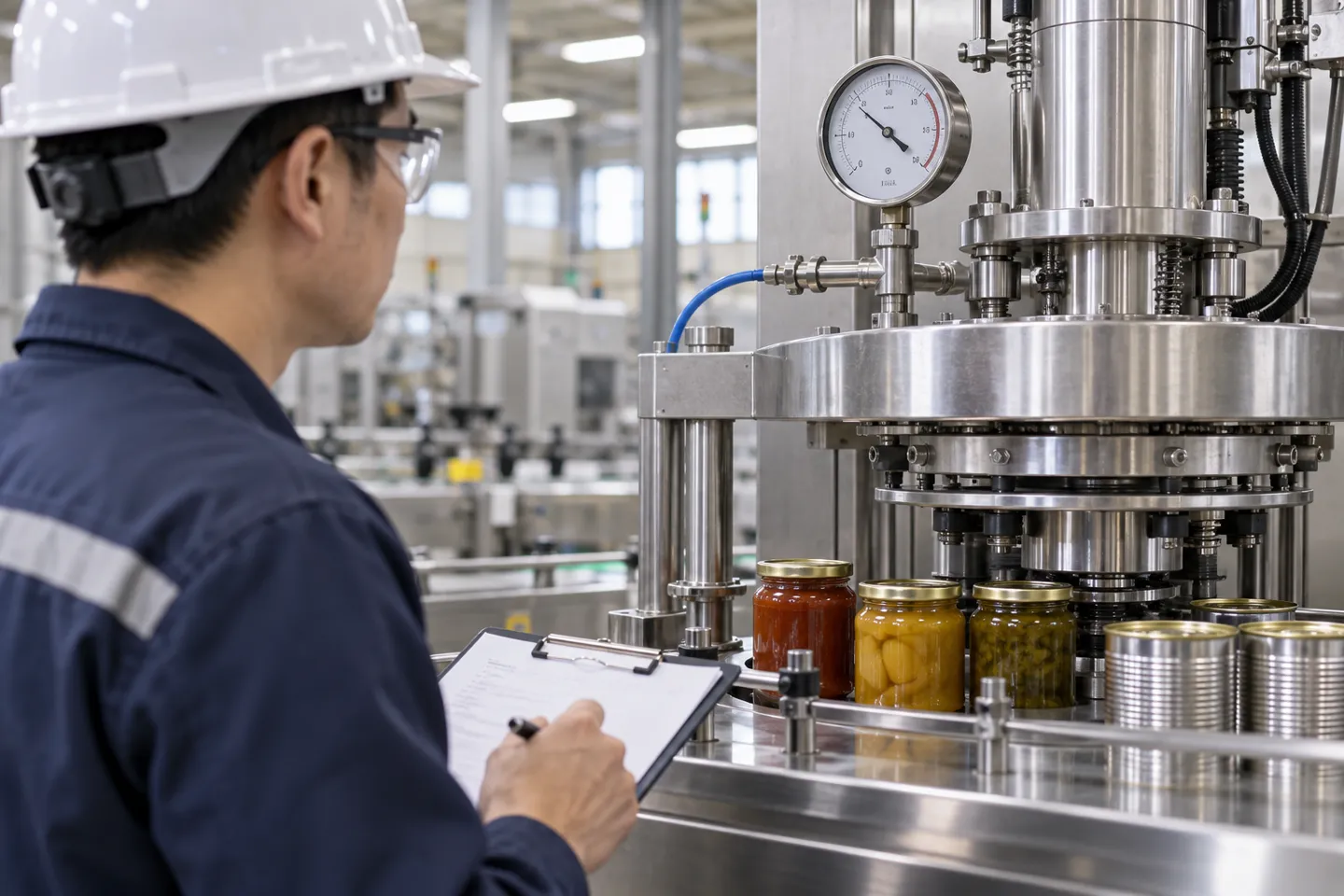
Failures arrive in three families, and the fastest way to waste a batch is to treat all three as the same problem.
The first family is closure failure: lids sitting loose or high, crooked, or cross-threaded. Specialist troubleshooters put placement and tooling ahead of settings here (Lancing Ltd, 2026). Check that lids are being seated square. Inspect the chuck and roller faces for wear. Confirm the right liner batch before touching torque values, because more torque on a worn part just breaks something else.
The second family is vacuum failure: the gauge never reaches target or domes come up days later. Order of suspicion: chamber gaskets and seals first, then the pump, then jar finishes with hairline cracks. These are maintenance items, not tuning items. Product developers on packaging forums tell the same story from the retail side: jars marketed as leak proof weep on shelves because nobody checked the finish-to-lid tolerance (Reddit, 2022).
The third family is the quiet one: micro-leaks that pass the line and surface as spoilage in trade. Batch hold tests catch them. Set your own stop line in advance: the same fault on two consecutive batches means the machine stops and the supplier gets called. A fault that survives your tuning is a component fault wearing your brand.
None of this changes the line from section three. A perfect seal on an unprocessed low-acid product is a perfectly sealed risk. Refrigeration and thermal-process discipline stand entirely apart from seal quality, and your HACCP plan should never have a vacuum gauge where a thermometer belongs.
The Purchase, Read Backwards: An Operator’s Math
Read the sections above in reverse and the purchasing logic assembles itself.
Start with volume and SKU count, because the tier decision is just those two numbers multiplied. A benchtop capper running 10 jars a minute for six productive hours a day is a theoretical ceiling near 3,600 jars, and a real day lands under it. If your orders live comfortably below that ceiling, the money you are tempted to spend on speed belongs in moulds and a spare-parts shelf instead. If one SKU is running steady at your ceiling week after week, that is what an inline system is for. The glass market’s growth curve says more of those decisions are coming (Grand View Research, 2026).
Then put acceptance ahead of price. Two quotes are only comparable when both carry the vacuum target, the oxygen figure, the dome-consistency expectation, and the spares list in writing. A cheaper quote without them is just a smaller number attached to a bigger risk. Distributors and agents specifying for customers should run the same test on behalf of the buyer, because changeover support is where return rates hide.
The stance of this whole article, stated plainly: for most producers reading this, a semi-automatic benchtop vacuum capper is the correct next machine. The discipline that protects the investment is the acceptance protocol, not the price negotiation. The exception is a locked contract with a single container format and full shifts, where buying inline first saves you from paying twice.
When you shortlist suppliers, treat tooling and after-sales as part of the machine price, because that is where the real math lives. We build Levapack sealing equipment around exactly this: moulds matched to your can diameter and height, and seaming rolls matched to tinplate, PET, aluminum, or paper tube. The semi-automatic can seamer in this range is sized so one operator can run it from day one. After the sale, the support package rides with the order. Warranty terms are spelled out on the quote (current category pages list 16 months including free replacement of damaged parts), with spare-part kits for wear items and 24-hour technical response. Compare suppliers on those lines and the decision tends to make itself.
Get a Vacuum Capping Quote Built Around Your Containers
Trial runs on your own jars and cans, filmed test videos, and mould pricing by SKU, before you commit.
Start your inquiryReferences
- CDC. “Home-Canned Foods.” 2024. https://www.cdc.gov/botulism/prevention/home-canned-foods.html
- Packaging Digest. “How Does Vacuum Capping Work?” n.d. https://www.packagingdigest.com/automation/how-does-vacuum-capping-work-
- Grand View Research. “Glass Packaging For Food & Beverages Market Report.” 2026. https://www.grandviewresearch.com/industry-analysis/glass-packaging-food-beverages-market-report
- Neostarpack Co., Ltd. “Vacuum Capping Machine (CCV2000) Specifications.” n.d. https://www.neostarpack.com/en/product/vacuum-capper.html
- Litian Packing. “Nitrogen Flushing in Nut Packaging: 5 Proven Fixes.” 2025. https://litianpacking.com/2025/11/08/nitrogen-flushing-nut-packaging/
- Lancing Ltd. “Jar Capping Machine Troubleshooting.” 2026. https://jarcappingmachines.co.uk/jar-capping-machine-troubleshooting.html
- Reddit, r/PackagingDesign. “Need a leaky jar solution.” 2022. https://www.reddit.com/r/PackagingDesign/comments/x09ty9/need_a_leaky_jar_solution/


 EN
 RU
 ES
 FR
 DE
 NL
 IT
 JA
 ID
 PT
 KO
 AR
 TH
 VI
 TR
 PL