
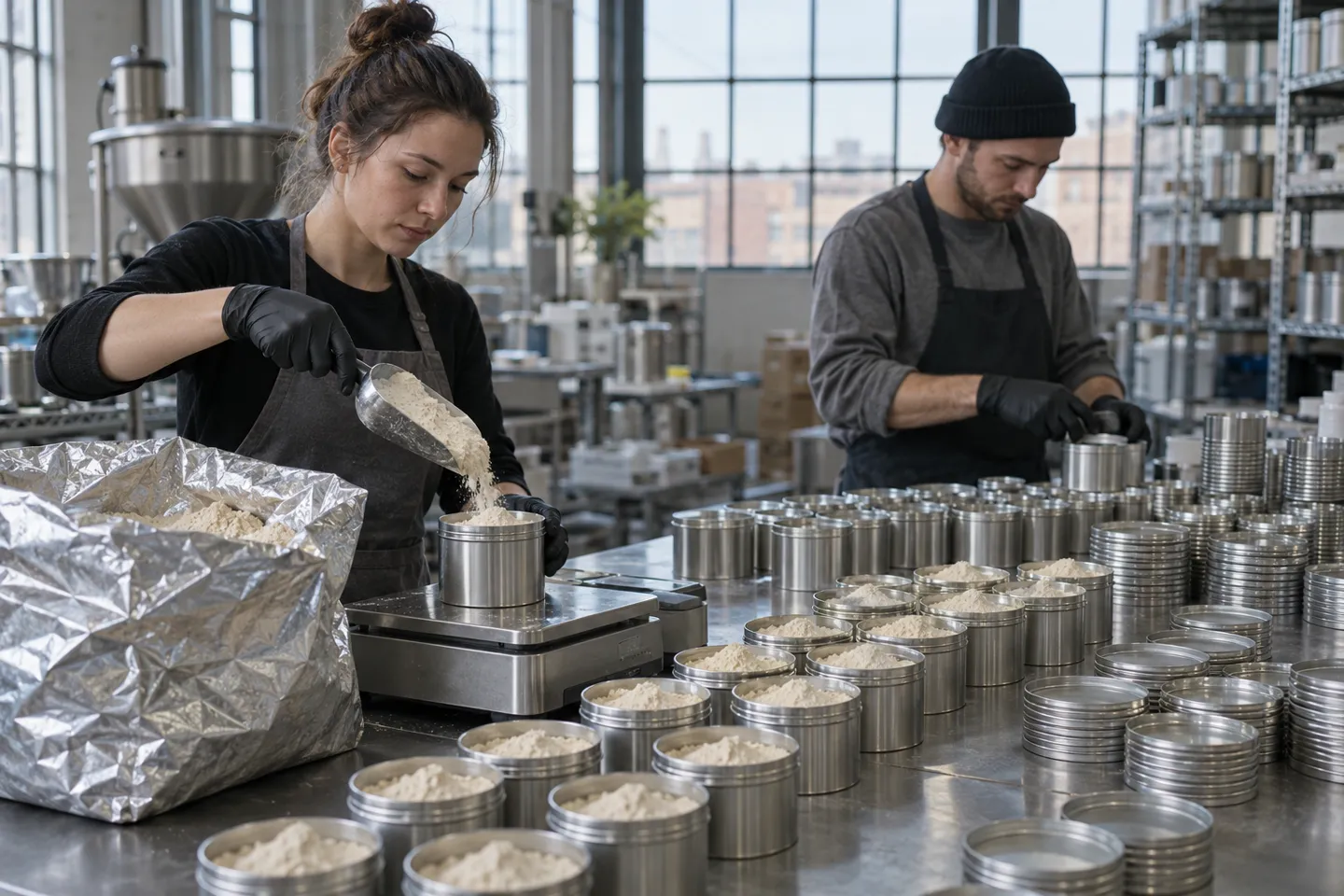
At 6:40 on a Tuesday morning, a two-person crew is forty minutes into a filling shift and already behind. The product is a protein powder, the container is a 500 g tin, and every jar on this table was filled by hand, weighed, topped up, and weighed again. The order due Friday has grown by three thousand tins since the customer renewed. Somewhere between the scale and the lid press, one question keeps coming back: would a machine fix this, and which machine?
That question is really about one axis: how much automation a filling machine carries. Manual and tabletop units sit at one end, fully automatic lines at the other, and semi-automatic machines occupy the stretch between. The labels blur at the edges, and the price tags blur even more. This article walks the whole axis with real numbers, then gives you a threshold test for your own output. It ends with the decision that matters more than the label: whether today’s machine becomes tomorrow’s bottleneck or tomorrow’s foundation.
What Semi-Automatic and Automatic Filling Machines Actually Do
A filling machine meters product into a container. Everything else is a question of who does the moving.
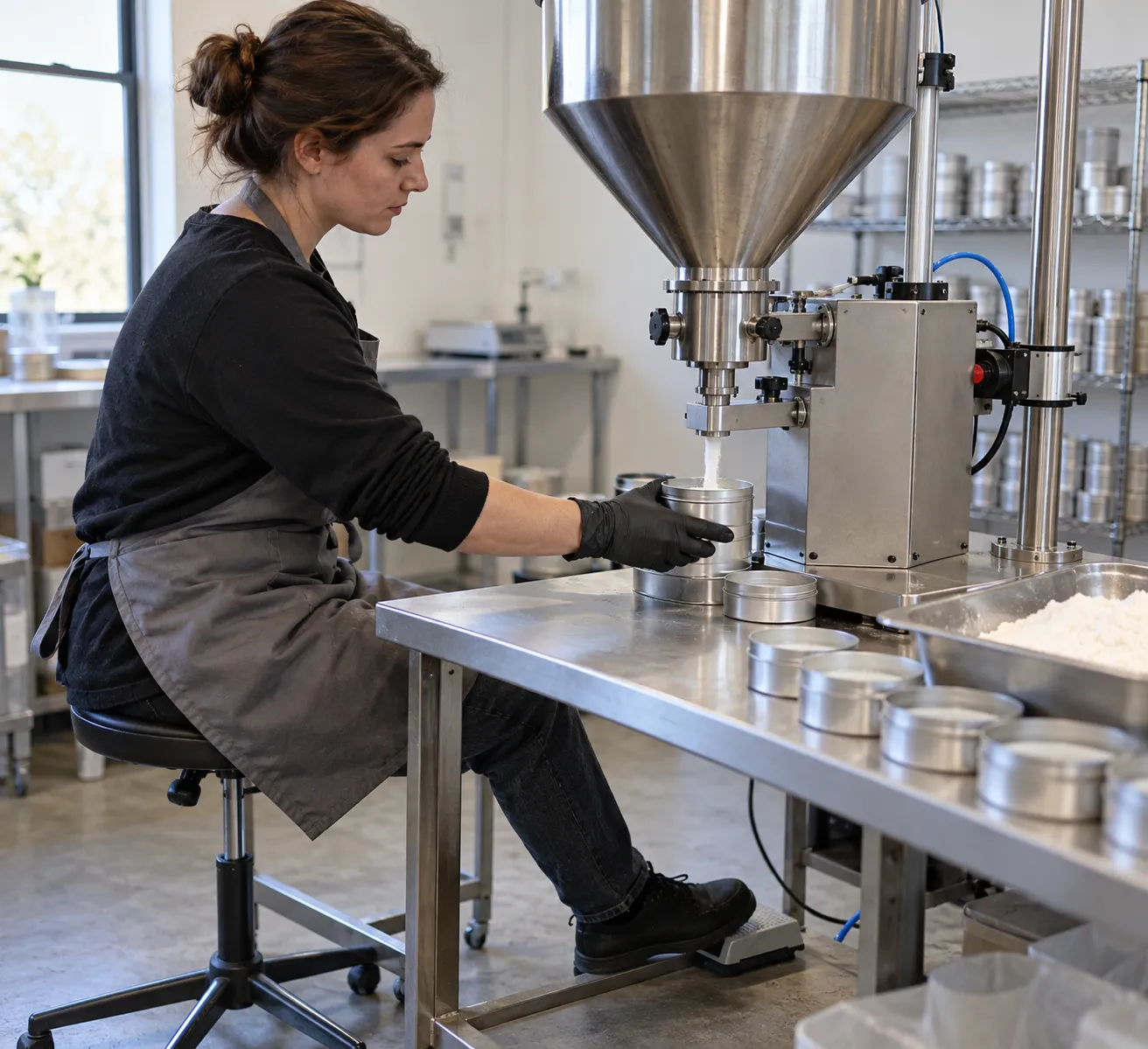
On a semi-automatic filler, the work splits in half. The machine meters: a servo-driven auger, a piston, or a pump dispenses a pre-set dose with far more consistency than a hand on a lever. The person moves: placing each jar or can under the nozzle, tapping a foot pedal or button to start the fill, then swapping in the next container. Speed depends partly on the machine and partly on the rhythm of whoever is feeding it.
On an automatic filler, the moving disappears. Containers ride a conveyor, sensors confirm position, and a PLC triggers each fill without anyone touching the container. The operator’s job shifts to oversight: watching fill weights, refilling the hopper, and running changeovers between products. Nobody places jars one by one.
One honest caveat belongs right here, because most comparison articles skip it. The industry draws no hard line between the two labels. Veteran equipment builders say it plainly: there are no set rules, and plenty of gray shades sit between what a seller calls semi-automatic and what a buyer gets. Plenty of tabletop machines ship with both a manual mode and an automatic mode on the same controls. What separates the levels is not the nameplate. It is how many containers a person has to touch per minute, and what happens to output when that person calls in sick.
The Four Levels of Filling Automation, With Real Numbers
Think of the market as four levels on the same axis. Each level answers the same three questions differently: what does the person do, what does the machine guarantee, and what does it cost in money and floor space.
Level 1: Manual and Tabletop Units
A manual unit is a filling head with a trigger: you position the container, pull or press, and the machine dispenses a timed or volumetric dose. Third-party pricing guides put liquid-filling manuals between $1,000 and $5,000, running 20 to 50 bottles an hour (Oden Machinery, 2025). Hobby-grade peristaltic units on marketplaces sell for a small fraction of that range.
This level earns its keep for recipe validation and tiny batches. Its ceiling arrives fast. Past a few hundred containers a day, the bottleneck is your own hands, and no accessory fixes that.
Level 2: Semi-Automatic Machines
Step up and the machine takes over metering while you keep handling containers. Benchtop and inline semi-automatic fillers cover a wide spread of build quality, and the numbers show it. Liquid-filling guides place them between $5,000 and $20,000 at 50 to 200 containers per hour (Oden Machinery, 2025).
That range deserves a pause, because the same word “semi-automatic” also labels desktop units selling for a few hundred dollars. The spread exists because the label says nothing about the mechanism inside. A single-head peristaltic unit and a dual-head servo auger with weighing feedback both wear it. When you compare quotes, compare the metering principle and the head count first, the label last.
For a small producer, this level is usually the first real machine. It removes the scale-and-top-up loop, holds the dose within the accuracy the metering system allows, and frees one pair of hands for lids, labels, or packing.
Level 3: Automatic Single Machines
An automatic filler adds the conveyor, the sensors, and the controls, and the container stops being touched. Throughput jumps by an order of magnitude. General guides put automatic liquid machines between $20,000 and $100,000 or more, at 200 to 3,000+ containers per hour (Oden Machinery, 2025).
Can-format machines publish sharper numbers. Dual-head servo auger fillers for powder run 25 to 40 cans per minute, depending on container size and dose. Six-nozzle volumetric machines hold liquid fill accuracy near 1% from a touchscreen setting. Multihead weigher systems for granules run in the 25 to 30 cans per minute class. At even the low end of those bands, one shift outproduces a hand-filled week.
The trade is not just price. Automatic machines want stable containers, consistent product, and an operator who can manage changeovers. They pay that back in consistency: every container gets the same dose whether it is the first of the shift or the ten-thousandth.
Level 4: Integrated Lines
Above the single machine sits the line: container infeed, filling, seaming or capping, labeling, coding, and discharge, all paced to the slowest station. A line can be two machines feeding each other by hand, or a fully linked run where nobody touches a container from start to finish.
For a growing producer the practical version of Level 4 is a filler paired with a matching seamer, sharing the same can handling standard, run by one or two people. The fully linked line is where volume justifies it, not before.
The four levels at a glance
| Level | People do | Machine guarantees | Real speed band | Typical price band | Floor space |
|---|---|---|---|---|---|
| Manual/tabletop | position and trigger every container | a timed or volumetric dose | 20-50 bottles/hour (liquid) | $1,000-5,000 | one bench |
| Semi-automatic | load, start, unload each container | consistent metered dose | 50-200 bottles/hour (liquid) | $5,000-20,000 | bench to small frame |
| Automatic single machine | oversee, refill, change over | untouched containers, uniform dosing | 200-3,000+ bottles/hour (liquid); 25-40 cans/min (dual-head powder) | $20,000-100,000+ | in-line footprint |
| Integrated line | supervise the line | whole flow from infeed to coded pack | paced to the line’s slowest station | project-priced | full production run |
One pattern hides in that table and explains most quoting confusion. The price bands overlap because the labels describe labor, not capability. Two quotes $15,000 apart can describe machines from the same level with different metering systems. Read the spec sheet, not the category name.
Which Level Stops Paying Off: The Threshold Test
Labels aside, your output decides the level for you. The test takes ten minutes with a calculator.
The threshold test in three numbers
the real pace for a 1,200-container shift, once changeovers, breaks, and hopper refills are priced in
what an 8,000-container shift demands, squarely in automatic single-machine territory
the annual multiplier: weekly filling hours times wage, held against the price gap between two levels
First, convert your order book into a pace. Take the cans or jars you must fill in a shift and divide by productive minutes. A shift of eight hours holds roughly 480 minutes, so 1,200 containers need a raw pace of 2.5 per minute. Add changeovers, breaks, and hopper refills, and the real target sits nearer 3 to 4 per minute.
Second, hold that pace against the speed bands above. The semi-automatic liquid band tops out around 200 bottles an hour, which is a little over 3 per minute. A 1,200-container shift inside that band is workable but close to its ceiling. The same math at 8,000 containers demands 17 to 20 per minute, which lands squarely in automatic single-machine territory. A dual-head machine rated 25 to 40 cans per minute covers it with room to grow.
Third, price the labor you are already spending. Multiply the hours a person spends filling per week by their wage, then by 52. Compare that annual figure against the price gap between the two levels you are considering. When the labor line approaches the machine-price gap within a year or two, the gap is no longer an expense. It is a purchase you are already making every year, in overtime.
Watch for the boundary the pace test hides. The calculation measures filling time, not handling time, and handling is exactly what semi-automatic machines still ask of a person. If your pace target only works on paper because it assumes zero load-unload seconds, the machine you need is one level up. Five signals confirm it before the math does: orders you cannot staff for, fill-weight complaints creeping into customer service, and overtime becoming routine. Two more end the debate: a sealing station waiting idle for the filler, and retail buyers asking for batch consistency documents you cannot produce.
Signals it is time to move up a level
- Orders arrive faster than your current crew can fill them, even with an extra pair of hands.
- Underfills or overfills start showing up in customer complaints or returns.
- Overtime and second shifts have become the plan rather than the exception.
- Your sealing or capping station regularly waits on the filler.
- Retail or distributor buyers request batch consistency records you cannot produce.
Matching the Filling Method to Your Product
Choosing the level is half the decision. The other half is the metering principle inside the machine, and this is where products differ sharply. A filler that doses protein powder beautifully will drown in chili sauce.
Powders and Solids: Augers, Weighers, and Cups
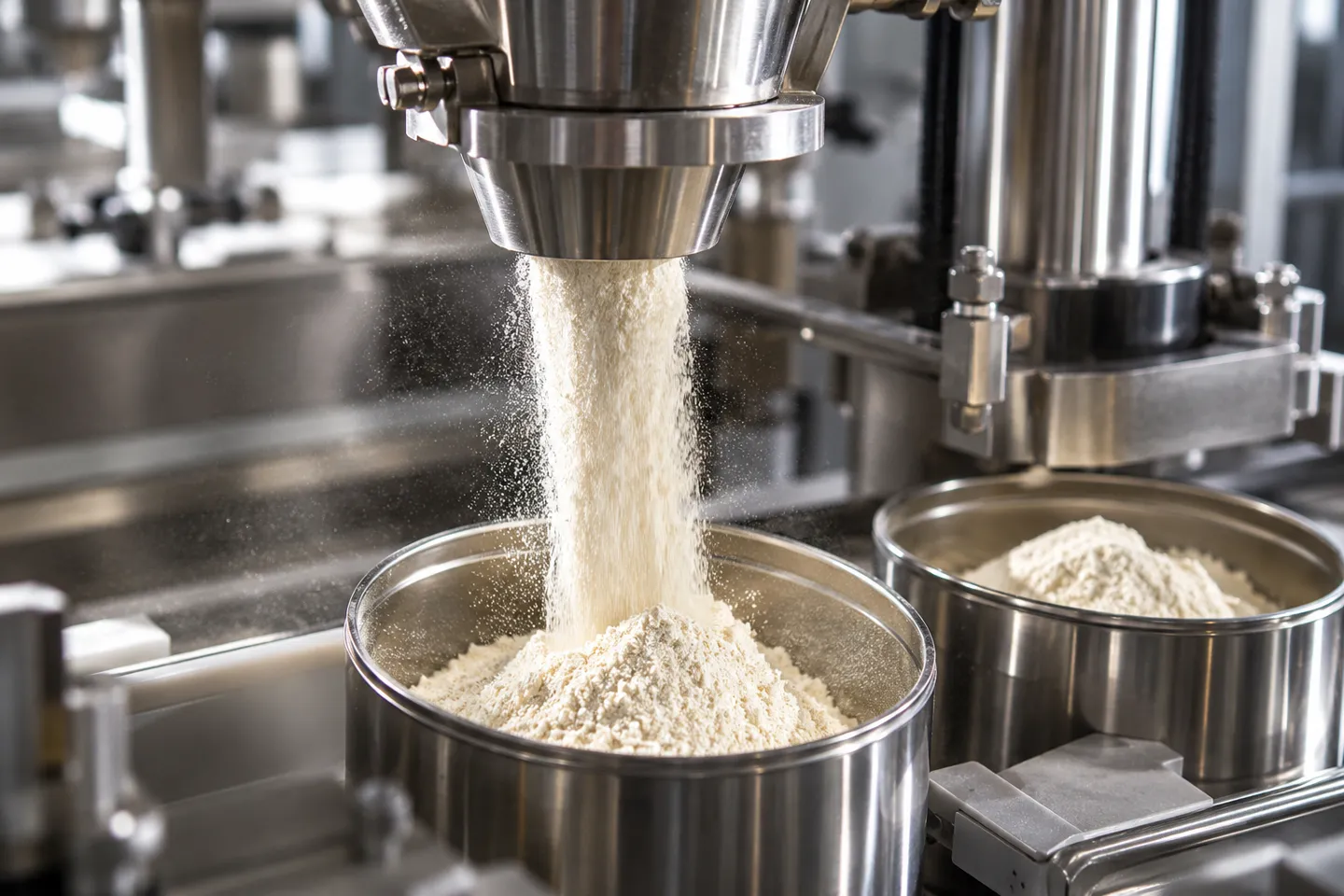
Free-flowing to finely milled powders pair with servo-driven auger fillers, which meter by turning a calibrated screw. Interchangeable augers let one machine span ultrafine powders to small granules, and weighing feedback that checks each fill and tops up short doses holds accuracy steady as the hopper empties. Formula storage, commonly up to eight recipes on automatic units, turns a product switch into a menu selection.
Granular products like beans, seeds, nuts, and pet kibble meter better by weight. Linear weighers with four heads run in the 25 to 30 cans per minute class. Multihead weighers combine partial doses from many buckets for irregular shapes like whole nuts and puffed snacks; multi-stage calibration and an automatic pause protect accuracy when feed runs low. Measuring-cup fillers remain the budget route for uniform small items like puffed foods. The boundary to respect is aeration: fluffy, low-density powders settle after filling, so ask for two-stage dosing and container settling options before you commit, not after.
Thin and Free-Flowing Liquids: Volumetric Nozzles and Gear Pumps
Water-like liquids are the easiest case. Volumetric nozzle machines set the dose on a touchscreen and repeat it with accuracy near 1%, and six-nozzle configurations fill six round cans or bottles per cycle. Gear pump fillers suit oils, syrups, and juices without particles: 316 stainless wetted parts, PEEK gears, and a suck-back option that stops drips from straggling down the nozzle. The boundary is particles: anything with seeds, fruit, or pulp does not belong through a gear pump, and carbonated drinks are their own equipment category entirely.
Pastes and Viscous Products: Pistons with Heated Hoppers
Thick products need a filling method that pushes. Piston fillers meter by drawing product into a cylinder and delivering the full stroke into the container, which handles sauces, gels, and creams that would starve a pump. Insulated hoppers with water or oil heating keep temperature-sensitive pastes flowing through a shift. Polished 316 stainless valves with a blow-off function clear the nozzle, so the container rim stays clean enough to seal. The boundary is setting temperature: a paste that solidifies at room temperature will bridge in an unheated hopper, so confirm the heating range against your product before signing.
Filling method vs product: where each one works and where it breaks
| Filling method | Best for | Works when | Switch when |
|---|---|---|---|
| Servo auger | powders, protein, coffee, spices | powder flows from the auger; weighing feedback compensates | ultrafine dusty powders need dust control, or blends segregate |
| Linear/multihead weigher | granules, nuts, kibble, snacks | product is weighable and free-running | product is sticky, wet, or clumping |
| Measuring cup | uniform small solids, puffed foods | pieces are consistent in size | portion accuracy must beat the cup’s tolerance |
| Volumetric nozzles | thin liquids, non-carbonated | liquid flows cleanly and does not foam | liquid is viscous, carbonated, or particle-laden |
| Gear pump | oils, syrups, juice | no particles; viscosity stays in pump range | product carries seeds, pulp, or solids |
| Piston with heated hopper | pastes, gels, thick sauces | product moves under piston pressure; heating keeps it fluid | product is shear-sensitive or temperature-fragile |
| Peristaltic pump | small-dose liquids, samples, pharma | dose is small and product is sterile-sensitive | throughput must scale past benchtop pace |
Two more parameters belong in any quote request regardless of product. Head count sets your pace ceiling, from a single head to dual heads to six nozzles. And changeover tooling decides what a product switch costs you: quick-release hoppers, stored formulas, and one-touch dose adjustment turn an afternoon of disassembly into minutes. Cans and bottles also part ways here, since round cans locate on a different centering principle than bottle necks; tell the supplier your container, not just your product.
Send LevaPack your product and shift target, and an engineer replies with the filler type and price band that fit your line.
Get a Machine RecommendationVet the Machine Before It Ships
The most expensive filling machine is the one that arrives fine and then has nobody behind it. Import forums carry the same story in different fonts: a tabletop unit with almost no reviews, a supplier that goes quiet after the payment, a part that takes six weeks to arrive. Behind every version sits a shift of production lost while waiting on a reply. Cheaper failures are quieter. A machine bought at the wrong level cannot keep pace, so product gets refilled by hand anyway. A warranty described one way on the sales call may read another way in the contract.
Every one of those failures is checkable before payment. Do these six things with any supplier, domestic or overseas.
First, put the warranty in writing with its start date and its month count, and ask what voids it. Second, request factory test records for your actual machine: consecutive sample runs with your containers, a no-load endurance run, and an aging test with periodic function checks. Manufacturers confident in their testing provide the records and often the video. Third, confirm the support channel in your hours: remote video support that answers in your working day, not their night. Fourth, verify certificates yourself; CE and ISO 9001 documents should be downloadable, not just claimed in a brochure. Fifth, order the critical spare parts kit with the machine so wear items ship with it, not after it. Sixth, settle installation and training in the contract: whether an engineer guides installation online or on site, and who trains your operator.
The failure is rarely the machine. It is the gap between what was promised and what the contract says: a warranty without a start date, support without a time zone, spare parts without a kit. Close each gap in writing before the wire transfer, not after the crate opens.
Pre-payment vetting checklist
- Warranty months and start date in the contract
- Factory test records and video for your machine
- Remote support hours in your time zone
- CE and ISO certificates verified as downloadable
- Critical spares kit on the same order
- Installation and operator training terms agreed
A supplier’s answers tell you as much as the machine spec. Slow, vague responses to these six questions predict the after-sales experience with uncomfortable accuracy.
The Upgrade Math: Add On, Don’t Rebuild
Reread the levels with one fact in view: semi-automatic and automatic machines share the same metering principles. The servo auger dosing a semi-automatic powder filler is the same principle doing 25 to 40 cans per minute in a dual-head automatic. Piston, volumetric, and weigher systems likewise span both levels. What changes between them is what moves the container, not what meters the product. In can filling, the same holds for the pair behind the filler, since seaming machines match the same can standards across levels.
For a small or mid-size producer, that shared DNA changes what today’s purchase means. A semi-automatic machine chosen with the line in mind, servo metering, weighing feedback, stored formulas, and can handling that matches a standard seamer, is not a stopgap. When volume arrives, the metering heads and the seaming station move onto the new conveyor, and the upgrade adds automated handling instead of discarding what you own. The difference between the two paths is the difference between adding a machine and rebuilding a production floor, with the downtime, revalidation, and retraining that a rebuild carries.
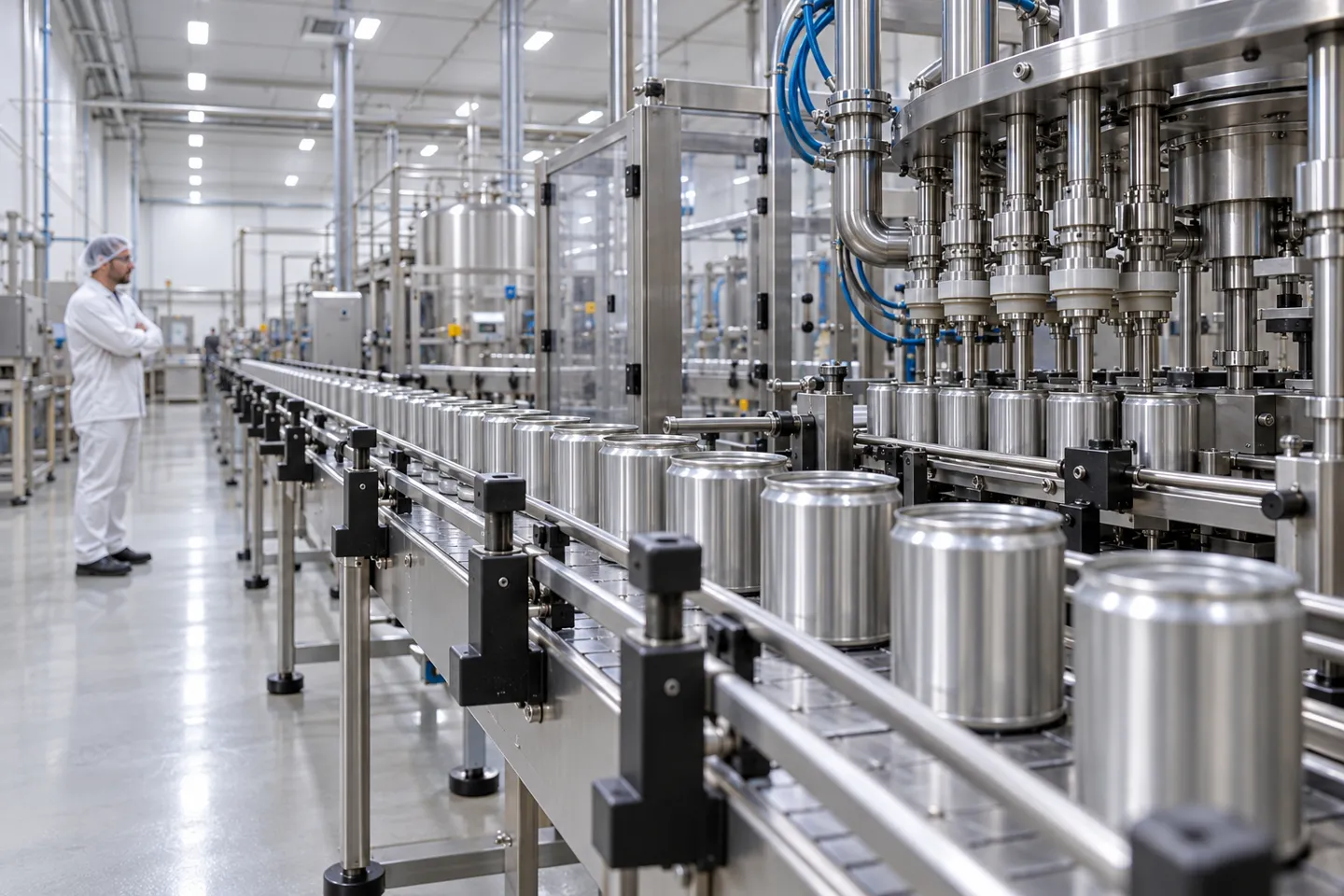
That is why the label on the quote matters less than the parameters under it. Buy the level your pace test demands, but specify the compatibility your growth will need. The machine you buy this year should still be the machine you run in the year your orders triple.
So the work before the purchase is short. Run the threshold test, match the metering principle to your product, and put the six vetting questions in the same email as your inquiry. A machine that answers all three is rare enough to be worth the asking.
LevaPack builds filling machines and complete canning lines on exactly that logic: single semi-automatic units, automatic machines, and linked lines, with filling and seaming configurations matched to your container. We customize head count, structure, and speed through OEM/ODM. Every machine is backed by a 12 to 16 month warranty depending on model and contract, 7×24 remote video support, and critical spare parts kits shipped with the unit. Our filling and seaming configurations are online, so you can compare specifications side by side before you talk to anyone.
Semi-automatic and automatic filling machines share the same metering principles. Upgrading means adding equipment, not rebuilding your line.
When you are ready to hold real quotes against your own numbers, LevaPack’s engineers will spec the machine around your product, container, fill target, and output. Filler, seamer, or complete line: the process is the same.
Get a Filling Machine Quote Built Around Your Numbers
Attach your product, container, and shift target. The reply covers the machine level, the metering principle, and the warranty terms in writing.
Request Your QuoteReferences
- Oden Machinery. “Liquid Filling Machine Price Guide: How Much Does a Liquid Filling Machine Cost?” 2025. https://odenmachinery.com/blog/liquid-filling-machine-price-guide/


 EN
 RU
 ES
 FR
 DE
 NL
 IT
 JA
 ID
 PT
 KO
 AR
 TH
 VI
 TR
 PL