
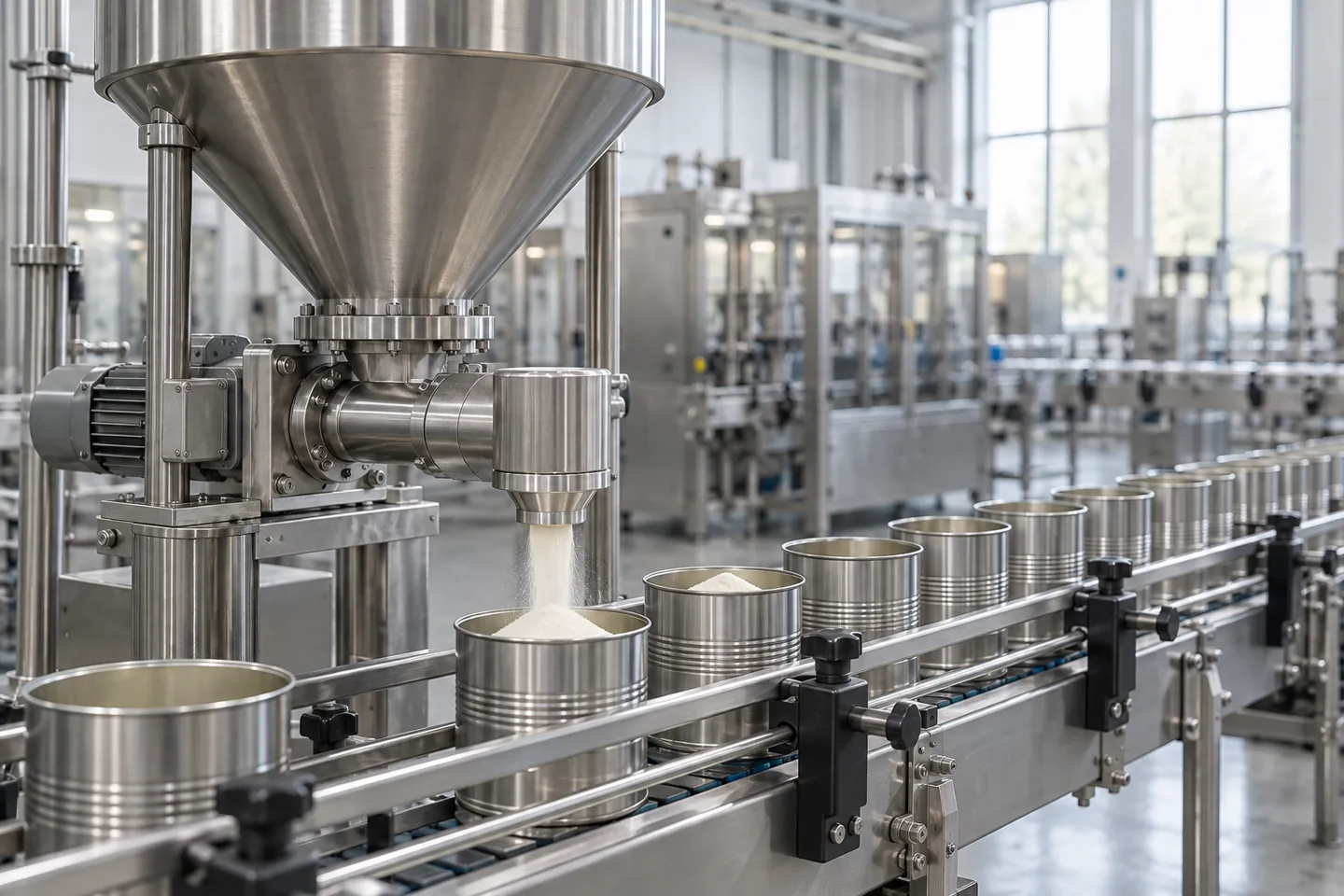
The batch is twenty minutes old when the line slows for no visible reason. The auger keeps turning, the hopper still looks half full, and the cans coming off the filler start running light. Someone taps the hopper side with a mallet. Flow resumes for two seconds, then chokes again. That stutter is powder bridging. Particles above the outlet have locked into a self-supporting arch, and the screw underneath is dosing air.
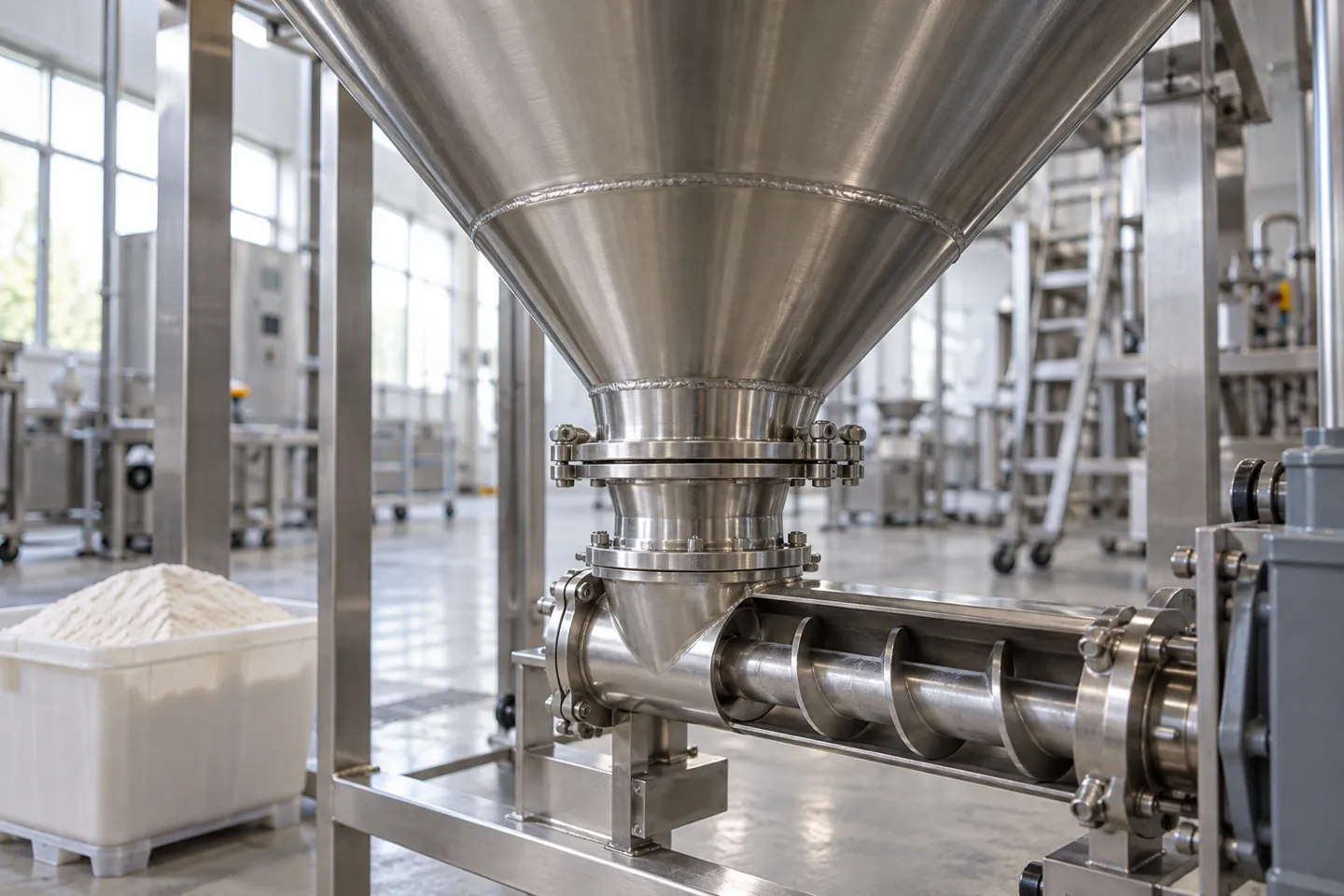
An arch forms in the same place almost every time: the cone section of the hopper and the feed shoe just above the auger inlet. That is where the powder is most compacted and the opening is narrowest. It is also where friction, mechanical interlocking, and moisture bonding have the best chance of holding a roof over the exit. The screw below keeps metering, the weight readings wander, and the operator sees a machine that is running while doing nothing.
The term travels under several flags, so it is worth pinning down the one this article covers. Powder bridging here means bulk powder that stops flowing inside handling and filling equipment: hoppers, feeders, and the inlet zone of an auger filler. It does not mean the powder bridging discussed in ammunition reloading, where granules lock under pressure in a case neck. It is not the “hopper bridging” posts about empty cans jamming in a sorting hopper, and it is not concrete or wood pellets caking in their containers. Same word, different physics. If your problem is a powder that will not fall, read on; the rest of this page is about you.
Fine, cohesive powders are the usual suspects: flour, milk powder, cocoa, spice blends, protein blends, powdered detergent. The lighter and finer the powder, and the more moisture it picks up from the air, the stronger the arch it can build. Granules and free-flowing crystals can hang up too, but they usually need help: a sharp corner, an overfilled hopper, or a humid week.
Diagnose Before You Fix: Bridging, Ratholing, Caking, or Flushing
Before touching anything, it pays to know which of the four classic flow failures you actually have, because their fixes point in opposite directions. “No powder coming down” is a symptom, not a diagnosis.
Four Flow Failures at a Glance
| Failure | What Is Happening | How It Looks on the Line | Right First Response |
|---|---|---|---|
| Bridging (arching): | A stable arch spans the outlet above the screw, so nothing falls. | Flow stops entirely; hopper level frozen; auger turns dry. | Break the arch safely (gentle top vibration on free-flowing powder, otherwise open and clear), then fix the cause. |
| Ratholing: | Only a narrow channel above the outlet empties while powder clings to the walls. | Level drops in a column, then stalls; walls look coated. | Collapse the rathole from the top; then address wall angle and finish. |
| Caking: | Powder builds layered, hardened deposits on walls and the cone. | Progressive slowdown over days; lumps in product. | Strip and clean; then control moisture and residue. |
| Flushing (flooding): | Powder loses structure and pours uncontrollably. | Overruns and spills; weight overfills. | De-aerate or compact slightly; check feed screw speed match. |
The expensive mistakes come from treating one failure as another. Add vibration to a ratholing problem and you shake more powder onto the walls. Press down on a flushing problem and you build tomorrow’s bridge. Misreading flushing as bridging, for example, sends people to compact a powder that was already too aerated to hold an arch. The taxonomy is not academic; it decides which lever you pull (Processing Magazine, 2023).
There is also a right way and a wrong way to spend the next thirty minutes. The wrong way is documented in a running thread on r/AskEngineers. A plant engineer there describes operators poking a hopper with a rod while pneumatic knockers knock themselves apart roughly weekly, and humidity keeps making the caking worse (r/AskEngineers, 2025). Hammering dents stainless steel, and every dent becomes a ledge that seeds the next arch. Rod-poking adds contamination risk to a food contact zone. Field-retrofit providers put the cost of a serious event at 30 to 60 minutes of clearing and resetting (Uniflow Packaging Machinery, 2026). They also report weight errors drifting past ±2% when a partial bridge starves the screw.
Those numbers explain why the fix-first reflex is worth breaking. A clear diagnosis plus a calm response costs minutes. A habit of hammering costs the same minutes every shift, and quietly makes the geometry worse. The permanent fix lives one layer down, in the powder, the hopper, and the hardware around the inlet.
What one misread bridge costs
30-60 min
to clear and reset after one serious bridge
±2%+
fill-weight drift while a partial bridge starves the screw
Figures reported by field retrofit providers, 2026.
Where Bridging Is Actually Solved: Powder, Geometry, and Active Help
Bridging rarely has a single cause, which is why single-bullet fixes disappoint. Think of three layers where the problem can be attacked: what the powder is doing, what the container is shaped like, and what active help is fitted at the inlet. Work through them in that order and most machines can be made to run a difficult powder.
Five Powder Properties That Set You Up for Bridging
Fineness leads the list: the smaller the particles, the more contact area and the more inter-particle friction per gram. Hygroscopicity is the accelerator; sugar-bearing blends, milk powder, and spice mixes grab moisture from the air and gain strength as an arch material over a shift. Irregular particles interlock like rubble masonry instead of sliding like marbles. Low bulk density powders compact into surprisingly stable structures because there is so little weight pushing down to shear the arch. And batch-to-batch moisture variation explains the classic complaint that the machine “ran fine last week”: same machine, wetter powder.
Material-side moves are cheap and worth doing first. Sieve out agglomerates before the hopper, blend batches to normalize moisture and particle size, and reject incoming lots that fail a moisture check. None of this touches the machine, and all of it changes how the machine behaves.
Hopper Geometry: The Fix That Costs Nothing Extra After Commissioning
The standard 60-degree cone that suits granules is often too shallow for cohesive fines. That is why retrofit guides push 70 to 75 degrees for those powders, or a mass-flow design in place of funnel flow (Uniflow Packaging Machinery, 2026). Sharp internal corners trap powder and grow into plugs, so corners get rounded and welds get polished smooth. Outlet size involves a real trade-off. It needs to be large enough to defeat the arch, but not so large that dosing accuracy suffers, because the auger meters what the outlet feeds it.
The most persistent myth
A bigger outlet does not reliably mean less bridging. Oversizing can make flow less consistent and hurt fill-weight accuracy. Geometry works by matching the container to the powder, not by brute-forcing the opening.
Active Help: Agitators, Vibrators, and Air
The most useful active device for fine cohesive powders is a slow agitator that reaches down into the inlet zone. That is where the arch forms, and where a short factory-fit paddle never arrives. Vibrators are the more common purchase and the more common mistake. On granular, free-flowing powder they help occasionally; on fine cohesive powder they can compact the arch material further and make the problem worse (Uniflow Packaging Machinery, 2026). Fluidization injects a little air into the powder and suits powders that behave badly mainly because they are too light to flow. Some IBC and silo systems ship it as standard equipment for exactly that reason (Visval, 2026). One more underrated setting sits below the hopper: the feed screw that supplies the metering auger. Overfeed it and you compact the inlet zone; starve it and the auger chatters between fills. Matching those speeds quietly removes one of the hidden causes.
The blunt version: “just add a vibrator” is the patch most likely to fail. “It’s just bad powder” is the excuse most likely to hide a geometry problem that a drawing change would fix. Field providers report that most bridging cases can be fixed or sharply reduced through equipment and process adjustments rather than by blaming the material (Uniflow Packaging Machinery, 2026).
Match the Countermeasure to the Powder, and Know Where It Fails
| Powder Type | Preferred Geometry | Preferred Active Help | Where This Approach Fails |
|---|---|---|---|
| Free-flowing granules: | Standard 60-degree cone is usually sufficient. | Occasional vibration is acceptable. | Sharp corners or overfilling can still hang up even free-flowing material. |
| Medium-cohesion fine powders: | Steeper cone (70 to 75 degrees), rounded corners, polished welds. | Slow agitator reaching the inlet zone. | If moisture is uncontrolled, even good geometry cakes over. |
| Strong-cohesion, hygroscopic powders: | Mass-flow design; sealed hopper covers; dehumidified supply air. | Agitator at the inlet plus humidity control. | Ambient humidity above the powder’s tolerance defeats hardware; this becomes a room problem. |
| Low bulk density light powders: | Wide-pitch, shallow-flute screw to limit compaction. | Gentle fluidization rather than vibration. | Vibration compacts these powders; too much fluidization tips them into flushing. |
Notice what the right-hand column has in common: hardware cannot outrun an uncontrolled room. That is the boundary of this station, and the reason the next one is about numbers you can hold every day.
Levapack matches hopper geometry, agitation reach, and feed control to your powder instead of a catalog default, and builds the machine around that spec.
Match the Machine to Your PowderThe Daily Bands That Keep Bridging Away
Two numbers decide most of the week-to-week story, and both are set in the room, not in the machine. The first is humidity. For most food powders, holding the production area between 40% and 55% relative humidity keeps hygroscopic caking slow enough to manage. Strongly hygroscopic products also want sealed hopper covers and dehumidified supply air. Summer weeks deserve a round of extra checks, because a machine that behaved in March can start arching in July with nothing else changed.
The second number is the hopper level. Keep the hopper between roughly 40% and 70% full during production, with a level sensor closing the loop on the top-up feeder (Uniflow Packaging Machinery, 2026). Both extremes cause trouble: a full hopper compacts powder at the inlet, and a nearly empty one feeds inconsistently and flirts with partial bridging. Consistent head pressure gives the auger a consistent bite, which shows up later as steadier fill weights.
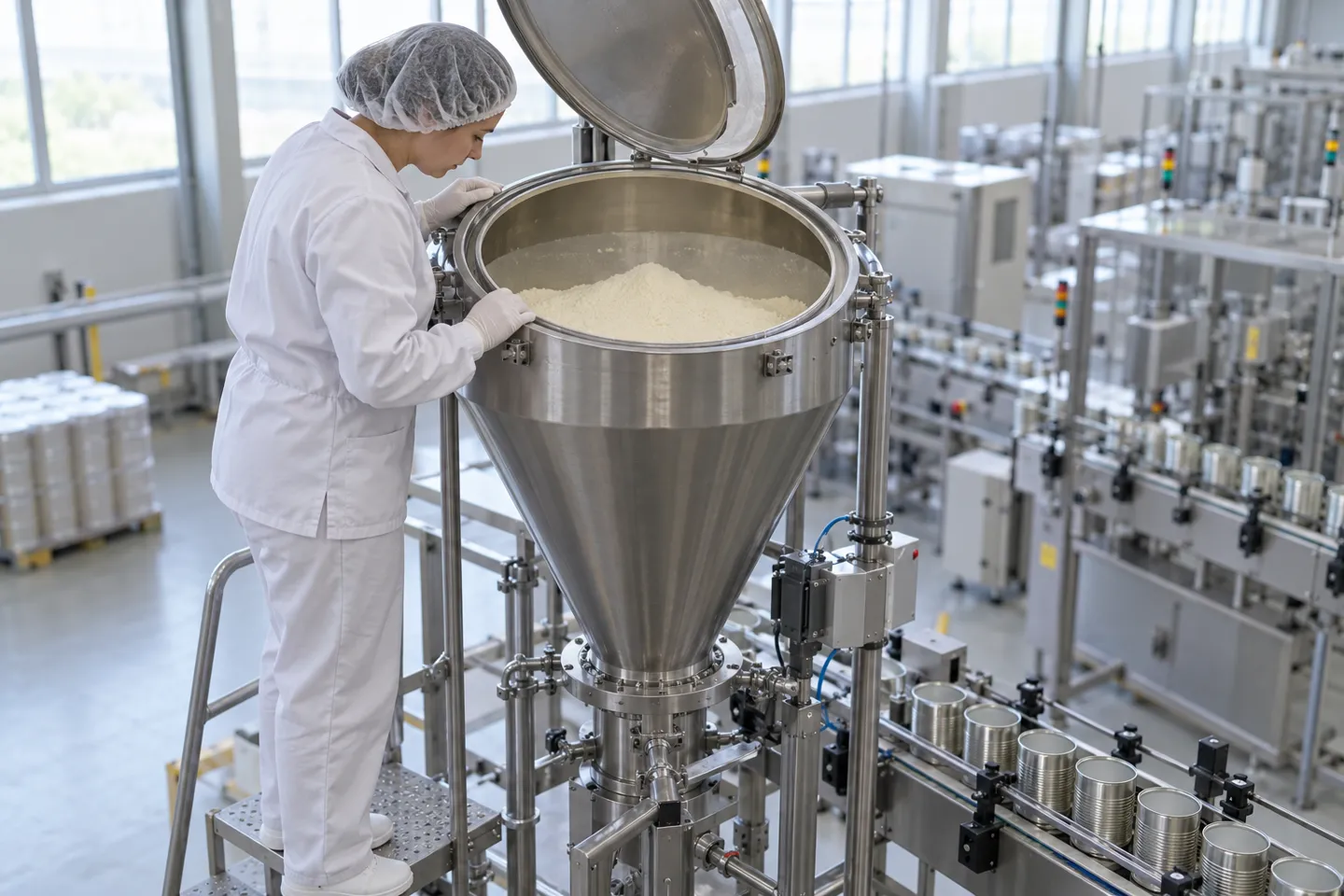
Between batches, cleaning is bridging prevention in disguise. Residue left on hopper walls and screw flights is the seed crystal for the next run’s arch. A full strip-down and wipe belongs in every changeover, with special attention to the outlet zone. Operations running many SKUs through the same machine carry this risk at its highest, because changeovers are frequent by design.
Daily anti-bridging checklist
- Hold the room at 40-55% RH; strongly hygroscopic powders also get sealed hopper covers and dehumidified supply air.
- Keep the hopper 40-70% full with a level sensor closing the top-up loop.
- Full strip-down and wipe at every changeover; scrape the outlet zone clean.
- Match the feed-screw speed to the metering auger.
- Settle ownership of can-rinse moisture and room climate before commissioning.
One line-level note sits behind that checklist: empty-can rinsing introduces water and humidity, room climate belongs to someone, and feed rates need matching. Who owns which of those is a commissioning question, and it is far cheaper to ask it before the purchase order than after. That question list is what the next station is for.
Spec It Before You Buy It: The Anti-Bridging RFQ and Acceptance Test
Everything above has a purchasing version. Every hardware choice that decides whether a powder bridges (cone angle, agitator reach, outlet size, level control, surface finish) is fixed at design time. That makes the inquiry stage the cheapest possible moment to prevent bridging, and the RFQ the right document to carry it.
The Six Lines Your RFQ Should Contain
Write the inquiry around six items. First, agitation: state the form and require that it reaches the auger inlet zone, not just stirs the top half of the cone. Second, cone angle: give the supplier your powder’s behavior and ask what angle and outlet their design uses for it. Third, level control: a level sensor with closed-loop top-up, so the 40% to 70% band holds itself. Fourth, accuracy and flow together: ask for the dosing tolerance to be guaranteed with flow stability, not on a bench with a friendly powder. Fifth, contact surfaces: material grade, internal finish, and weld treatment that leaves no ledges. Sixth, changeover design: tool-free strip-down so the cleaning routine from the previous section actually happens.
The anti-bridging RFQ, in six lines
- Agitation form, with guaranteed reach into the auger inlet zone.
- Cone angle and outlet sized to your powder, not to a catalog default.
- Level sensor with closed-loop top-up.
- Dosing tolerance guaranteed together with flow stability.
- Contact material grade, internal finish, and weld treatment.
- Tool-free strip-down for changeover cleaning.
For a reference point on what to ask: some builders publish ±1 g nominal dosing accuracy and build contact parts from 2 mm food-grade 304 or 316 stainless steel (Levapack, 2026). The same builders run every machine through 100-plus consecutive test cycles before shipment, with a 48-hour no-load test and test video to close it out. That level of published specificity is what a good answer to this RFQ looks like, regardless of who you buy from.
Acceptance Testing: Your Powder, Your Numbers
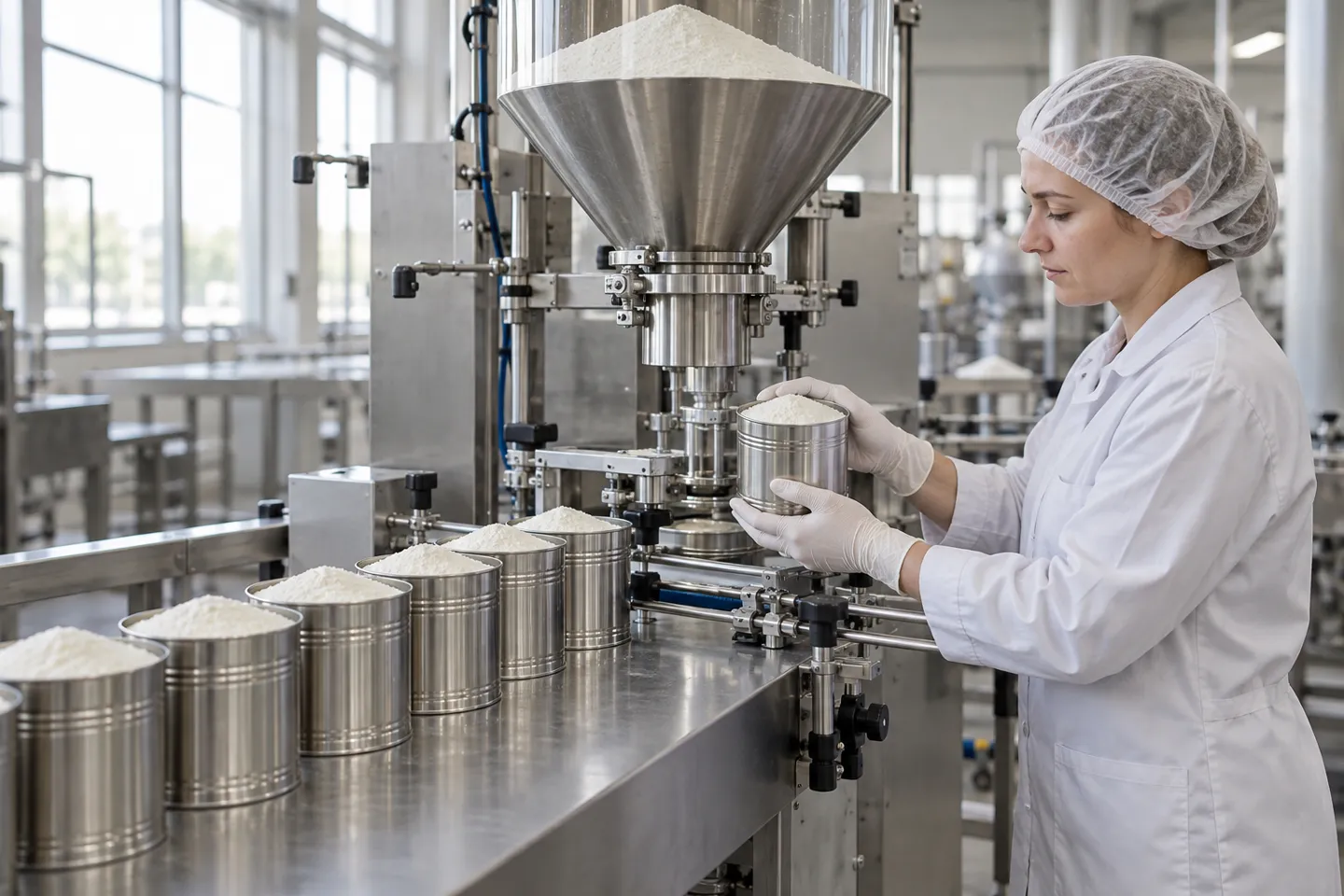
A demonstration with the supplier’s standard powder proves the machine works on the supplier’s standard powder. Acceptance means a continuous run with your own powder, at your fill weight, in your container. During the run, three numbers matter: how many bridge events occur, how long each takes to clear, and how much the fill weight drifts. Ask for the test protocol in writing and for video of the runs, so the results survive the sales cycle.
The one clause worth remembering
The supplier must run your powder through a continuous test, then hand you the bridge count, clearing time, and weight-drift numbers in writing.
01
Bridge count
arches during the run
02
Clearing time
minutes to restore flow
03
Weight drift
deviation from fill weight
Retrofit or Replace: The Order of Judgment
When a current machine is the patient, judge in order. Start with the daily bands, because humidity and level cost almost nothing to correct. Move to geometry retrofits: steeper cone inserts, a longer agitator, rounded corners. Only then weigh a different machine. Retrofit is genuinely viable, and field providers document cases where it was. Read their numbers with their framing attached, though: one reported protein-powder line ran 3 to 5 bridge events per shift with ±1.8% accuracy swing before retrofit (Uniflow Packaging Machinery, 2026). After the retrofit it ran near-zero events with ±0.3% to ±0.4%. Useful, and also an admission of what the buyer endured first. On a new purchase, the six-line RFQ plus the acceptance test is how that tuition gets paid in advance instead.
The Business Side of Flow
The production math is unforgiving once the numbers from earlier in this page are multiplied out. A serious bridge costs 30 to 60 minutes; a partial bridge drifts weights past ±2%. Either one, a few times a week, quietly consumes the margin that a lower machine price promised. A machine that is “cheap” and then patched with vibrators and hammer marks is rarely cheap by year end.
That is why the acceptance clause is a supplier filter and not just a test script. A supplier who agrees to run your powder, shares factory test protocols, and signs numbers into acceptance is pricing risk honestly. A supplier who quotes only a rated speed against a catalog powder is selling you the privilege of becoming their retrofit case study.
For dealers and system integrators the same logic travels one step further. When a customer asks whether their protein blend will bridge in the proposed line, the dealer who answers with cone angle, agitation reach, and level control is selling a scheme. The one who answers with a brochure is selling a bare machine. The questions in this page, asked out loud and early, are the difference.
If you want hopper geometry, agitation, and level control matched to your own powder from the start, Levapack builds powder filling machines to order and puts test video behind every acceptance run.
Run the Acceptance Test on Your Powder
Hopper geometry, agitation reach, and level control, matched to your powder and proven with test video before the machine ships.
Get a Powder-Matched QuoteReferences
- Uniflow Packaging Machinery. “Powder Bridging in Auger Fillers: 8 Root Causes & Proven Field Fixes.” 2026. https://uniflowpack.com/blog/powder-bridging-auger-fillers-causes-fixes/
- r/AskEngineers (Reddit). “How to solve slow discharging from a screw conveyor?” 2025. https://www.reddit.com/r/AskEngineers/comments/1lp5d38/how_to_solve_slow_discharging_from_a_screw/
- Processing Magazine (Hapman). “Understanding ratholing and bridging phenomena in bulk powder feeding.” 2023. https://www.processingmagazine.com/material-handling-dry-wet/weighers-feeders/article/53079307/hapman-understanding-ratholing-and-bridging-phenomena-in-bulk-powder-feeding
- Visval. “Overcome powder bridging problems with fluidisation.” 2026. https://www.visval.com/en/powder-handling/powder-bridging


 EN
 RU
 ES
 FR
 DE
 NL
 IT
 JA
 ID
 PT
 KO
 AR
 TH
 VI
 TR
 PL