
Two quotes can land on the same desk for machines called the same thing: a $900 benchtop sealer and a $7,800 fully automatic seaming machine. Both will seal a can. Only one of them fits your production plan. The can sealing machine price you end up paying has almost nothing to do with brand, and almost everything to do with which of four machine worlds the quote comes from.
What a Can Sealing Machine Actually Does (and What It Isn’t)
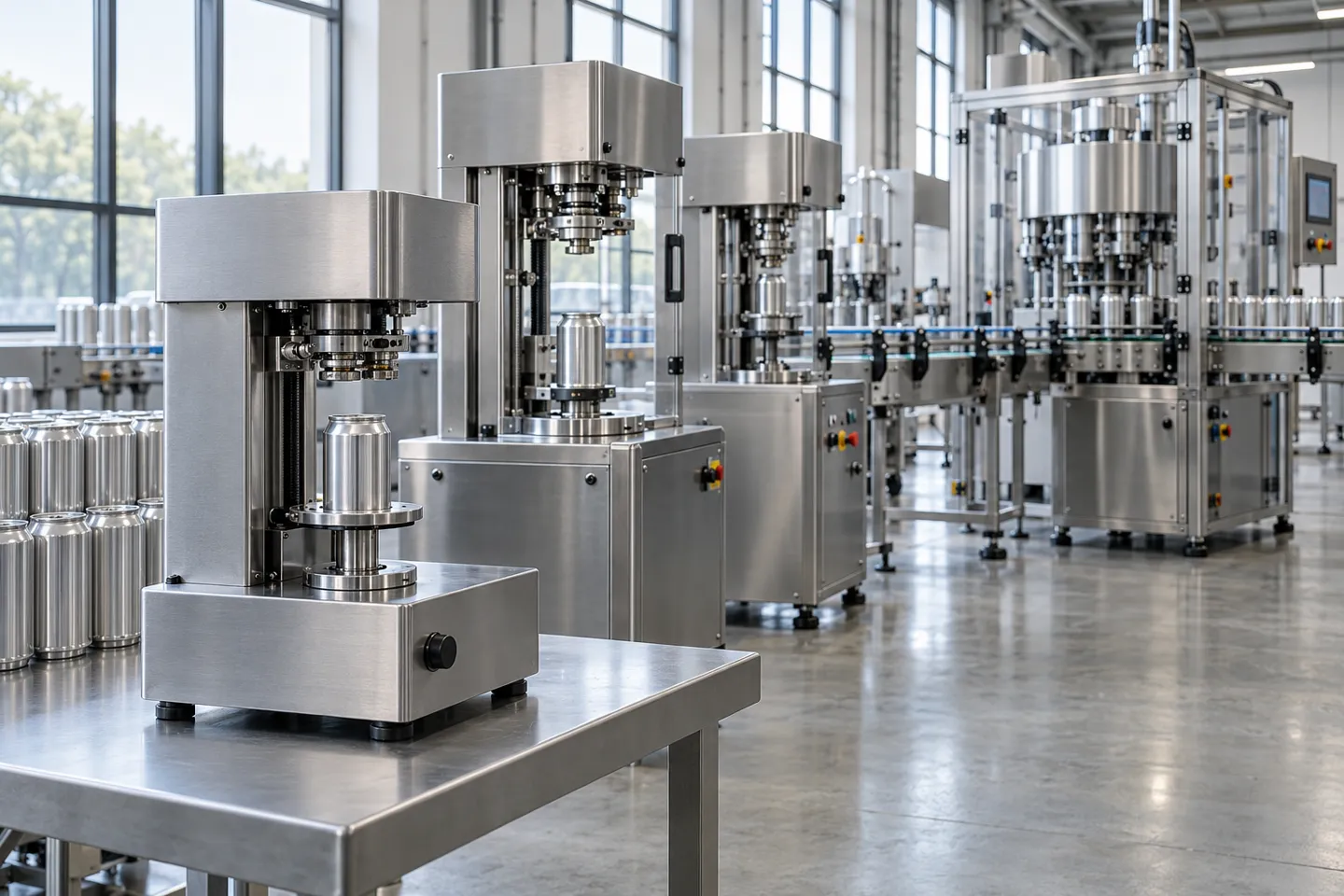
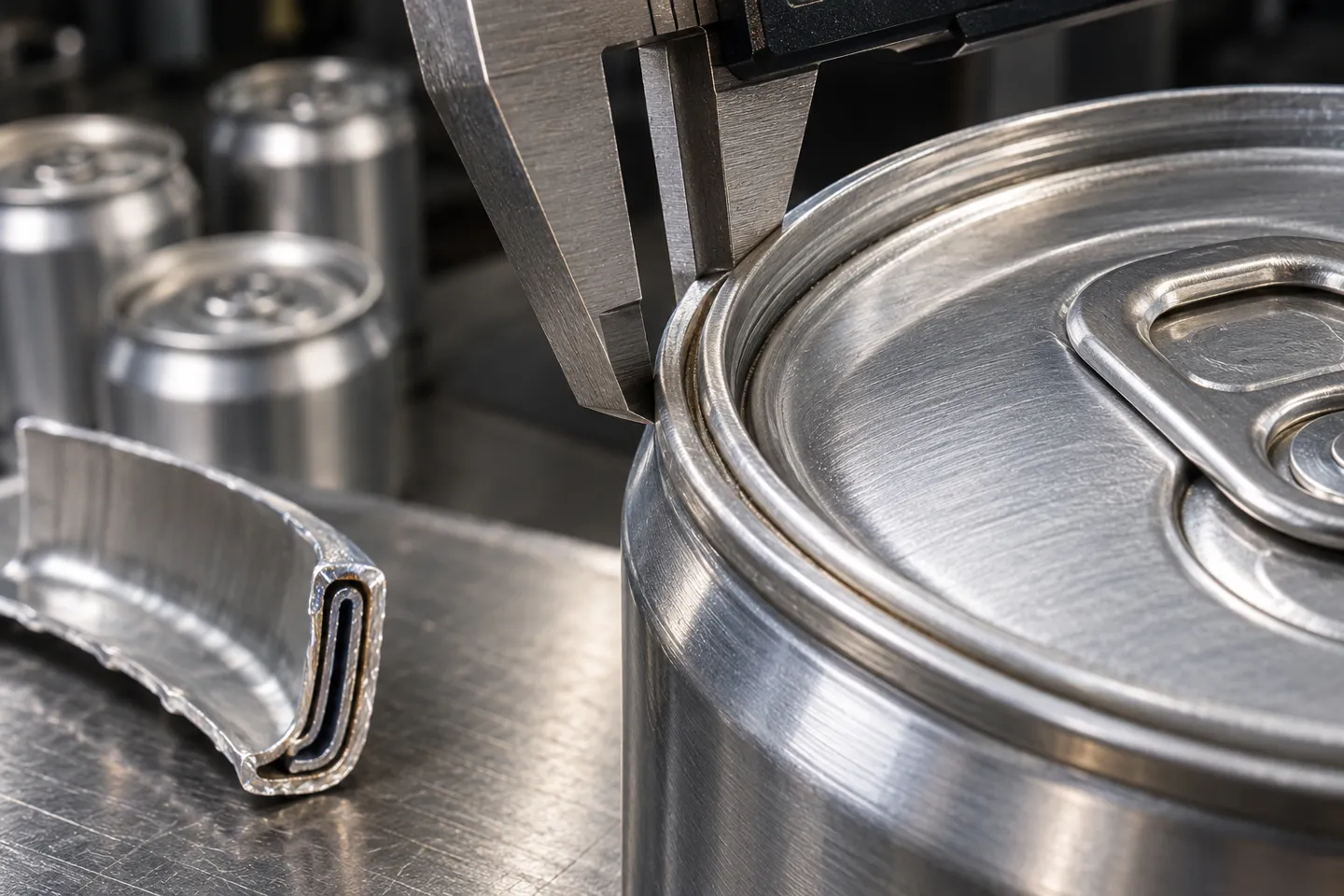
A can sealing machine, usually called a can seamer, joins the lid to the can body with a double seam. The can (or the seaming head, depending on the design) rotates while two small rollers press against the edge in sequence. The first roller folds the lid’s curl underneath the flange of the can body. The second roller flattens the whole sandwich into a tight mechanical lock. No glue, no heat, just folded metal compressed in the right geometry.
That last part matters more than it sounds. The seam is a seven-layer cross section of interlocked metal, and its quality decides whether the can survives retorting, stacking, and weeks on a shelf without leaking or bulging. Regulators treat seam integrity as a core food safety control for canned foods for exactly this reason.
Before going further, clear the lookalikes out of the way, because search results mix them in constantly. A bubble tea cup sealer heat-seals plastic film over a cup. An impulse sealer melts the open end of a plastic bag. A home vacuum machine sucks air out of a plastic pouch. None of them form a double seam, and none of them belong in this price conversation. What follows is only about machines that seam metal ends onto cans: tinplate, aluminum, PET, and paper cans alike.
The Four Price Worlds of Can Sealing Machines
Type “can sealing machine” into a marketplace and you will find handheld gadgets next to industrial lines, as if they were the same product category. They are not. There are four distinct price worlds, each with its own construction logic and its own buyer.
One search term. Four price worlds.
$15$50,000+
Three orders of magnitude on one search term. Averages mean nothing here; the quote becomes readable only once you know which of the four machine worlds your production volume lives in.
Manual and Countertop Sealers: The $15 to $500 World
At the bottom sit hand-cranked and simple electric sealers. You place the can, pull a lever or press a button, wait a few seconds, and swap in the next can. Marketplace listings for this class run from about $15 for basic handheld units to a few hundred dollars for benchtop models (KaTom Restaurant Supply, 2026). Homebrewing forums track this world closely: a capable benchtop seamer for home use costs roughly $450 to $500, and buyers there still debate whether the purchase is justified for a few batches a month (Homebrew Talk, 2022).
Why does a machine with one motor and two rollers cost even $500? A manufacturing engineer who builds assembly equipment broke it down in a public thread. Production volume for these machines is tiny, so every enclosure and frame is a small-batch sheet metal job with setup costs spread over dozens of units, not thousands (r/Homebrewing, 2021). The only truly custom precision parts are the seaming rollers and the can lifter. Small market, hand assembly, low volume: that is the whole price story of this tier.
Benchtop Semi-Automatic: The $500 to $2,000 Commercial Step
The next world adds a motor-driven sealing cycle. You still load the can and the lid by hand, but the machine controls the seaming sequence, so every can gets the same treatment. Juice bars, coffee shops crowling their roasts, and small drink brands live here. A commercial-grade PET can seamer in this class lists around $1,899 (Hammont, 2026), and industry buying guides place the full semi-automatic band between roughly $500 and $6,000 (OUTSTANDING, 2026).
The economics of this tier are about labor, not the sticker. At one to three cans per minute with one operator, a $1,500 machine pays for itself against hand-cranking the moment sealing time stops being the bottleneck of your day. What this tier cannot do is guarantee seam consistency at volume or lock in a shelf life claim, because nothing about the process is measured or controlled.
Industrial Semi-Auto to Low-Speed Full-Auto: The $2,000 to $15,000 World
This is the tier where “can sealing machine price” becomes a procurement exercise. Machines here run roughly 15 to 50 cans per minute, handle can diameters from about 30 mm to 130 mm, and are built from food-grade stainless steel. Published spec sheets in this class show single-head machines with two seaming rollers, four-roller double-seam heads, servo drives, and optional vacuum or nitrogen-flush stations. Residual oxygen reads between 3-5% on standard units, and below 3% on the higher-spec machines (industrial seamer specifications). B2B sourcing catalogs list industrial can seamers in the $5,000 to $8,000 range per unit with a minimum order of one machine (Made-in-China, 2026).
Inside this tier, the price spread is driven by specs rather than by whether the machine is manual or motorized. Seaming head count, roller configuration, vacuum and nitrogen capability, drive type, and material grade each move the number, and each maps to a specific product requirement. This tier is where most growing food and beverage producers land, and it gets its own deep dive in the next section.
Fully Automatic Lines: $20,000 and Up
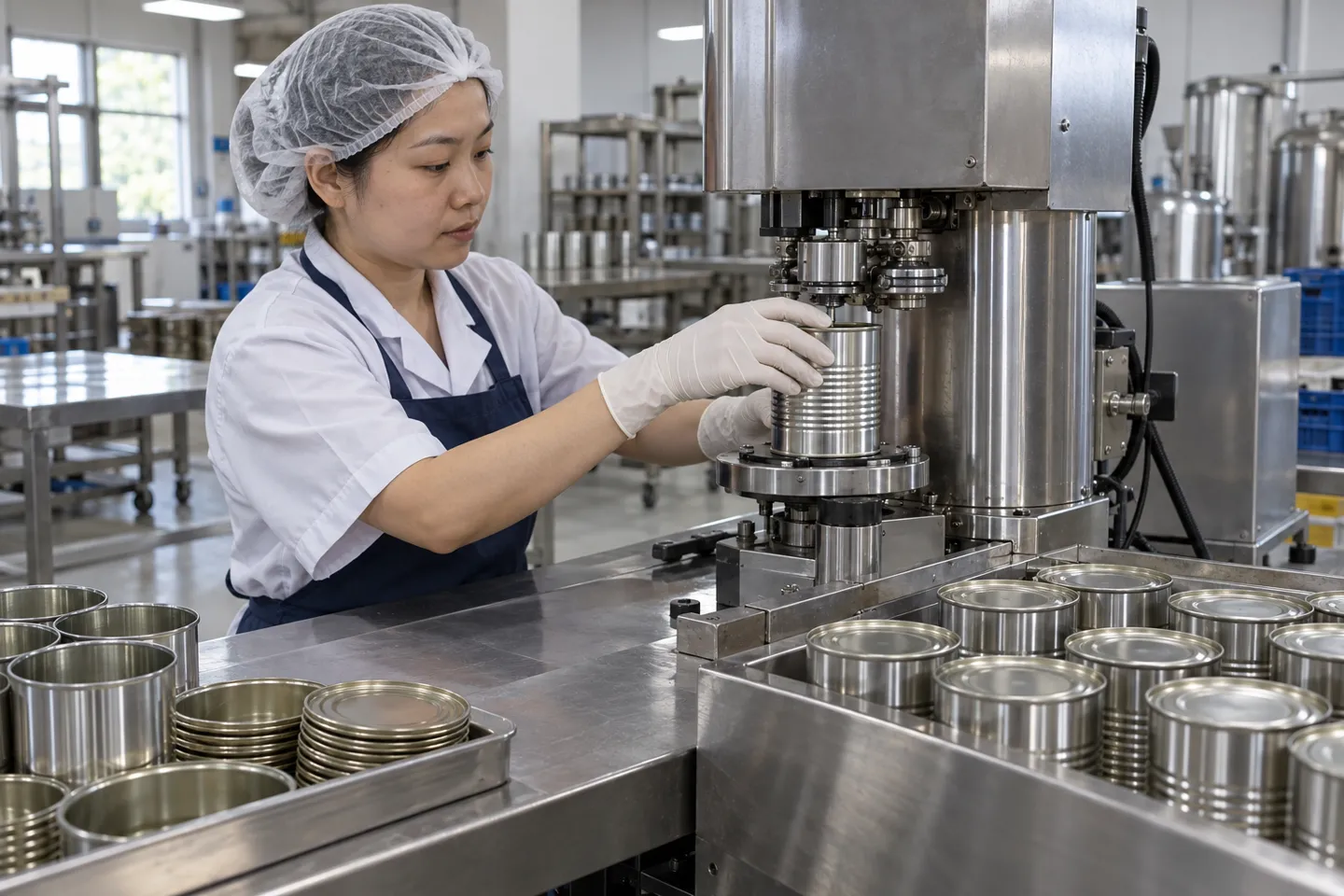
At the top, sealing becomes one station in a line. An infeed table feeds cleaned cans, a filler dosed for your product runs ahead of the seamer, the seamer runs 30 to 50-plus cans per minute continuously, and labelers and coders finish the back end. Industry guides put fully automatic inline and rotary sealers between roughly $5,000 for compact units and well past $50,000 for multi-head rotary systems (OUTSTANDING, 2026). Integration, commissioning, and changeover engineering, not the seamer chassis, account for much of the cost at this level.
| Tier | Typical price band | Who it fits | What you get | Where this tier stops working |
|---|---|---|---|---|
| Manual / countertop | $15-500 | Home users, homebrewers, R&D samples | Hand-cranked or basic electric double seam, 1-3 cans/min | Any commercial volume; no consistency or shelf life control |
| Benchtop semi-automatic | $500-2,000 | Juice bars, cafes, crowler bars, startups | Motor-driven cycle, one operator, low tens of cans/day | Carbonated drinks at scale, shelf life claims, multi-size tooling |
| Industrial semi-auto / low-speed full-auto | $2,000-15,000 | Growing food and beverage SMEs | 15-50 cans/min, stainless build, vacuum/nitrogen options, servo control | Continuous multi-shift lines above ~20,000 cans/day |
| Fully automatic line integration | $20,000+ | Regional producers and contract packers | Integrated fill-seam-label line, retort-compatible seams, 30-50+ cans/min | Nothing, until your product mix demands a different filler |
Matching the Machine Tier to Your Daily Volume
Tier confusion is the most expensive mistake in this purchase, and both directions of the mistake cost real money. The fix is a three-step calculation you can do on paper before contacting anyone.
First, convert your sales plan into a rate. Take your realistic peak day, divide by effective production minutes. Effective minutes are not the whole shift: changeovers, cleaning, and breaks mean a well-run single shift delivers maybe 60-70% of nominal time. A target of 5,000 cans a day over a 7-hour effective window needs about 12-15 cans per minute. That number alone already tells you a countertop unit cannot carry the plan and a high-speed line would idle.
Second, add your product’s constraints, because they can override the rate. Carbonated drinks need the headspace protected during seaming. Nuts, coffee, milk powder, and anything with oils that oxidize need nitrogen flush and a residual oxygen spec. High-acid or salty products push you toward higher stainless grades. Each constraint tends to move you up within a tier rather than across tiers.
Third, pick the tier whose rated speed sits comfortably above your required rate, targeting roughly 60-70% load at peak. A machine running flat-out all day has no margin for wear, product changes, or a good sales month.
Size the machine in three steps
- 1Peak day volume ÷ effective minutes (60-70% of shift) = required cans/min.
- 2Check product constraints: carbonation, oxygen sensitivity, acidity, retort.
- 3Choose the tier where rated speed ≈ 150% of your required rate, then tune specs within the tier.
Buying above your math wastes capital and adds maintenance you will never amortize. Buyers on homebrewing forums regret exactly this when they price a $500 seamer against a few batches a month (Homebrew Talk, 2022). Buying below your math is worse. The tier becomes your growth ceiling, operators compensate with overtime, and seam quality drifts as the machine runs beyond its comfort zone.
What Moves the Price Within a Tier: Specs, Hidden Costs, and Your RFQ
Once the tier is fixed, quotes within it can still differ by a factor of three. The differences are legible if you know which components carry the cost and which ones your product will never use.
Seaming Heads and Roller Configuration
The basic industrial configuration is one seaming head with a pair of rollers, one for each seaming operation. Adding a second head doubles throughput potential without doubling floor space, and four-roller heads (two pairs per head) compress both seaming operations in one pass for higher speeds. Every additional 1,000 cans per hour of rated capacity adds roughly $2,000 to $5,000 to the machine price, according to industry buying guides (OUTSTANDING, 2026). Pay for head count only when your rate calculation from the previous section demands it.
Headspace Control: Vacuum and Nitrogen Options
Atmosphere handling is the biggest spec jump inside the industrial tier. An ambient seamer is the cheapest. A negative-pressure vacuum station pulls air out before seaming, which suits shelf-stable canned foods. A vacuum-plus-nitrogen station flushes inert gas after vacuum, holding residual oxygen to published specs of 3-5% on standard units and below 3% on high-spec machines (published seamer specs). If you pack nuts, coffee, milk powder, pet food, or anything whose flavor dies with oxidation, this option is not optional. If you pack acidic liquids in retort-stable cans, the vacuum path matters more than nitrogen. Buyers who pay for nitrogen flush on oxygen-insensitive products are donating money.
Drive, Materials, and Build Grade
The drive decides how the machine ages. Fixed-speed geared motors do one thing reliably; servo drives add precise positioning, overload detection that stops the machine before parts break, and faster can-size changeovers. Frame and contact materials follow the same logic of product fit: carbon steel is cheapest and wrong for food, 304 stainless is the food-grade baseline adding roughly 20-30% to the base price, and 316 stainless, for high-acid, salty, or pharmaceutical contexts, adds another 30-50% over 304 (OUTSTANDING, 2026). Seaming rollers themselves are hardened tool steel; published spec sheets commonly call out alloys like Cr12 for wear resistance (seamer material specifications).
| Spec driver | Price effect | Pay for it when | Skip it when |
|---|---|---|---|
| Extra seaming head / 4-roller config | +$2,000-5,000 per 1,000 cans/hr of capacity | Required rate above ~20 cans/min sustained | Rate fits a single head at 60-70% load |
| Vacuum station | Mid-tier adder | Shelf-stable low-acid cans, retort processes | Frozen or high-acid products where vacuum is not critical |
| Vacuum + nitrogen flush, O2 <3% | Top-tier adder | Nuts, coffee, milk powder, pet food, high-fat recipes | Oxygen-insensitive products |
| Servo drive | Moderate adder | Frequent size changeovers, multi-SKU lines | Single-SKU, single-size production |
| 316 stainless instead of 304 | +30-50% over 304 | High-acid, salty, pharma, marine export | Standard sauces and beverages where 304 is the norm |
The Costs That Show Up After the Quote
The quote is not the invoice. Industry guides itemize the gap well. An additional can size requires a new seaming chuck and roller set, typically $500 to $1,500 per format. Ocean freight for one crated semi-automatic machine runs roughly $300 to $1,200 depending on destination. Customs brokerage adds a few hundred, and machines shipped from China can face Section 301 tariffs on top of standard duty rates (OUTSTANDING, 2026). Their landed-cost example is worth memorizing: a $3,500 machine becomes a $5,300 to $8,200 landed cost by the time it runs in a US facility.
To make quotes comparable, put five things in every RFQ: can diameter, height, and material; the product; required cans per minute; atmosphere requirement; daily volume target. A supplier who receives all five can quote a machine configuration instead of a catalog number, and you can compare bids line by line.
Send that RFQ to factories, not just resellers, and ask each one two questions that reveal how they price: what do you hold in stock, and what do you tool in-house? We invite buyers to measure us on both. Levapack keeps around 80 standard machines in stock, so standard-config fully automatic seamers ship in about 7 days and semi-automatic units in about a day. Every seaming chuck and roller set is cut to your can diameter and height, whether your cans are tinplate, aluminum, PET, or paper tube. The can sealing machine specifications and lead times we publish let you check both claims before writing to us. A factory that machines its own change parts can commit a date and a price against your actual can drawing; a trading company can only pass both along with a margin.
Send your can drawing and daily volume target, and an engineer replies with a priced configuration for your exact can.
Request a Factory QuoteWhere to Buy and How to Vet the Seller
Marketplaces suit the bottom two tiers only. The listing you buy for $739 with free shipping is a countertop unit, and no industrial machine changes hands this way (Walmart, 2026). For the industrial tier, B2B sourcing catalogs are the main doorway: prices are visible, minimum orders are one machine, and ranges can be compared across listings (Made-in-China, 2026). Factory-direct purchasing cuts the reseller margin and keeps you talking to the people who machine your change parts, which matters most when your can is non-standard. The used market is legitimate for tight budgets in the bottom two tiers. Seaming rollers wear invisibly inside the head, though, so a used seamer without a seam test is a gamble.
Whichever channel you choose, the vetting actions are the same, and buyers in trading groups ask for exactly this kind of verification before wiring money (Facebook Groups, 2026):
Vetting actions before the deposit
- Confirm the business license and get a live video walk-through of the production floor, not a brochure.
- Require a seaming video made with YOUR can samples and YOUR lids, not a demo reel.
- Ask for one reference customer with your industry and a similar can size.
- Write the acceptance metrics, spare parts list, and warranty scope into the contract before the deposit.
The pattern behind all four actions is the same: replace claims with artifacts. A video of your own can being seamed, and a contract clause naming the seam metrics, are worth more than any certificate in a PDF.
Acceptance, Wear Parts, and Support
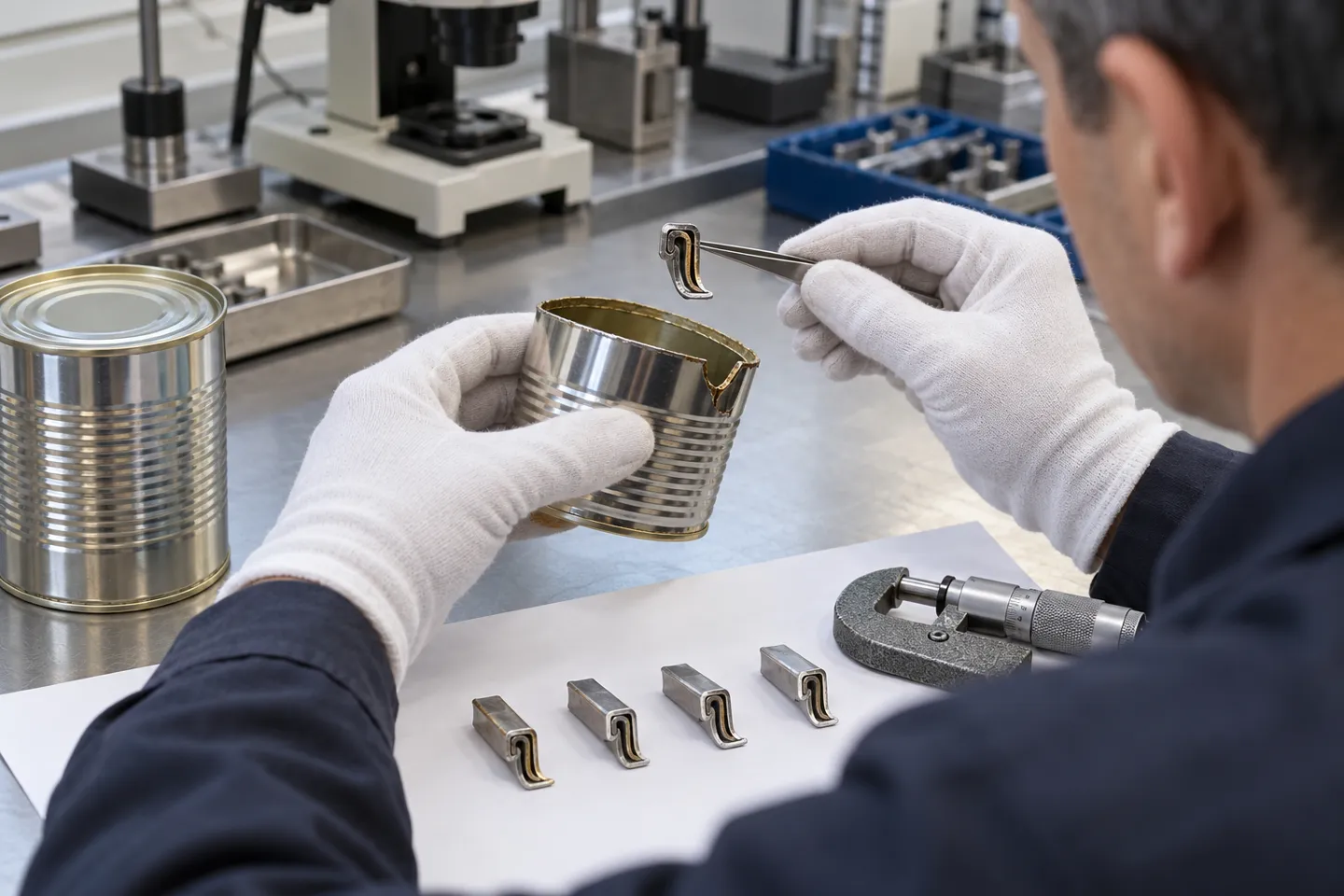
The day the machine arrives is when discipline pays. Run your sample cans through it, a hundred or more in a row, and inspect the results before signing anything. Cut open seams and look at the cross section: food safety inspectors judge double seams primarily on overlap and tightness (U.S. FDA, 2014). If your line uses vacuum or nitrogen, measure residual oxygen against the contract spec. Record all of it on video, because a documented acceptance test is the only thing that turns a dispute into a claim.
Plan for wear from day one. Seaming rollers and chucks are consumables: a roller set lasts somewhere between 500,000 and 2,000,000 cycles depending on can material, and a replacement set costs $50 to $300 (OUTSTANDING, 2026). Order a spare set with the machine, not after the first set dulls, because seam quality degrades gradually before it fails an inspection.
Support terms deserve the same scrutiny as the price. Ask what the response commitment is, whether troubleshooting happens over video call or requires a technician on a plane, and whether the warranty covers labor and parts or just parts. Wear parts are usually excluded from warranties everywhere in this industry, which is exactly why the spare set belongs in your first order.
Before the shipment leaves the factory: 100+ consecutive seaming runs on your cans, seam cross-sections checked for overlap and tightness, vacuum/residual oxygen measured against contract specs, all on video. No signature without all four.
The Business Math: Total Cost of Ownership
Zoom out and the purchase is a ten-year cost, not a quote. Two machines with identical stickers can drift far apart once change parts, freight, duties, spares, and downtime enter the picture. A $3,500 industrial seamer that lands at $8,200 with tariff and freight is not a $2,900 markup surprise if you budgeted it; it is a budgeting error if you did not (OUTSTANDING, 2026).
What Total Cost Includes
| Cost item | Where it hides | What to do about it |
|---|---|---|
| Machine tier price | The visible number | Fix the tier with the volume math before comparing quotes |
| Change parts per can size | $500-1,500 per extra format | Count your SKUs today and next year; bundle tooling in the first order |
| Freight, duties, brokerage | 15-40% on top of FOB for China imports | Ask for landed-cost estimates, not FOB quotes |
| Wear parts | $50-300 per roller set, 0.5-2M cycle life | One spare set per seaming head in the initial order |
| Downtime | Unbudgeted, largest when it happens | Response-time commitment and spare kit in the contract |
| Acceptance failure | Rework, dispute, lost season | Written seam metrics plus video acceptance before shipment |
Where the Negotiation Wins Actually Are
Buyers often spend their bargaining energy shaving the sticker price, then sign whatever sits below it. Flip that. A few hundred dollars off the machine price is the smallest lever on this table. The bigger levers are a spare roller and chuck set included in the order, change-part tooling priced now instead of later, a written response-time commitment, and acceptance metrics in the contract. A supplier either stands behind the machine in those clauses or quietly does not. Those clauses also cost the supplier far less to give than the discount you were about to ask for.
The same logic caps how much speed you should buy. Your rate calculation sets the tier; anything above roughly 150% of your required rate is capital that never earns a return and maintenance you pay for anyway. The cheapest configuration is almost never the smallest sticker, it is the configuration whose specs match your product and whose total cost you can state on one page.
When you build that one-page comparison, it is worth adding a line for Levapack: factory-direct can seamers from semi-auto to 50 cans per minute, change parts cut to your can drawing, and a 16-month warranty that covers free replacement of damaged parts.
Get a Can Seamer Quoted Against Your Own Can
Factory-direct semi-automatic to fully automatic can seamers: around 80 standard machines in stock, seaming chucks and rollers cut to your can drawing, and a 16-month warranty with free replacement of damaged parts.
Get a Factory-Direct QuoteReferences
- KaTom Restaurant Supply. “Can Sealer Machines & Supplies.” 2026. https://www.katom.com/cat/can-sealer-machine-supplies.html
- Hammont. “Automatic Seamer Machine for Clear Beverage Can.” 2026. https://hammont.com/products/clear-pet-bottle-aluminum-cap-sealing-machine
- Made-in-China. “Can Seamer Machine Price.” 2026. https://www.made-in-china.com/products-search/hot-china-products/Can_Seamer_Machine_Price.html
- OUTSTANDING. “Can Sealing Machine Price: Costs, Types & Buying Guide 2026.” 2026. https://www.outstandingpack.com/can-sealing-machine-price/
- r/Homebrewing. “ELI5: Why are can seamers so expensive?” 2021. https://www.reddit.com/r/Homebrewing/comments/l9glq4/eli5_why_are_can_seamers_so_expensive/
- Homebrew Talk. “Affordable Can Seamer?!” 2022. https://homebrewtalk.com/threads/affordable-can-seamer.699366/
- U.S. FDA. “Guide to Inspections of Low Acid Canned Food Manufacturers, Part 3.” 2014. https://www.fda.gov/inspections-compliance-enforcement-and-criminal-investigations/inspection-guides/guide-inspections-low-acid-canned-food-manufacturers-part-3
- Walmart. “Automatic Tin Can Sealing Machine.” 2026. https://www.walmart.com/c/kp/automatic-tin-can-sealing-machine
- Facebook Groups. “AskNanima: sealing machine advice.” 2026. https://www.facebook.com/groups/AskNanima/posts/25810274275267055/


 EN
 RU
 ES
 FR
 DE
 NL
 IT
 JA
 ID
 PT
 KO
 AR
 TH
 VI
 TR
 PL