
A cup filler looks like the simplest machine on the packaging floor. It is also the one buyers misjudge most often, because the spec sheet that wins the comparison is not the number that decides whether you make money. That gap sits in one word your product brochure never mentions: density.
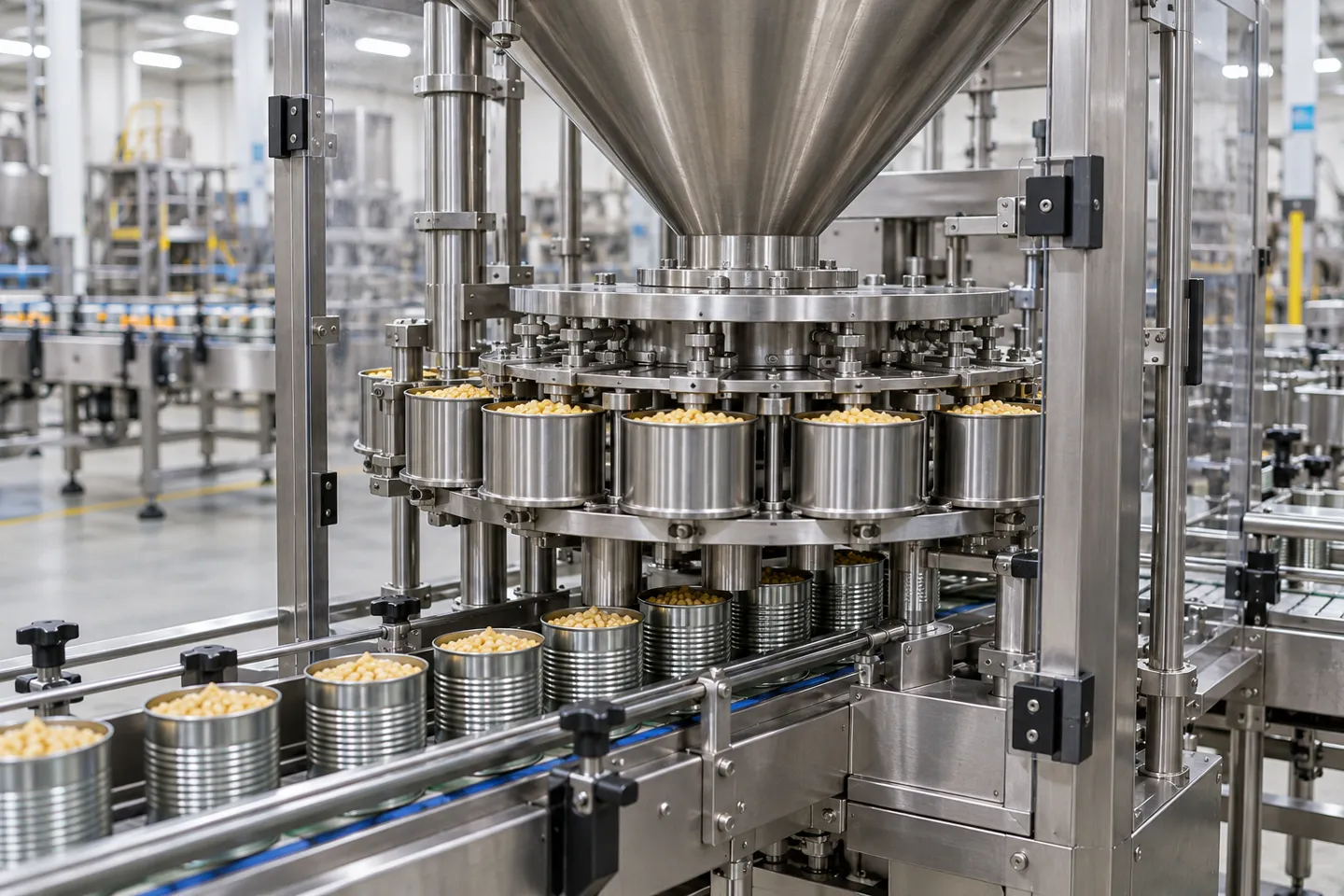
How a Volumetric Cup Filler Actually Works
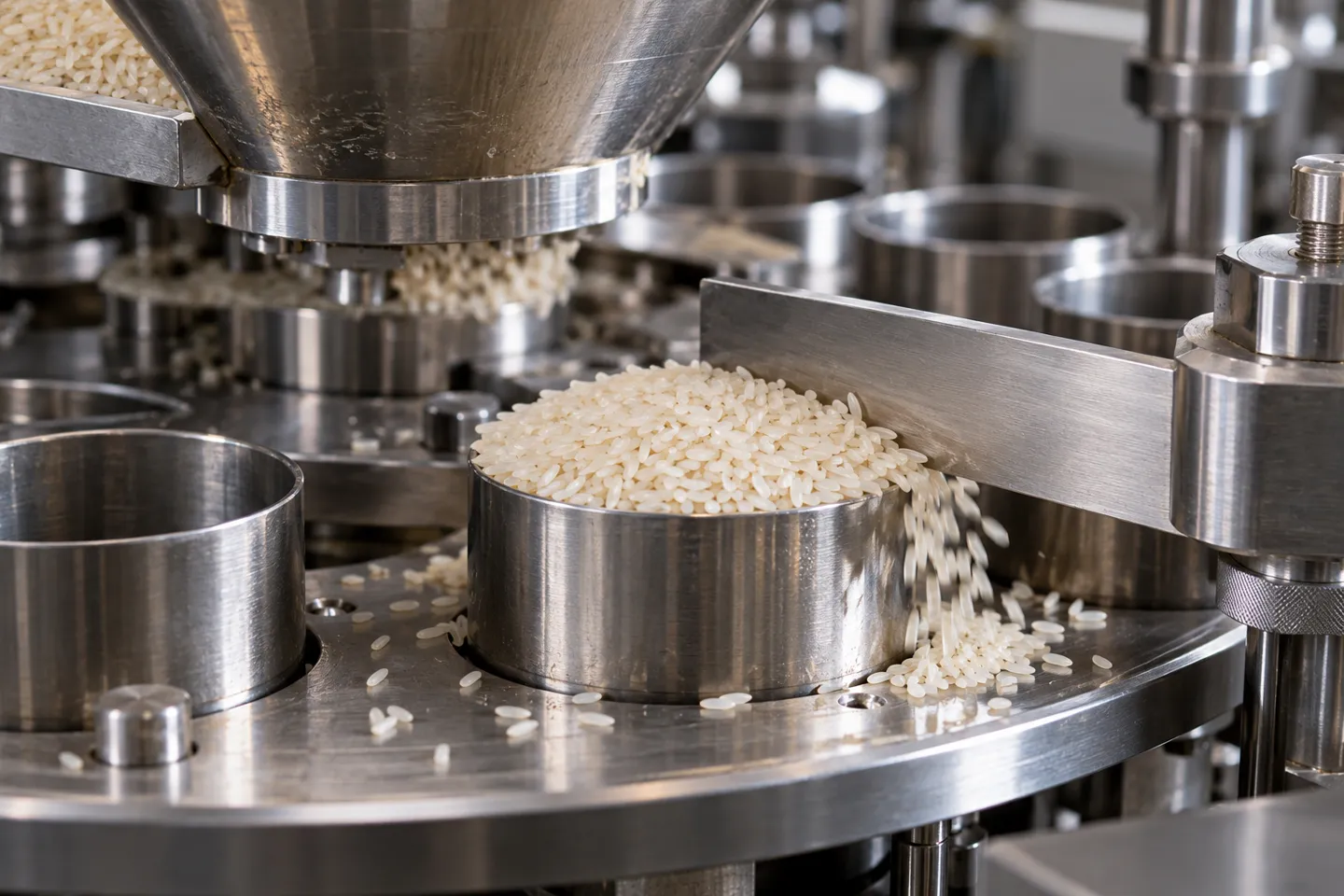
Watch one for ten seconds and you have seen everything. A measuring cup rides a rotating plate under the hopper. Product fills the cup. A blade scrapes the top level as the cup passes. At the discharge spout, a gate opens and the load drops into your container.
The whole cycle in ten seconds
Fill
Cup passes under the hopper and fills
Level
A blade scrapes the cup top flat
Drop
Gate opens at the spout, load falls
That is the entire cycle. And it explains the speed. There is no scale to wait for and no settle time, just a fixed mechanical motion repeating down the carousel. Inline machines typically run 30 to 80 containers per minute, and rotary versions cover a 30 to 120 containers per minute band, with the actual number set by container size and how freely your product flows (All-Fill, 2026).
Hold on to the catch, because the rest of this article lives inside it. The cup controls space. Nobody in that loop ever measures weight. The machine delivers a full cup, and it trusts that a full cup of your product weighs what you think it weighs.
What It Can and Cannot Fill
That trust is exactly why the product list matters more than the machine list.
Volumetric cup fillers are happy with dry, free-flowing, fairly uniform products: rice, beans, grains, seeds, nuts, coffee beans, sugar, salt, coarse spices, candy, pet food kibble (H&H Design, 2025). If the product pours like sand and weighs the same every scoop, the cup repeats it faithfully.
| Green zone: pour it in | Red zone: walk away |
|---|---|
| Rice, beans, grains, seeds | Flour, protein powder, milk powder |
| Nuts, coffee beans, candy | Sticky or oily powders |
| Salt, sugar, coarse spices | Moisture-sensitive products |
| Pet food kibble, popcorn | Materials whose density shifts batch to batch |
The red zone is not a warning label, it is a physics result. Fine and sticky powders adhere to the cup, bridge over the feed opening, and dose unevenly, which is why filler makers route flour, protein powder and milk powder to auger machines instead (Ruisoon, 2026). And when density itself drifts, even a perfectly clean product defeats the cup. Production engineers on r/manufacturing put the trade in plain terms: volumetric feeders ask for less operator skill but deliver less accuracy, and whether that trade makes sense depends on the value of your product set against labor and uptime (Reddit, 2025).
Cup Filler, Auger, or Weigh Feeder: Pick by One Question
Most comparison charts start with accuracy and lead you in circles. Start with your product instead, and the chart collapses into one question: how stable is your bulk density?
| Cup filler | Auger filler | Weigh feeding | |
|---|---|---|---|
| Meters by | Fixed cup volume | Screw rotations | Actual weight |
| Happy with | Free-flowing, stable-density granules | Fine, sticky, non-flowing powders | Nearly everything |
| Accuracy basis | Volume, weight drifts with density | Tighter volume control | Weight directly, down to around ±0.1 g class on multihead systems (SunAura, 2026) |
| Speed | Fastest of the three | Moderate | Slowest per station |
| Changeover | Swap or adjust cups | Change screw settings, store recipes | Enter a new target weight |
| Cost to buy and run | Lowest | Mid to high | Highest |
One more thing the marketing copy blurs. You will see claims that cup fillers deliver “complete accuracy”. Read that as mechanical repeatability: the same cup fills the same way every cycle. It says nothing about whether a full cup of your product equals the weight on your label. Those are two different physical quantities, and a typical cup line lands within about 1% of target weight when the product behaves (HonorPack, 2024). Repeatability is the machine’s virtue. Trueness is your problem.
What 1% Actually Costs You
The giveaway bill and the compliance floor
Run the arithmetic on a realistic line. A mid-size operation filling 200 g jars at 40 containers per minute, two shifts, 250 production days, moves roughly 9.6 million jars a year. At 1% drift you give away 2 grams per jar. That is 19 tonnes of product leaving the building for free, every year, at any product cost you care to multiply it by.
The underfill side bills you differently. When your label declares net weight, mass is the quantity you are legally accountable for, and reaching it through a volume assumption puts that assumption inside your compliance case. Many markets regulate prepackaged goods on an average-plus-minimum basis, the rules differ by market, and the tighter your fill distribution, the closer you can hold the target to nominal without breaching a minimum (Motionwell, 2026). Loose distribution forces you to overfill every single container just to keep the low tail legal.
What 1% costs on one mid-size line
200 g jars · 40 containers per minute · two shifts · 250 production days
9.6 M
jars filled per year
2 g
given away per jar at 1% drift
19 t
of product out the door free, every year
Volumetric buys speed, weighing buys proof: the money density drifts away, either you count it or you pay it.
Close the loop: dose by volume, verify by weight
The good news is that this does not have to be an either-or purchase. The standard fix keeps the fast cup filler and adds a checkweigher downstream. Every container gets weighed, the measured weight feeds back to the filler, the fill trims to hold the mean on target as density drifts through the shift, and out-of-band containers are rejected automatically (Motionwell, 2026). The budget version is the one small producers already run by hand: weigh a sample from each batch, adjust the cup, repeat. When you shortlist suppliers, treat the volumetric-plus-checkweigher configuration as a normal request; most serious filling line builders will quote it as a custom build rather than an exotic add-on.
Fitting a Cup Filler Into a Canning Line
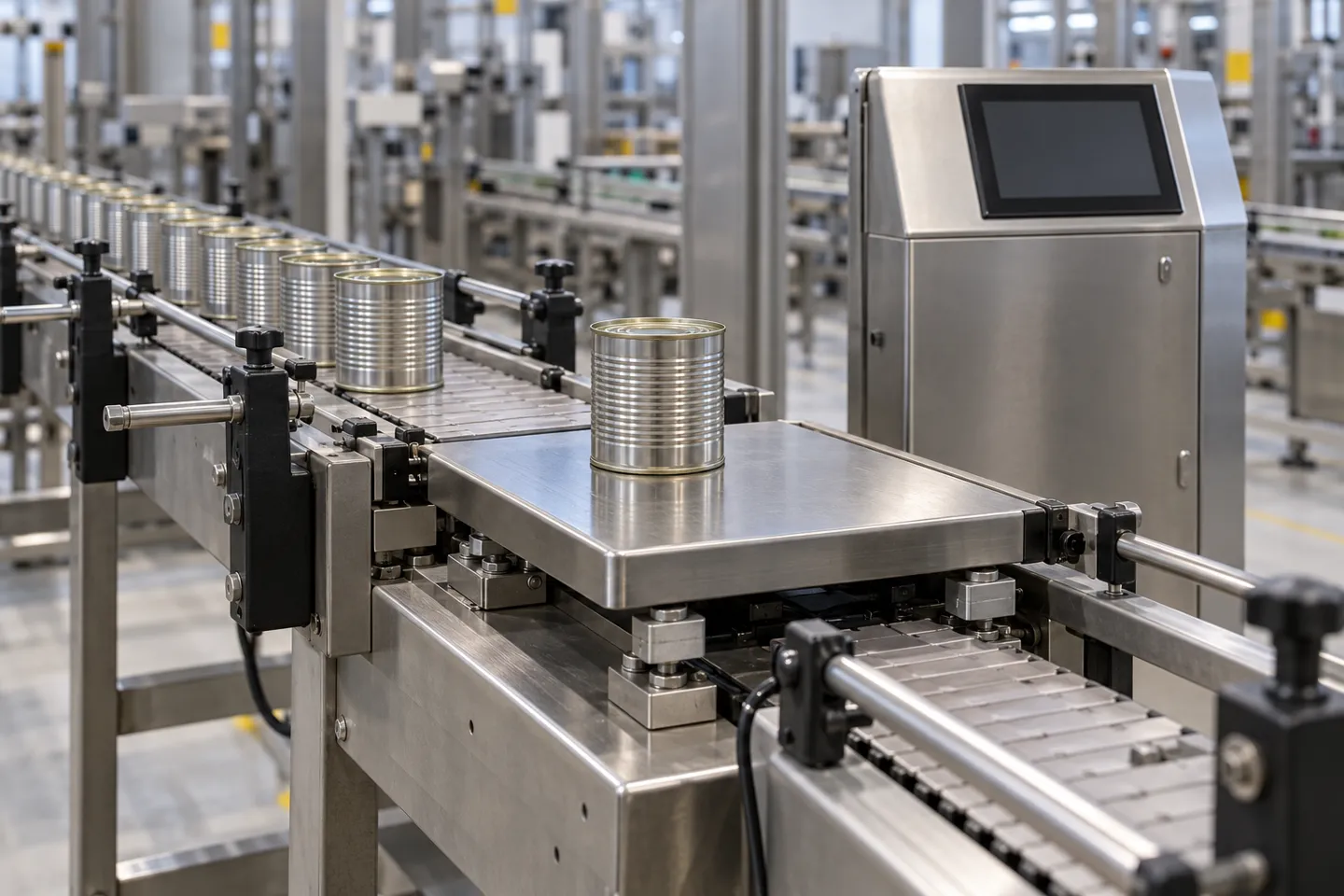
Most content you will find about cup fillers assumes bags. Rigid containers change the conversation, because filling is only one station of a canning line and the stations argue with each other when they come from different philosophies.
What sits above and below the filler
Upstream, cans arrive on a conveyor or rotary table and, if the product is dry and dusty, may pass a cleaning or sterilizing station. Downstream is where cans differ from bags the most: the filled can gets closed by a seamer or capper, and the closure you pick becomes a product decision. A double seam locks a tin can for a wet or long-shelf-life fill. Snap-on lids and foil induction seals suit dry blends. And if your product is sensitive to oxygen, a nitrogen flush right before closing holds residual oxygen low, which is what actually protects flavor on the shelf. Choose the filler and the closer together, or the fastest filler on the market will sit idle behind a seamer that cannot keep up.
Where the filler sits in the line
Cans feed in
Conveyor or rotary table
Cup filler
The fixed-volume heart
Nitrogen flush
Right before closing
Seam or cap
Seamer, capper or induction seal
What you can and should customize
Canning equipment rewards buyers who treat dimensions as decisions. Filling head count sets your rate ceiling. Can diameter and height changeovers decide how many SKUs one line really serves. Contact parts in 304 or 316 stainless, main components from brand-name electrical suppliers you can source locally, and CE marking for export to Europe or North America are all spec-level choices on a proper quotation. We build volumetric filling machines for cans exactly this way, configurable from single machines to complete fill-seal-label lines, because a line whose filler and seamer share one control logic is a line that commissions faster and argues less on the floor (can filling machines).
Single machine or full line?
If your filling, closing and labeling stations already exist and just need a better metering heart, buy the machine. If you are standing a new line, price the full line before you price the filler, because the integration, the guardings and one HMI across stations are where the hidden costs of mixing suppliers live. There is no universal output threshold that flips the answer; it flips when the cost of synchronizing separate machines passes the premium of a matched line, and that crossover arrives earlier than most buyers expect.
Acceptance Before and After the PO
The failure mode that costs buyers real money is not a bad machine. It is a good machine accepted against the wrong test.
Before it ships
Run your actual product, not the vendor’s demo material, at your target rate, in your container. Ask for the test video as a condition of acceptance. And test head by head: on a multi-cup or multi-head machine, the batch average can sit perfectly on target while individual cups drift to either side of it, which is why acceptance should check the distribution, not just the mean (Motionwell, 2026).
After installation
Spend the first production week measuring what the spec sheet could not promise: actual fill weight distribution on your product, checkweigher feedback tuned and logged, one full changeover timed end to end. Confirm the spare parts kit and operator training arrived with the machine, not as a future invoice. And ask any supplier what their factory test protocol covers before you ask what the machine costs; a builder who runs sample cycles, endurance tests and films the results before shipping tends to have far less to argue about afterwards.
Acceptance, before and after
Before it ships
After it lands
The Five-Question Checklist
Take these five questions to any supplier conversation and the technology choice mostly makes itself.
- Scoop test. Fill ten identical scoops of your product and weigh them. Spread within about 1%: the cup route is open. Wider: move to auger or weigh.
- Label test. Declaring weight? You need weight verification somewhere on the line, whatever fills it.
- Rate test. Match the band: cup fillers own the 30 to 120 containers per minute territory on free-flowing product.
- Budget test. Cup fillers cost least to buy and maintain, weigh systems cost most, augers sit between (H&H Design, 2025).
- Market test. Export destinations decide how strict your fill distribution must be. Ask before you set the target weight, not after the first shipment.
The cup filler is the fastest and cheapest metering answer on the floor when your product lets it be. Density decides whether it lets you. Bring your product, container drawing and target rate to the conversation, and a configured recommendation beats a catalog every time: start from the volumetric filling machines for cans page and ask the question that matters, whether your product is one of the ones a cup filler will treat well.
Get a Filling Recommendation Built Around Your Product
Send your product details, container drawing and target rate. Our engineers reply with a configured machine or full-line proposal.
Request a Custom QuoteReferences
- All-Fill. Volumetric Cup Filling Machines. https://www.all-fill.com/equipment/volumetric-cup-fillers (2026)
- HonorPack. What is a Volumetric Cup Filler Machine? https://honorpack.com/what-is-a-volumetric-cup-filler-machine/ (2024)
- H&H Design & Manufacturing. Cup Filler vs Auger Filler: Key Differences Explained. https://www.hhdesignmfg.com/feeds/blog/cup-auger-filler (2025)
- Ruisoon. Volumetric Cup Filler vs Auger Filler. https://ruisoon.net/volumetric-cup-filler-vs-auger-filler/ (2026)
- Motionwell Automation. Volumetric vs Gravimetric Filling. https://motionwell.com.sg/capabilities/volumetric-vs-gravimetric-filling/ (2026)
- SunAura Machinery. Multihead Weighers / VFFS buying guide. https://sunaurakey.com/vffs-machine-buying-guide-vertical-form-fill-seal/ (2026)
- r/manufacturing. Filling machine for compost. https://www.reddit.com/r/manufacturing/comments/1hpj0t0/filling_machine_for_compost/ (2025)


 EN
 RU
 ES
 FR
 DE
 NL
 IT
 JA
 ID
 PT
 KO
 AR
 TH
 VI
 TR
 PL