
Eight pallets of filled, sealed cans went to the crusher. The brewery that packed them spent the next month renting a mobile canning line while it waited for replacement stabilizer arms to arrive, and its maintenance lead spent three days at the distributor’s warehouse hand-screening fifty pallets for leakers. A second brewery in the same discussion thread lost thousands of cases to a recall and ended up rebuilding its seamer completely, new rollers throughout (r/TheBrewery, 2023).
Neither machine failed in any dramatic way. Small parts wore past their useful life, nobody had replacements on hand, and every waiting hour turned into finished goods destroyed or production postponed. That is the whole case for taking packaging machine spare parts seriously: the difference between a line that runs and a line that waits is rarely the machine itself. It is whether the right part is on a shelf, ordered on time, and installed by someone who knew what to check.
Spare parts are the components a packaging machine is designed to have replaced. Seaming rollers and chucks on a can seamer. Auger flights and weigh buckets on a powder filler. Piston seals and nozzles on a liquid filler. Gripper pads and lid-feed fingers on a capper. Belts, bearings, sensors, valves, and seals throughout. Most of them are small enough to carry in one hand, and collectively they decide whether your line is a production asset or a very expensive sculpture.
This guide uses canning and seaming lines for its examples, because that is where the failure stories are loudest. The framework transfers to pouch machines and cartoners with different part names and the same logic. The order of the sections follows the decisions you actually make: what kind of part has failed, when to replace it, what to keep on the shelf, how to order one that fits, and how the whole spare parts budget reads to the person who signs for it.
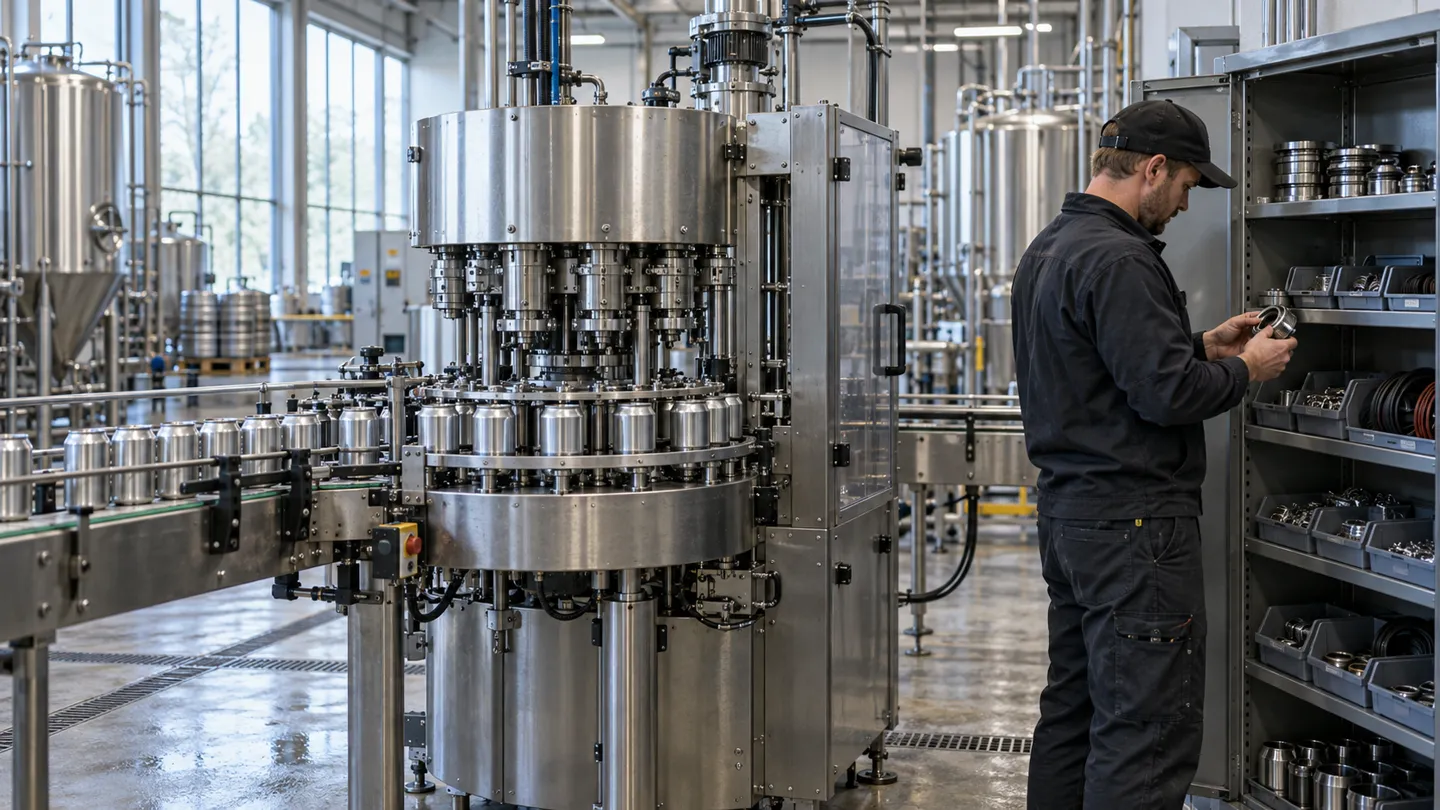
Wear Parts, Core Parts, and Consumables
Every parts catalog organizes components by machine function: feeding, conveying, sealing, labeling, controls. That grouping helps you buy a machine. It does a poor job of telling you what will eventually need replacing, because a single sealing unit contains a chuck that may run for years and a seal that will not last a quarter.
The axis that matters for spares is how a part fails. Parts built for contact, friction, or flex are consumed by doing their job. Seaming rollers, chucks, auger flights, weigh buckets, filling nozzles, piston seals, belts, and gripper pads all belong to this family. Parts built to carry load or compute are expected to last the life of the machine: frames, motors, drives, PLCs, gearboxes. They get replaced on failure and watched by inspection, not by schedule. A third group, consumables such as lubricants and filters, gets used up by maintenance itself.
| Part class | Typical components | Replacement logic |
|---|---|---|
| Wear parts | Seaming rollers, chucks, auger flights, weigh buckets, nozzles, piston seals, belts, gripper pads | Replace on a count of work done (cans, cycles) |
| Core parts | Frame, motors, drives, PLC and HMI, gearboxes, bearing housings | Replace on failure; inspect on a schedule |
| Consumables | Lubricants, filters, wipers, cleaning aids | Renew at every service interval |
One boundary to keep in mind: the classification moves with duty. A conveyor belt on a three-shift line running 45 cans per minute is a wear part. The same belt on a semi-auto machine that runs a few hours a day behaves like a core component. Specialty variants, such as child-resistant capper grippers or 316 stainless contact parts for pharmaceutical work, follow the wear logic of their family with stricter material documentation on top. When a classification is unclear, the wear parts list in your machine manual is the referee.
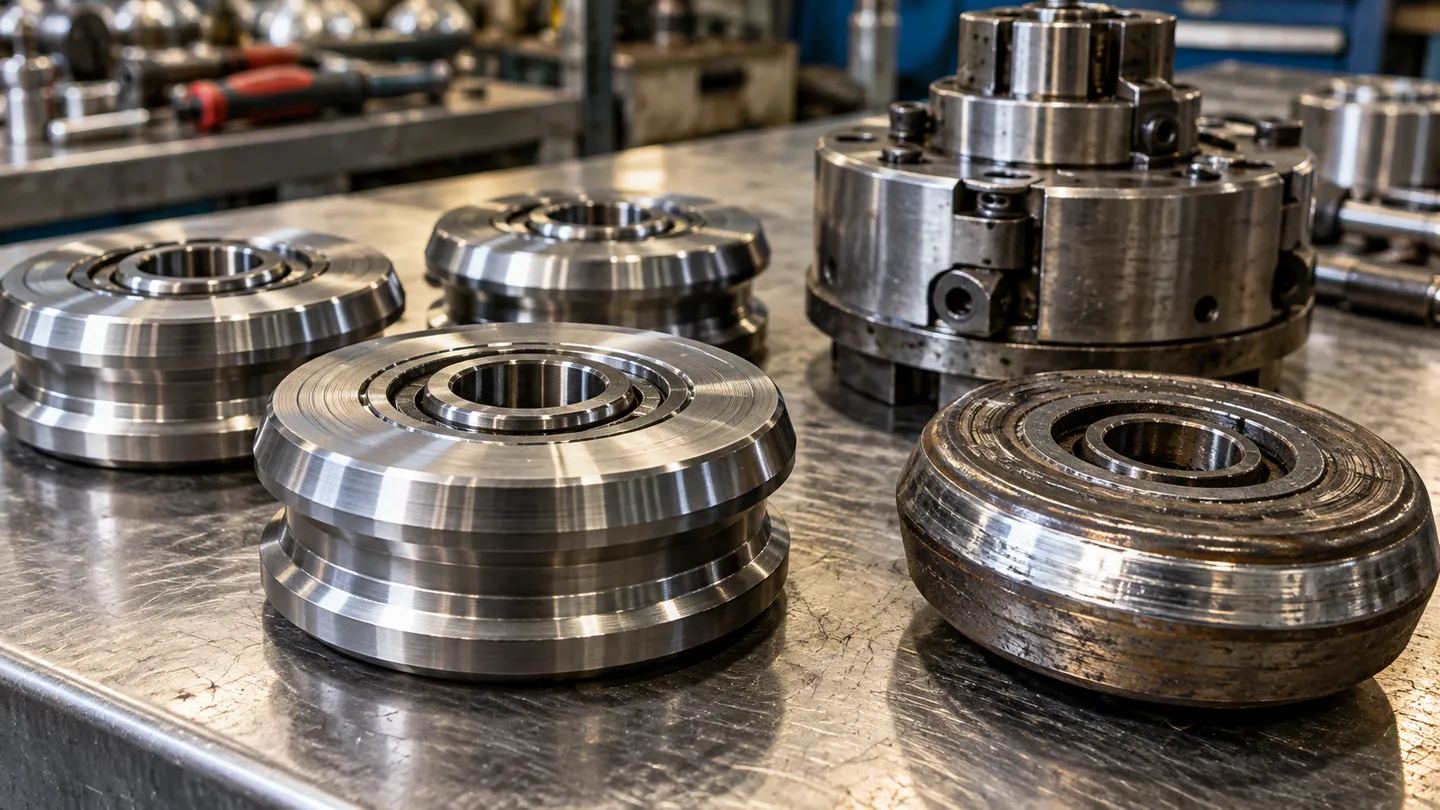
When to Replace: Counts, Not Calendars
The most expensive habit in spare parts management is replacing by calendar date. A schedule that says “change rollers quarterly” makes two assumptions at once: it guesses your production volume, and it guesses the life of the specific part you bought. When either guess is wrong, you either scrap parts that had work left in them or run parts into the ground. Both outcomes cost money, and the second one can cost a pallet of product.
Replacement Cycles Are Counted in Cans, Not Months
Wear parts measure their life in work done. Cans seamed, fills completed, caps torqued. So the number that matters is a count, and counts drift with conditions. The same machine that once logged more than 3 million cans on a set of seaming rollers now needs new rollers every 1.2 to 1.5 million cans, and nothing about the machine changed except how it was run.
Seaming roller life on one five-head rotary seamer
3,000,000+
cans per set, historical log
1.2-1.5 million
cans per set, current log
Same machine, running 46-47 cans per minute. Production brewery data via r/TheBrewery, 2023.
What makes the interval move? Lid and end batches change, and a switch to a different lid style can call for different roller and chuck specifications altogether. Line speed rises. Can or end suppliers change. Each of these moves the count at which a worn part starts producing defects. The practical response is to track cans the way you track batches: put a counter on the seamer, log the count at every roller change, start with a conservative interval, and tighten it to your own data within the first quarter.
The Teardown Is the Only Referee
Schedules and hunches both lose to measurement. A seam teardown cuts a finished can apart and measures what matters: first and second operation thickness, seam height, countersink, body hook, and cover hook. How often to measure is one place where no two plants agree. One line running an Angelus seam checks seam width and height every 30 minutes with a full teardown every 4 hours, while other crews tear down at startup and once per pallet (r/TheBrewery, 2019). The frequency matters less than the discipline: measure before you change a part and measure after, so you know the part actually fixed the seam.
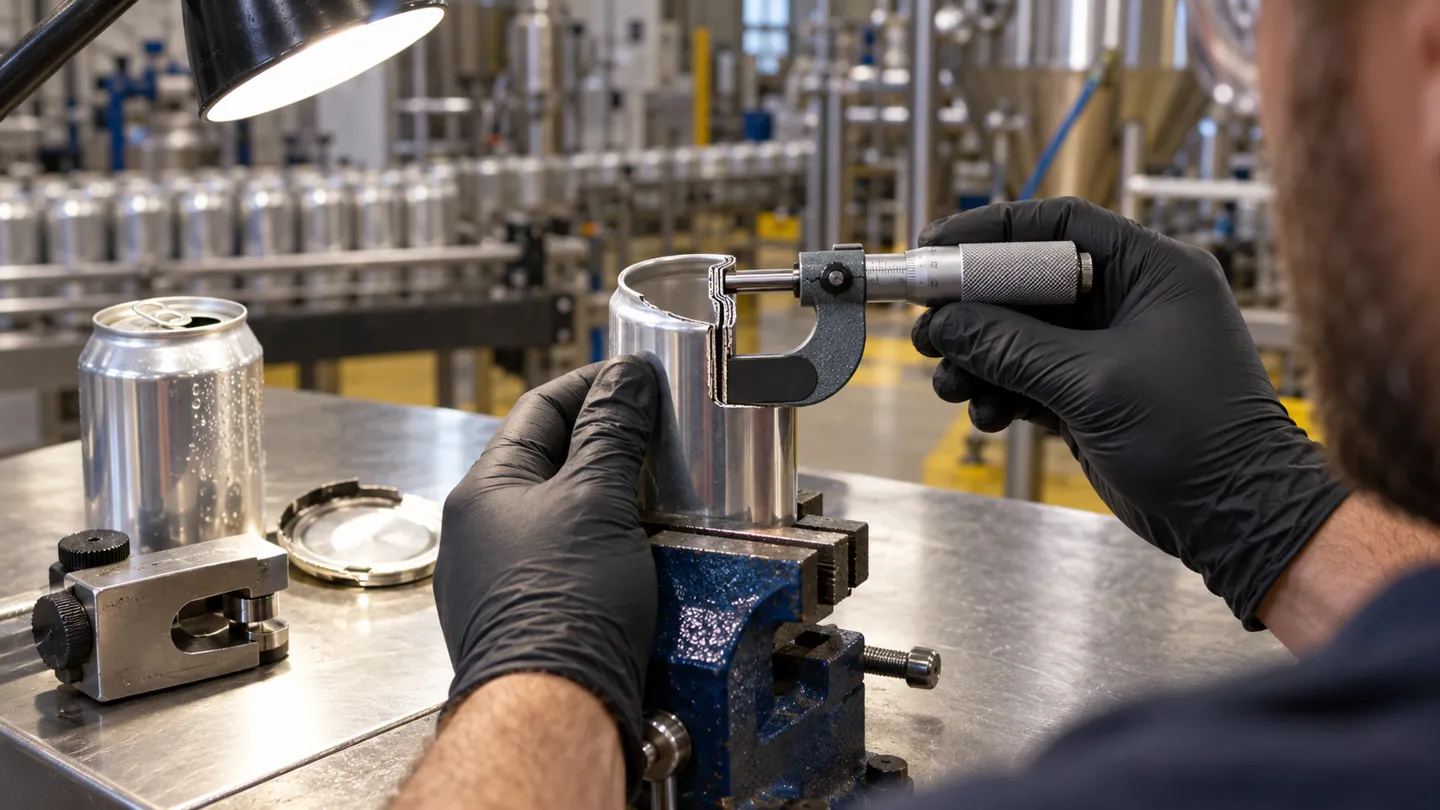
Stress tests screen, but they do not certify. A 75°C hot-water bath is a common pass-fail screen, yet in one real case cans that passed the bath still leaked downstream at the distributor (r/TheBrewery, 2023). Treat baths and visual checks as screening tools. The teardown numbers are what decide.
The calendar trap: a quarterly replacement schedule silently assumes both a production volume and a part life. When line speed, lid batch, or supplier changes, the calendar goes blind. Count cans instead, and let teardown measurements call the replacement.
Failure Signals That Beat Any Schedule
Some parts announce their wear between scheduled checks, and reading those signals is a maintenance skill worth building. A worn chuck tends to score the can wall just below the body hook; one brewery traced leaks in roughly one can out of ten to exactly this mark and fixed the problem in about two hours by swapping the swing arm and chuck assembly (r/TheBrewery, 2023). The checkable action: run a fingernail around the can wall below the seam on finished cans. Score lines mean the chuck, not the lid.
Slow pneumatic leaks are quieter and nastier. A lift cylinder that bleeds air can intermittently drop below the pressure the seam needs, producing occasional leakers that random sampling will never catch, while the failure rate climbs as the seal wears (r/TheBrewery, 2019). The action: foam the actuator and fittings with soapy water through several dry cycles and watch for bubbles, rotating the cylinder shaft as you go, because some seals leak at one position only. Dried product residue on a lift-plate seal behaves like sandpaper, so cleaning is part of the inspection.
Finally, watch how the parts move. A seaming tool needs at least three full revolutions properly engaged with the can; a tool that stops following the can leaves wrinkles under the lid that leak (r/TheBrewery, 2023). Check for lateral play in tool bearings by hand, and listen at speed: bearing noise from spindle or seam stacks is a more reliable early warning than any calendar.
Three field checks between scheduled teardowns
Score marks below the seam
Run a fingernail around the can wall below the body hook on finished cans. Score lines indict the chuck, not the lid.
Slow pneumatic leaks
Foam the lift actuator and fittings with soapy water through several dry cycles, rotating the cylinder shaft as you go.
Bearing noise and play
Check tool bearings for lateral play by hand, and listen at speed: bearing noise is the earliest warning you will get.
What to Stock: The Three-Tier Spare Parts Plan
You cannot stock everything, and you should not stock nothing. The sorting rule is two questions per part: how often does it fail, and how long does a replacement take to arrive. Both answers are well documented for this industry. Industry maintenance data traces roughly 60% of unplanned stops to worn seals, fouled sensors, and product jams, and lists realistic lead times: 2 to 4 weeks for specialty filler seals, 3 to 6 weeks for custom labeler rollers, and 4 to 8 weeks for programmable components like drives and PLCs (OxMaint, 2026). The same source puts the cost of waiting at an estimated $22,000 per hour of packaging line downtime, across lost production, labor, and missed deliveries, with the average line seeing 47 unplanned stops a week.
That second number is what a spare parts shelf is actually priced against. Here is the three-tier structure that falls out of it.
Downtime economics at a glance
$22,000
estimated cost of one hour of packaging line downtime
60%
of unplanned stops trace to worn seals, fouled sensors, and product jams
47
unplanned stops per week on the average packaging line
Industry maintenance data, OxMaint, 2026.
Tier 1: Wear Parts You Count and Stock
Convert the replacement cycles from the last section into shelf quantities. Your line speed times shifts gives cans per day, your tracked roller interval gives cans per change, and dividing one by the other gives weeks of cover per set. For a line at roughly 45 cans per minute, the 1.2 to 1.5 million can roller interval works out to one roller set roughly every three to four weeks of continuous running, so a two-set buffer is a defensible starting point until your own log tightens the number. For fillers, industry practice runs two to three complete seal kits per machine (OxMaint, 2026).
If you are a startup cannery buying your first machine, start simpler: take the kit that ships with the machine, add one extra set of the fastest-wearing items, and let the first quarter of production data correct you. Cash spent on the correct two or three extra wear parts is the cheapest insurance you will ever buy.
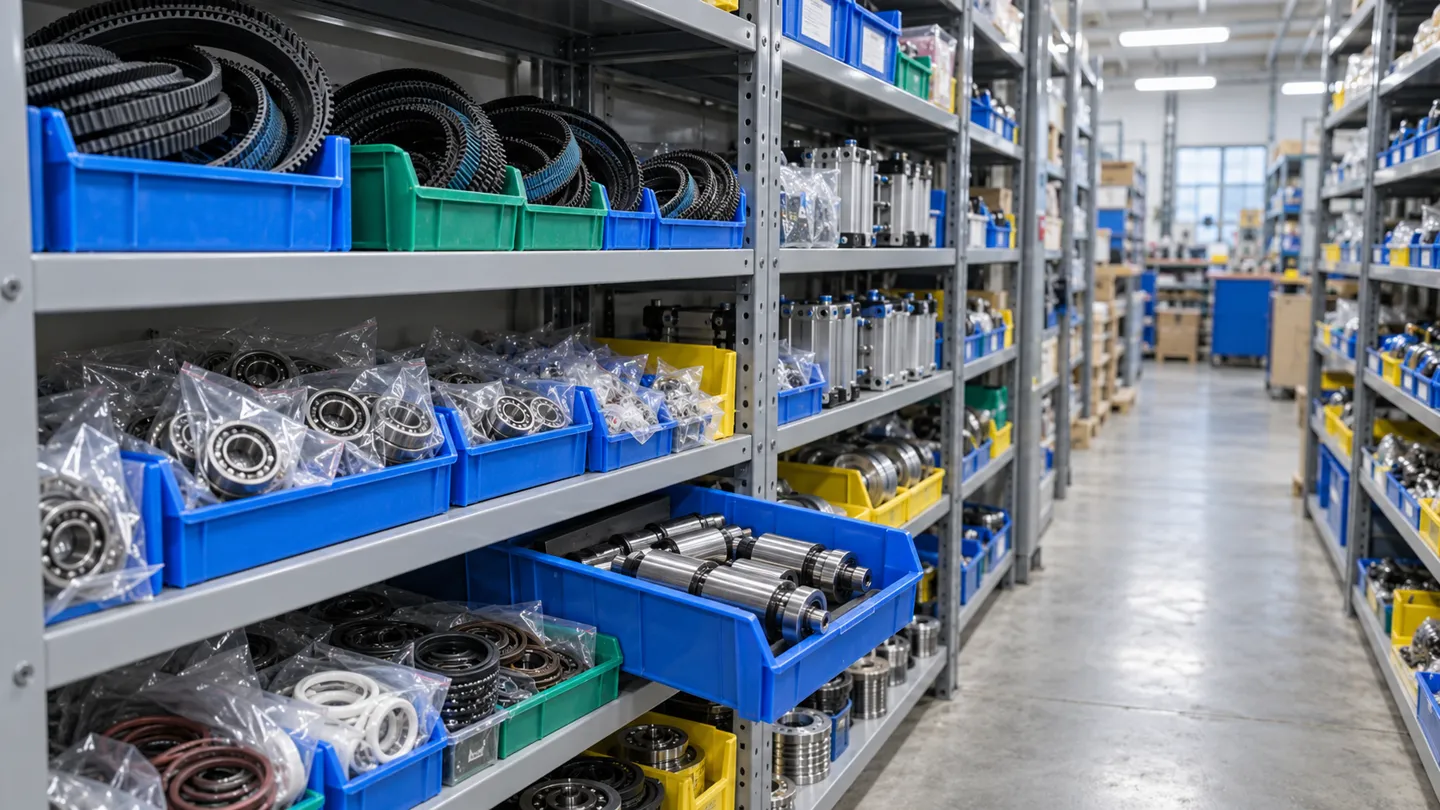
Tier 2: Criticals You Inspect and Order Fast
The second tier is parts that fail rarely but stop everything when they do: chuck and swing-arm assemblies, induction seal heads, sensors, servo drives, PLC components. The stocking rule from maintenance practice is blunt: keep stock of any part whose lead time exceeds two weeks and whose failure can stop the line (OxMaint, 2026). For everything shorter, negotiate a lead-time commitment with your supplier instead of holding the part, and keep at least one spare motor per critical machine (OxMaint, 2026).
When you take this tier to management, price the alternative. A spare PLC module with a 4 to 8 week lead time costs a few hundred to a few thousand dollars. A line down for a day is an estimated $22,000 an hour (OxMaint, 2026). The tier-2 shelf is not inventory carrying cost. It is production insurance priced at a tiny fraction of the risk.
What a First-Order Kit Should Include, and How to Receive It
Kits differ by machine family, and any supplier worth the order can tell you exactly what goes in yours. A can seamer kit centers on a roller set, a chuck, cylinder seal kits, and the belts and bearings that move the can. A powder filler kit centers on an auger, weigh bucket sets, nozzles, and piston seals. A capper kit centers on gripper pads, lid-feed fingers, and drive belts. The timing matters as much as the contents: the moment to lock this kit is the day you sign for the machine, when the kit, the part numbers, and the drawings can be written into one order at the best price you will ever get on them.
Receiving discipline closes the loop. Check part numbers against the packing list on arrival. Demand material certificates where they matter, 316 stainless for product contact parts, die steel grades for seaming rollers and chucks. Spin every bearing by hand and dry-cycle moving parts before anything goes on the shelf, because a defective spare discovered in storage costs nothing and the same defect discovered during a changeover costs a shift.
| Component | How it fails | Interval to track | Field signal | Stock tier |
|---|---|---|---|---|
| Seaming rollers | Contact wear, pitting | Millions of cans per set (start 1.2-1.5M conservative) | Seam measurement drift, noise at speed | Tier 1 |
| Chuck assembly | Scoring, face wear | Millions of cans; inspect with rollers | Score marks below body hook; ~1 in 10 leakers | Tier 2 (assembly) |
| Lift/seal cylinders | Internal seal wear | Per inspection | Intermittent leakers; foam test bubbles | Tier 2 |
| Auger flight | Edge wear from product | Cans or hours per filler data | Fill weight drift | Tier 1 |
| Weigh buckets | Wear, product buildup | Per filler data | Weight variance reports | Tier 1 |
| Gripper pads, lid-feed fingers | Contact wear | Cycles per capper data | Skewed lids, jams at infeed | Tier 1 |
| Belts, standard bearings | Fatigue | Per inspection | Noise, wobble | Tier 1 (local buy) |
| Sensors, drives, PLC parts | Electrical failure | Unpredictable | Alarms, intermittent faults | Tier 2 (lead-time rule) |
The matrix is a prioritization tool, not a stocking mandate. A single-shift semi-auto operation can run tier 1 as one set on the shelf and lean on a supplier lead-time agreement for everything else, while a three-shift high-speed line doubles the tier-1 counts. Your machine manual’s recommended spares list is the baseline; the matrix decides the order in which you buy toward it.
Before you sign any parts budget, five checks:
The pre-order spare parts audit
- Tier-1 counts converted from your own can counter, not from a calendar
- Tier-2 list matches the two-week lead-time rule
- Kit contents locked into the machine order with part numbers and drawings
- Receiving checks assign an owner (material certs, part numbers, dry-cycle)
- Teardown and count logs live in one place the maintenance team actually reads
This is also where a supplier either earns the machine order or doesn’t. Our own practice at Levapack is to treat the kit as part of the machine: every canning line we ship includes a spare parts kit covering the wear-prone consumables and the fundamental functioning parts, our electrical components come from brands like Omron, SEW, and Schneider so your team can source replacements locally as well, and before any seamer leaves the factory we run your actual cans through it for over 100 consecutive cycles and send you the test video. The kit, the part numbers, and the drawings arrive with the machine, and the wear parts behind them are covered by our spare parts kits and after-sales support for the first year under warranty.
How to Order Parts That Actually Fit
Most wrong-part orders are not supplier failures. They are information failures at the point of ordering. A complete parts inquiry carries three things: the machine nameplate with model and serial number, the drawing or part number of the component you need, and the working conditions it must survive, meaning line speed, can and lid type, product, and temperature range. The serial number matters more than people expect. It is what lets the supplier match your exact build instead of the closest catalog machine.
Where you buy from is a spectrum, not a binary. Original equipment manufacturers are right that precision matters; a seamer maker like Ferrum positions its spares as engineered to the same precision standards as the original machine (Ferrum). Independent parts houses answer a different problem: availability and breadth, with some stocking over 2,500 unique packaging machine parts across machine types (Kwalyti). Both are useful. The discipline is knowing which part class belongs in which channel.
| Sourcing tier | What you verify | Best for | Watch out for |
|---|---|---|---|
| OEM original | Serial number match, factory part number | Seam-critical parts: rollers, chucks, control components | Longest lead times on discontinued models |
| Certified compatible | Drawing match, material certificates (die steel grade, 316 stainless), dimensional tolerance | High-wear consumables at volume, discontinued OEM parts | Suppliers who cannot produce a material certificate |
| Generic standard | Catalog spec match (belt section, bearing code) | Belts, bearings, pneumatics, fasteners | Substituting generic parts in seam-critical positions |
That table resolves the genuine-versus-aftermarket argument the way maintenance teams actually live it. Seam-critical and product-contact parts, meaning rollers, chucks, and anything touching food, justify OEM or a certified compatible part with material documentation. Standard transmission and power components are commodities; overpaying for a branded bearing code that three manufacturers produce identically helps nobody. One boundary is absolute: a product-contact seal without a material certificate does not go on the machine, whatever the discount.
Discontinued machines follow the same logic one step further. When the OEM no longer supplies a part, the drawing and material spec become the ordering basis, and the first article gets trial-fitted and tear-down verified before you order a batch. Distributors can apply the same structure on the supply side: stock your catalog by the three stocking tiers from the last section, and let drawings plus material certificates be the entry bar for any compatible part you resell.
Send Levapack your machine nameplate and the part number you need, and our engineers will confirm fit, material certification, and lead time before you order.
Check My Part FitThe Business Math of Spare Parts
Read back through the facts this guide has established and they assemble into a ledger. Wear parts have countable lives, and those lives drift with conditions: 3 million cans on a roller set became 1.2 to 1.5 million without anyone changing the machine. Missed drift is not an abstraction: it produced crushed pallets, a month of rented mobile canning capacity, and at least one recall. A stopped line costs an estimated $22,000 an hour, and most of those stops start in parts small enough to hold in one hand (OxMaint, 2026).
The conclusion is that a spare parts budget is not a cost line. It is the price of insuring production against a known and quantified failure mode, and like any insurance, it is cheapest the day you buy the machine. That is the one moment when you hold full bargaining power over kit contents, spare parts pricing, documentation, and wear-interval guidance, because the supplier wants the order more than they will want the third-year parts shipment.
So run procurement as one act instead of four negotiations: machine, spare parts kit, part numbers and drawings, wear intervals, all in the same contract. Distributors and trading companies can flip the same structure into a service: kit your customers’ lines by the three tiers, and the one-time machine sale becomes a recurring parts relationship.
Three questions to put to any packaging machine supplier before you sign: What exactly is in the spare parts kit? What is the lead time on the wear parts? And who answers, how fast, when the line stops?
We build canning lines this way ourselves: whether you order a single seamer or a complete line, we quote the spare parts kit, the wear-part documentation, and the drawings as part of the same order, which is exactly how our customization options for single machines and full lines are structured. If you are comparing suppliers, make them answer the three questions above in writing. Their answers will tell you more about the next five years of uptime than anything in their brochure.
Lock Your Spare Parts Kit Into the Machine Order
Tell Levapack what you pack and how fast you run it. We quote the machine, the wear-parts kit, the part numbers, and the drawings as one order, and every seamer is tested with your actual cans before it ships.
Quote My LineReferences
- OxMaint. “Packaging Machine Maintenance on the Production Line.” 2026. https://oxmaint.com/industries/manufacturing-plant/packaging-machine-maintenance-production-line
- r/TheBrewery (u/hoovus9 et al.). “Seamer issues or defective cans?” Reddit, 2023. https://www.reddit.com/r/TheBrewery/comments/yxcx8p/seamer_issues_or_defective_cans/
- r/TheBrewery (u/ShootsieWootsie et al.). “Can seamer sampling rates.” Reddit, 2019. https://www.reddit.com/r/TheBrewery/comments/bw1l2k/can_seamer_sampling_rates/
- Plan It Packaging. “The True Cost of Waiting: Why Spare Parts Matter in Food Packaging Operations.” 2026. https://www.planitpackaging.com/blog/the-true-cost-of-waiting-why-spare-parts-matter-in-food-packaging-operations
- Ferrum AG. “Genuine Ferrum Spare Parts for your Can Seamer.” https://www.ferrum.net/en/service/pa/spare-parts.php
- Kwalyti. “Packaging Equipment Parts & Repair.” https://www.kwalyti.com/collections/replacement-parts


 EN
 RU
 ES
 FR
 DE
 NL
 IT
 JA
 ID
 PT
 KO
 AR
 TH
 VI
 TR
 PL