
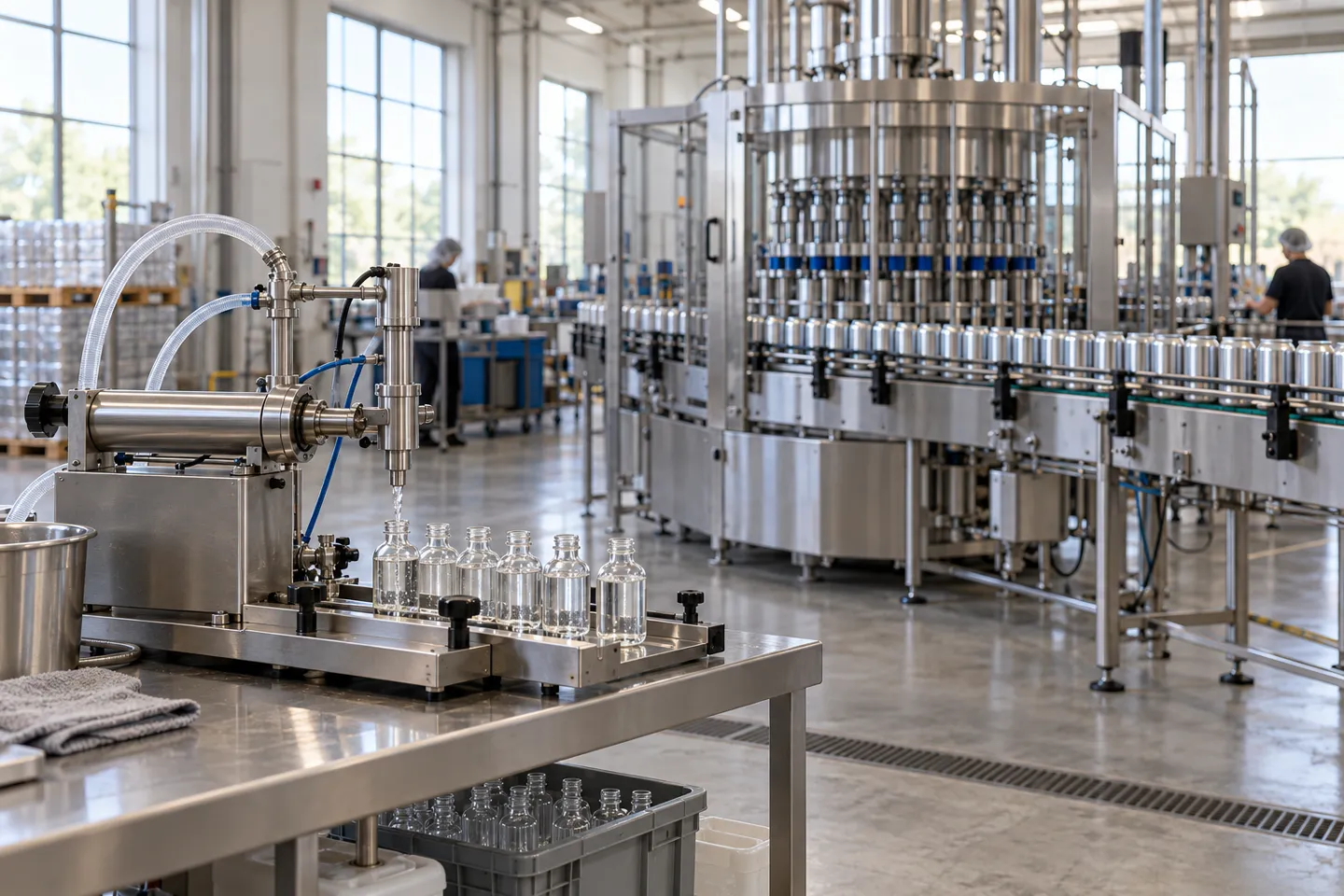
An $80 tabletop filler drips liquid into 2-ounce bottles on a workbench. A rotary can filler with six heads quotes north of $30,000 and never asks an operator to touch a container. Both products are sold under the same name: filling machine.
That naming overlap is why “how much does a filling machine cost” is such a hard question to answer honestly. The buyer pricing a first semi-automatic unit and the buyer budgeting a full line are shopping in different worlds. Most published price talk blends those worlds together. This guide keeps them separate. It then works through what actually moves a quote: the metering principle, the configuration, the way you buy, and the costs that show up after the invoice.
The Real Price Map of Filling Machines
Container format and production scale put you in a price tier before anything else happens. A benchtop unit fills 2-ounce bitters bottles. A semi-automatic piston filler handles jars of sauce. A fully automatic rotary line runs beverage cans. These are not versions of one product. They are different machines that happen to share a label. Marketplace listings for tabletop units start far below the industrial floor, under $150 (Amazon, 2026).
For liquid filling equipment, the industry usually splits the middle of the market into three tiers (Oden Machinery, 2025):
Filling machine price tiers (liquid filling)
| Automation level | Typical price | Typical throughput | Who it fits |
|---|---|---|---|
| Manual / tabletop | $1,000-$5,000 | 20-50 containers/hour | startups, labs, craft producers |
| Semi-automatic | $5,000-$20,000 | 50-200 containers/hour | growing producers with an operator per shift |
| Automatic | $20,000-$100,000+ | 200-3,000+ containers/hour | established lines with steady volume |
Two cautions before you use this table. First, it describes liquid filling. Powder and solid dosing equipment (auger fillers, net-weight weighers) sits inside similar bands, but prices step up with weighing hardware. Second, these are machine-body ranges. Tooling for your container, an air compressor, freight, and installation are not in these numbers. That is exactly why the gap between a quote and reality surprises so many first-time buyers.
Where you land in the table is mostly a throughput decision. The interesting question, and the one this guide spends most of its time on, is why two machines in the same tier can quote $5,000 and $18,000.
What Sets the Price Inside One Tier
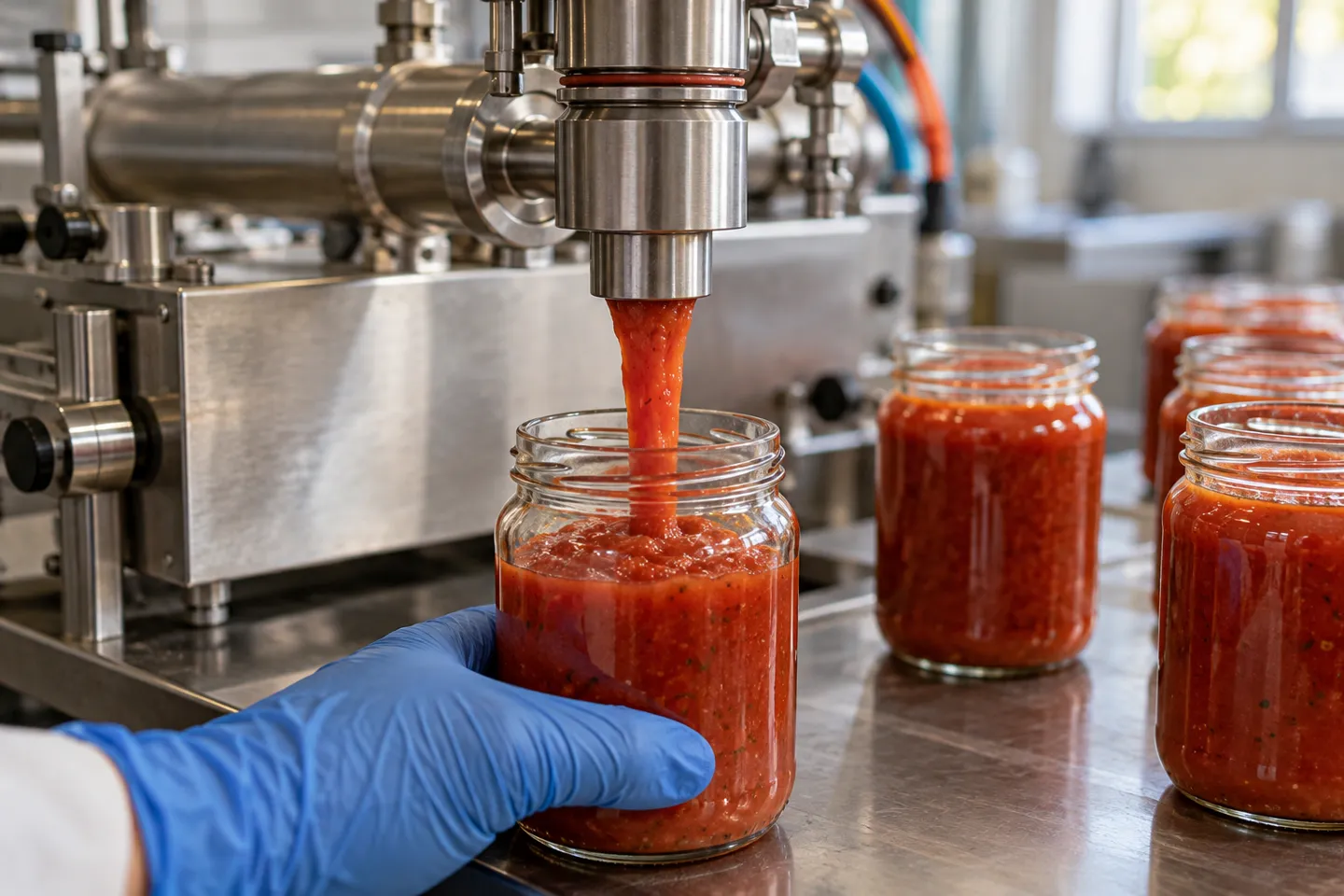
The biggest in-tier price driver is the metering principle, the mechanism that decides how much product goes into each container. From cheapest to most expensive: timed-flow or gravity fillers, piston (volumetric) fillers, auger fillers for powder, and net-weight fillers for granules and solids.
The logic is precision plus mechanics. A timed-flow filler counts seconds and is cheap because it is simple. But it inherits every inconsistency of your product’s flow rate. A piston filler measures a fixed volume, which is why typical volumetric accuracy lands near 1%. Auger fillers meter powder with a rotating screw and can reach about ±1 g on suitable products. Holding that number, however, takes dust control, hopper agitation, and product-specific screw geometry. Net-weight systems add load cells and a two-stage fill (a coarse fill, then a top-up), which is the most accurate and the most expensive common option.
Product behavior decides which principle you need, and the choice is not reversible with add-ons. Thin, stable liquids tolerate the cheap principles. Sauces and creams need pistons. Free-flowing versus fluffy powders need different screw profiles and agitation. If a salesperson quotes you on a principle that does not match your material, stop there. No amount of option-list negotiation will make it fill accurately.
So before comparing prices, write down your material’s behavior and your target fill accuracy. Those two lines determine which sub-range of a tier you should be looking at, and they are the first thing a serious supplier will ask about.
Should You Buy a Machine Yet
The most expensive filling machine is the one you bought a year too early. Before comparing quotes at all, run a three-step check that tells you whether automation pays at your current volume.
- Step 1: Price your labor honestly. At 8 bottles per minute a worker fills roughly 480 bottles an hour. US average hourly earnings for private-sector production and nonsupervisory employees were $32.60 in September 2026 (U.S. Bureau of Labor Statistics, 2026), so that hour of filling costs about $33 before benefits.
- Step 2: Check order certainty. One steady contract justifies equipment that seasonal or fluctuating orders do not; a candy producer on r/manufacturing upgraded only after landing a grocery chain account (r/manufacturing, 2025).
- Step 3: Size the machine to the next 18 months of known demand, not to the volume you hope for, and remember the filling machine is usually the most expensive station so the line should be designed around it.
The candid version of this check comes from practitioners, not vendors. In one discussion among small manufacturers, an automation-industry commenter put a US-built bottle filling and capping line at $25,000-$30,000 (r/manufacturing, 2024). The overseas-built equivalent, he estimated, costs roughly a third less even after shipping and tariffs. The same commenter advised buying overseas only if you have someone handy in-house to swap parts. Another commenter in the same thread argued that at 8 bottles per minute, paying a person is often cheaper than owning a machine. Automation only wins, in his view, when volume, labor cost, or time constraints make the math obvious.
That is the boundary to respect. If a machine would sit idle between orders, manual packing or outsourced labor keeps your cash free for the things that actually grow the business. Some buyers are bottlenecked by calendar time rather than money. That was the situation in that thread. There, a modest machine that frees you from the filling step can pay for itself in months.
Send Levapack your containers and hourly output, and an engineer will tell you honestly whether a machine pays for itself yet.
Ask an EngineerWhere a Quote Doubles: Configuration
Two quotes for the same output can differ by a factor of 3 to 10. The difference is rarely margin. It is configuration. These six areas are where the money hides, and each one comes with a question you should ask any supplier before comparing prices.
Weighing Feedback and Two-Stage Filling
Moving from simple volumetric dosing to weigh-and-topping-up means the machine corrects each fill against a target weight. For supplement powders and anything with a declared-weight requirement, it directly reduces product giveaway and underfill risk. Ask a supplier for measured fill accuracy at your target weight, not a brochure number.
Head Count and Throughput Band
Heads multiply output: a single-head powder filler covers roughly 20-35 cans per minute, a double-head configuration 50 or more. Buy the band you run daily rather than the peak you might reach. Do ask which change parts a frame needs to add heads later, because modularity is much cheaper than replacement.
Servo vs. Ordinary Drives
Servo drives buy you repeatable accuracy, faster changeovers through stored recipes, and fault warning before parts break. A line running one stable SKU gets little from them. A line cycling between products gets a lot. Ask a supplier to state changeover time in minutes for both drive options.
Material and Hygiene Design
304 stainless steel is the working standard. 316 earns its premium with salty, acidic, or chloride-heavy products. Frame plate thickness and surface finish decide how the machine ages under washdown. Ask exactly which contact parts are 316 and what the plate spec is. Treat clean-in-place design the same way: it is either in the welds and tubing or it is not.
Component Brand Tier
PLC, HMI, motors, and pneumatic parts from first-line makers (Siemens, SEW, SMC, Schneider, Delta, Omron are common choices) cost more up front. They pay back when your own electrician can buy and swap a failed part locally. Ask for the component list by brand, because “imported parts” is not a specification.
Customization and Change Parts
Custom engineering is the largest and least controlled price lever of all. It covers unusual container diameters, special can formats, and synchronization with upstream and downstream machines. Custom is sometimes the only correct answer, but get the scope in writing: what is being customized, what stays standard, and what a future format change will cost.
Configuration payback matrix
| Configuration | Worth the premium when | Check this if it doesn’t apply |
|---|---|---|
| Weighing feedback + top-up | high-value powder or declared-weight rules | confirm accuracy spec at your target weight |
| Extra heads | daily demand above one head’s band | ask which change parts enable a later add |
| Servo drives | frequent SKU changeovers | ask stated changeover minutes per option |
| 316 contact parts | salty, acidic, or chloride products | ask which parts are 316 and plate thickness |
| First-line components | no local service network | ask for brand-by-brand component list |
| Custom tooling | container outside standard ranges | get custom scope and standard baseline in writing |
Keep this matrix next to any quote. A supplier who will not answer the questions in the third column is not cheaper. The missing answers are just unbilled costs waiting for you after installation.
Three Ways to Buy: New Direct, Brand, Used
The same requirement can be met three ways. You can buy new direct from a manufacturer (most commonly from China), buy new from a local brand or integrator, or buy used. The price differences between these routes dwarf configuration differences, so this choice deserves the same rigor.
Three ways to buy a filling machine
| Dimension | Direct from manufacturer | Local brand / integrator | Used market |
|---|---|---|---|
| Indicative price | lowest machine-body price | highest ($25-30k class for lines) | mid-range |
| Lead time | weeks of production plus ocean freight | often longest queue | immediate availability |
| Service response | remote-first, timezone-dependent | fastest, onsite | depends on seller |
| Parts | ship internationally, kit included by good suppliers | local distributors | legacy-dependent |
| Best for | buyers with in-house maintenance skills | buyers who need hands onsite | standard formats with known wear history |
The Landed Cost Behind a Quote
A machine-body price is not a landed cost. The landed build-up is: FOB machine price, ocean freight, import duty, installation and commissioning, operator training, and the first year of spare parts. Practitioner estimates put the direct-import route roughly a third below a comparable US-built line even after shipping and tariffs (r/manufacturing, 2024). Duty rates vary by machine class and destination, so confirm the applicable rate by HS code before comparing two quotes from different countries. A qualitative “duty included” claim in a quote is not a number you can bank.
Where the Used Market Fits
Specialist marketplaces list filling machines roughly in the $5,000-$50,000 band depending on type, capacity, and automation (LabX, 2026). Used equipment works well for mature, common container formats where wear is inspectable and change parts are still in production. It works badly for specialized formats or discontinued machines, where a worn change part can idle a line longer than new-machine lead time.
Whichever route you choose, write the service terms into the comparison, not into the fine print. Compare remote diagnosis, guaranteed response hours, and who pays for a site visit. A direct import is only genuinely cheaper if those terms are explicit, because one unsupported breakdown can consume the entire price advantage.
Protect the Money You Spend
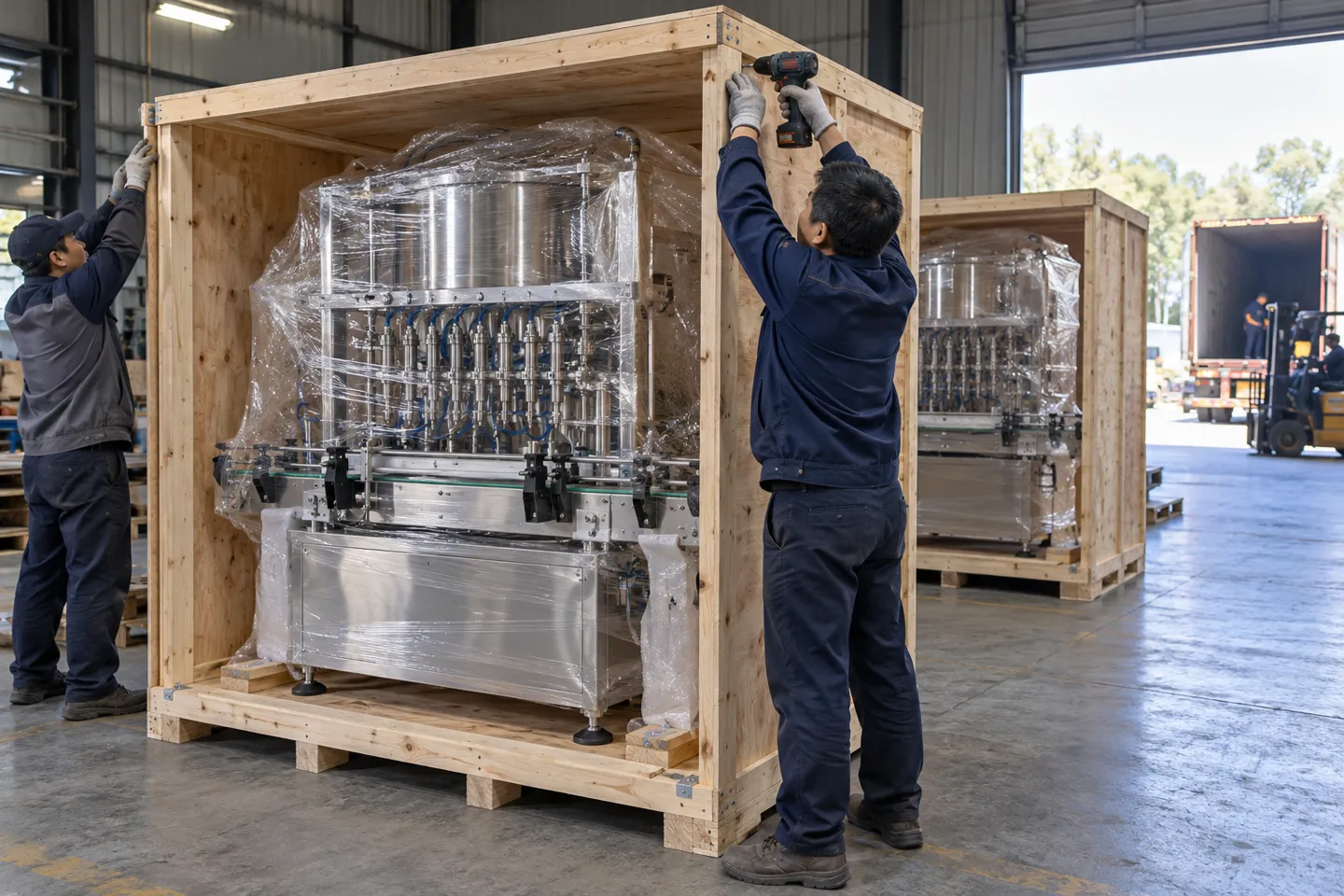
Once a supplier is shortlisted, the remaining risk is contractual, not technical. These five confirmations, all done before the final payment, are where buyers protect their budget.
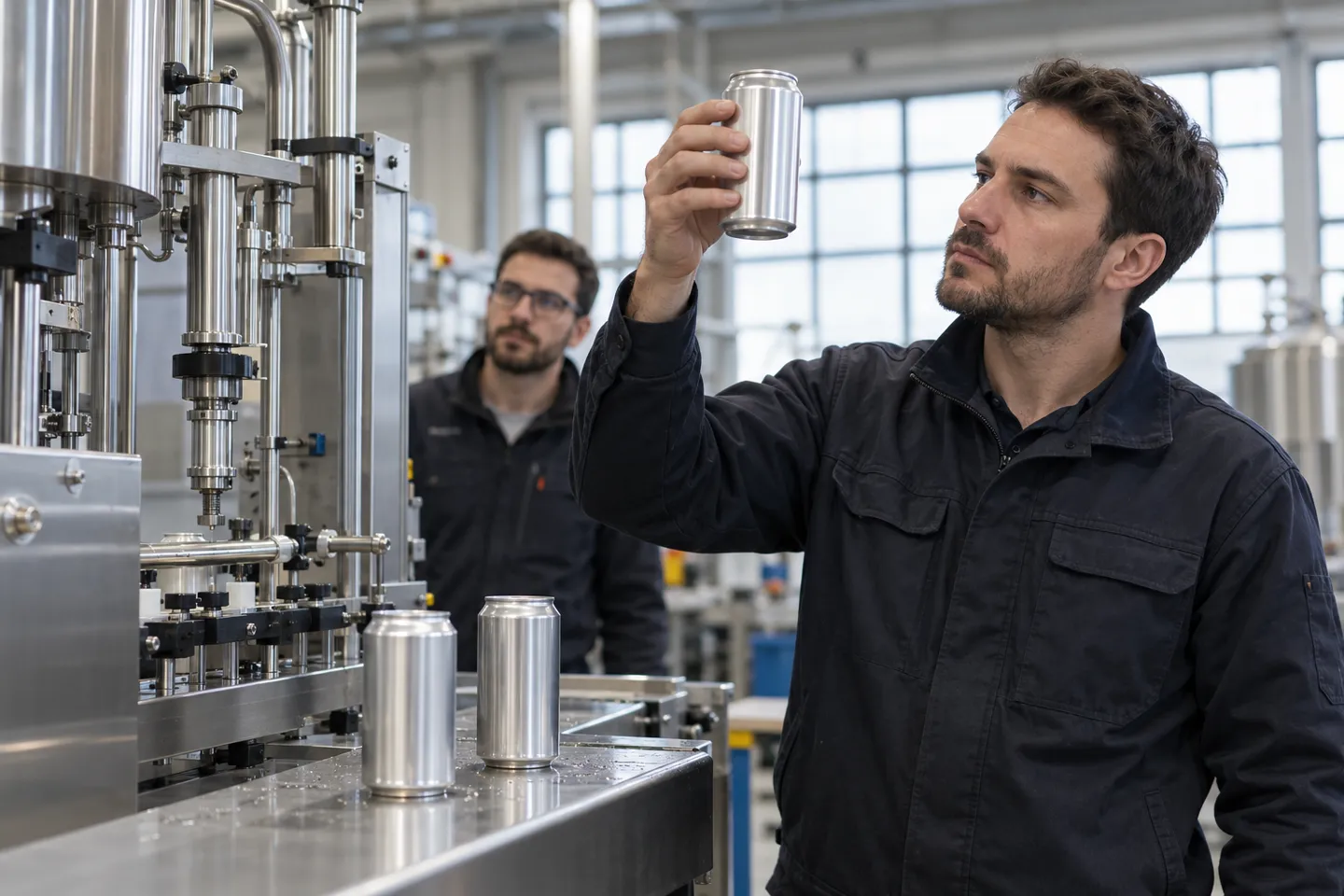
- 1. Trial run with YOUR containers: require a factory test on your sample cans or bottles, video recorded, with 100+ consecutive cycles as a reasonable bar; established suppliers will meet it.
- 2. Warranty, read line by line: total period (often one year), what counts as wear parts, remote diagnosis response time, and who pays for onsite service.
- 3. Buy the spare parts kit with the machine: consumables and fundamentals in one box cost far less than a stopped line waiting for international shipping.
- 4. Installation and training method: online guidance, onsite engineer, or both, and who pays travel.
- 5. Payment tied to acceptance: hold a final portion until the acceptance test passes at your site.
The hidden-cost list completes the protection. Tooling and change parts for a second container size sit outside the quoted machine price. So do an air compressor, electrical adaptation to your plant’s power standard, and shipping charges on replacement parts. None of them is large alone. Together they are big enough to flip a comparison made on machine price alone. Buyers who price them at quotation stage compare offers on equal terms instead of discovering them at commissioning.
The Five-Year Math
Every figure in this guide points at one comparison method: total cost of ownership over five years. Two machines whose quotes sit three times apart can reverse places once those columns are added, because the cheaper quote often means thinner service, weaker components, and more downtime.
Total cost of ownership, five years
Three times apart on paper. Reversed after five years.
Machine price
Landed-cost gap
Five years of spares and wear parts
Stopped hours
Future change parts
The same math disciplines configuration choices. An upgrade pays for itself when it returns its premium within roughly two years of operation. Weighing feedback on a declared-weight product clears that bar easily. A fourth filling head on a line that runs one shift may never clear it. The practitioner estimates in this guide, a third less for direct import, $33 an hour for production labor, 100+ test cycles before shipment, are all inputs to this one calculation, not separate decisions.
Before you request quotes, send suppliers six facts so the replies arrive comparable. List your material and its behavior, target output in containers per minute, container dimensions and closure, factory conditions, available power and air supply, and your target budget band. Vague inquiries collect vague quotes, and vague quotes are where the 3x to 10x spread begins.
Six facts that make every quote comparable
1Material and its behavior
2Target output, containers per minute
3Container dimensions and closure
4Factory conditions
5Available power and air supply
6Target budget band
When we quote on that basis at Levapack, the conversation starts with your containers and output target. Our can filling machines and full canning lines are configured per application rather than sold off a price list. Our can filling equipment carries a 16-month warranty with spare parts kits and 24/7 support, which is how the five-year columns stay predictable (custom can packaging line case studies). The same per-application logic applies whether you need a single powder filler or a synchronized line (can filling machine configurations).
Price is a snapshot; the five-year math is the movie. Send the six facts, insist on the trial run, and let the total, not the quote, pick the machine.
If you want a second quote to run through this math, Levapack builds can filling machines and complete canning lines, with CE-certified sealing and capping equipment, for producers worldwide (Levapack).
Turn the Five-Year Math Into Your Quote
Send your six facts and get a configured can filling machine quote with a 16-month warranty, spare parts kits, and 24/7 support.
Request a Machine QuoteReferences
- Oden Machinery. “Liquid Filling Machine Price Guide: How Much Does a Liquid Filling Machine Cost?” 2025. https://odenmachinery.com/blog/liquid-filling-machine-price-guide/
- U.S. Bureau of Labor Statistics. “Employment Situation Summary, September 2026.” 2026. https://www.bls.gov/news.release/empsit.nr0.htm
- LabX. “Filling Machines For Sale, New and Used.” 2026. https://www.labx.com/categories/filling-machines-for-sale
- r/manufacturing (Reddit). “Automated bottle filling + capping line.” 2024. https://www.reddit.com/r/manufacturing/comments/18h5wvj/automated_bottle_filling_capping_line/
- r/manufacturing (Reddit). “Help Finding Machine To Fill Stand Up Pouch With Candy.” 2025. https://www.reddit.com/r/manufacturing/comments/1glrftw/help_finding_machine_to_fill_stand_up_pouch_with/
- Amazon. “Filling Machine” search listings. 2026. https://www.amazon.com/Filling-Machine/s?k=Filling+Machine


 EN
 RU
 ES
 FR
 DE
 NL
 IT
 JA
 ID
 PT
 KO
 AR
 TH
 VI
 TR
 PL