
Introduction
In modern manufacturing, precision is not merely a goal; it is an economic and regulatory necessity. Across the food and beverage, pharmaceutical, chemical, and cosmetic industries, the process of filling a container is a critical control point. It represents the final, tangible delivery of a brand’s promise to its consumer. To fail at this stage is to incur immediate and measurable loss—either through product “giveaway,” regulatory non-compliance, or the erosion of brand consistency.
The engineering solution to this business problem is the quantitative filling machine. This equipment moves beyond simple packaging and into the realm of high-speed, automated metrology. It is designed to solve the challenge of precision by dispensing a discrete, verifiable, and repeatable quantity of a product into thousands of containers per hour.
However, the selection of this critical asset is a complex engineering and financial decision. The optimal machine for dispensing honey is fundamentally different from one designed for pharmaceutical powders. This guide provides a technical framework for operations managers, engineers, and purchasing specialists to navigate this landscape. We will analyze the core filling principles, establish a methodology for technical comparison, and define the financial and operational questions that must be answered to secure a successful investment.
Solving Precision: What Is a Quantitative Filling Machine?
Simply put, a quantitative filling machine is an automated system for filling a certain predetermined amount of product. The defining feature of a filling machine is the word “quantitative.” It is dispensed and controlled either by a specific measurement system of volume, weight, count, and so forth.
This key feature answers the following core business problems:
- Reducing Product Waste: For any CPG (Consumer Packaged Goods) company, “overfill” is a direct, non-recoverable financial loss. If a process dispenses 103 grams of product into a 100-gram package, that 3% overage represents pure, vaporized profit. A quantitative filler, by targeting the precise net weight, minimizes this “giveaway,” often delivering a return on investment (ROI) measurable in months, not years.
- Ensuring Compliance: On the contrary, “underfill” constitutes major legal and brand risk. The penalties applied by weights and measures authorities across the world are extreme for packages that are not compliant with the stated quantity. A calibrated quantitative filler brings both the compliance peril of fines and recalls and the peace of mind of regulatory assurance: the accuracy and, most importantly, the repeatability to satisfy every package compliant, every time.
- Consistency: Consumers learn through their experience. Trust is gained, and once broken, it is extremely difficult to restore. A bottle of sauce, a jar of cream, or a bag of coffee that is visible as fuller or emptier than its neighbors damages this trust. Trust that was gained through experience is lost more easily than it is gained. The precision filling helps alleviate disparity by ensuring every single unit is shipped as a consistent representation of the brand.
For this reason, quantitative filler is more than a piece of integration. It is a fully integrated qualitative cost-control system, crucial to scale a manufacturing operation profitably and safely.
The 4 Core Filling Principles Explained
The filling machines are available in various forms, with each required to fill a certain product based on the product form, be it in liquid or powder, or paste. Four principles prevail in the filling process in quantitative filling: piston fillers, auger fillers, net weight fillers, and flow meter fillers. They all have a dosing mechanism and level of accuracy, as well as a range of applications, and this guarantees that the manufacturers can choose the most effective technology to use in their production lines.
Piston Fillers: Best for Viscous Products
Piston filling machines are used in viscous or semi-viscous materials like creams, sauces, gels, and oils. They work on the principle of a piston and cylinder, which forces a sample of a specific amount of liquid or paste in and out. This mechanical operation is very repeatable and very precise, and is used as paste filling machines and liquid filling machines in the food, cosmetics, as well as pharmaceutical industries.
These machines are built mostly of stainless steel and are hygienic and durable and at the same time of high sanitary standards. The filling level and filling head can be adjusted by operators to different sizes of containers to increase flexibility in production lines. Their consistency reduces wastage of products and leads to high-quality products, and at the same time offers reliable performance and convenience in manual and automatic filling systems.
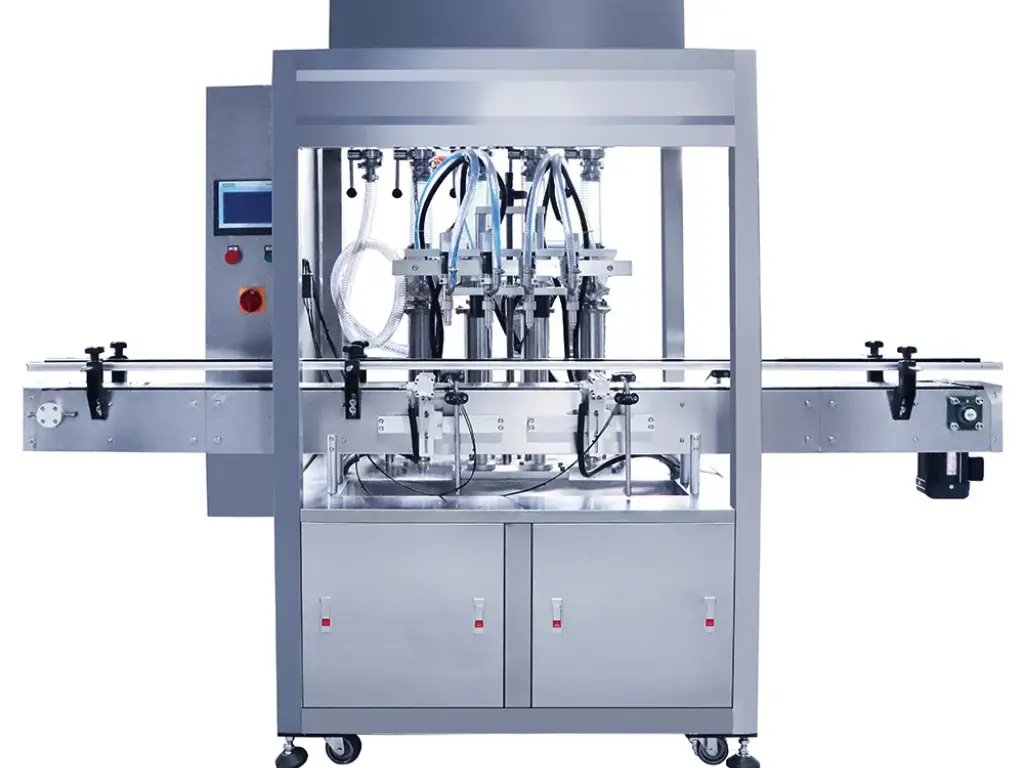
Key Features:
- Model: LPE-VFM006
- Piston Filling Type: Piston cylinder with low wear metering cylinder, for maintenance-free operation.
- Multi-Compatibility: Ideal for everything from water to cream, including pastes like tomato sauce, chili sauce, and honey.
- Easy to Use: Easy operation with an imported PLC and a user-friendly interface.
- Wide Application Range: Suitable for industries like food, edible oil, pharmaceuticals, daily chemicals, and pesticides.
Auger Fillers: The Standard for Powders
Used for items like flour, coffee, and protein powders, auger filling machines work best for filling dry, powder, and granular materials. The auger screw effectively regulates product flow and dosage by rotating at a predetermined speed. This system significantly reduces product waste and works even when filling products with varying flow properties.
Constructed from stainless steel, auger filling machines meet product quality and reliability standards for different sectors. The auger system design works with both linear filling machines and fully automatic filling machines, allowing seamless integration into automatic high-speed production processes. Systems can be tailored to different levels of automation to balance production line efficiency and labor cost reduction.
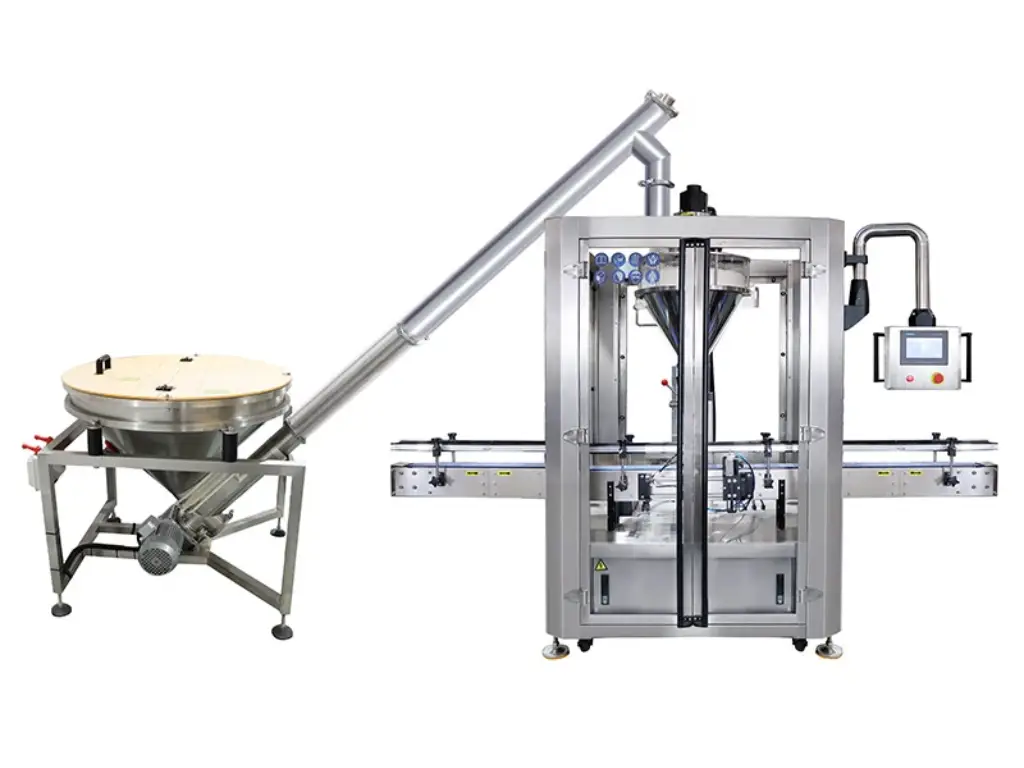
Key Features:
- Model: LPE-PFM001
- Boost Productivity: Fills 20-35 cans per minute.
- Automotive: Automatically complete powder feeding, quantitative dispensing.
- Easy Clean: Easily accessible and cleanable hopper without tools.
- Durable: All parts, the servo motor, and screw, made from robust stainless steel.
- Changeable Auger: Accurate dispensing of various powder materials.
- Vibration Feeding: Smooth material flow due to the integrated vibration feature.
Net Weight Fillers: For High-Value Products
Net weight fillers provide accuracy unmatched by volume-based systems, making them ideal for high-end and sensitive products like specialty oils, pharmaceuticals, and chemicals. Instead of measuring by volume, these systems utilize load cells to deliver product weight and ensure equal and precise quantities per unit, overfill elimination, and reduced product waste.
Net weight filling machines are built to last with their stainless steel enclosures and precision sensors. They are reliable and adaptable to different industry standards and compliance requirements. They help maintain hygiene and product integrity, whether filling liquids, solids, or semi-viscous products. Work seamlessly in modern automatic filling lines where there is dependable net weight accuracy and increased operational efficiency.
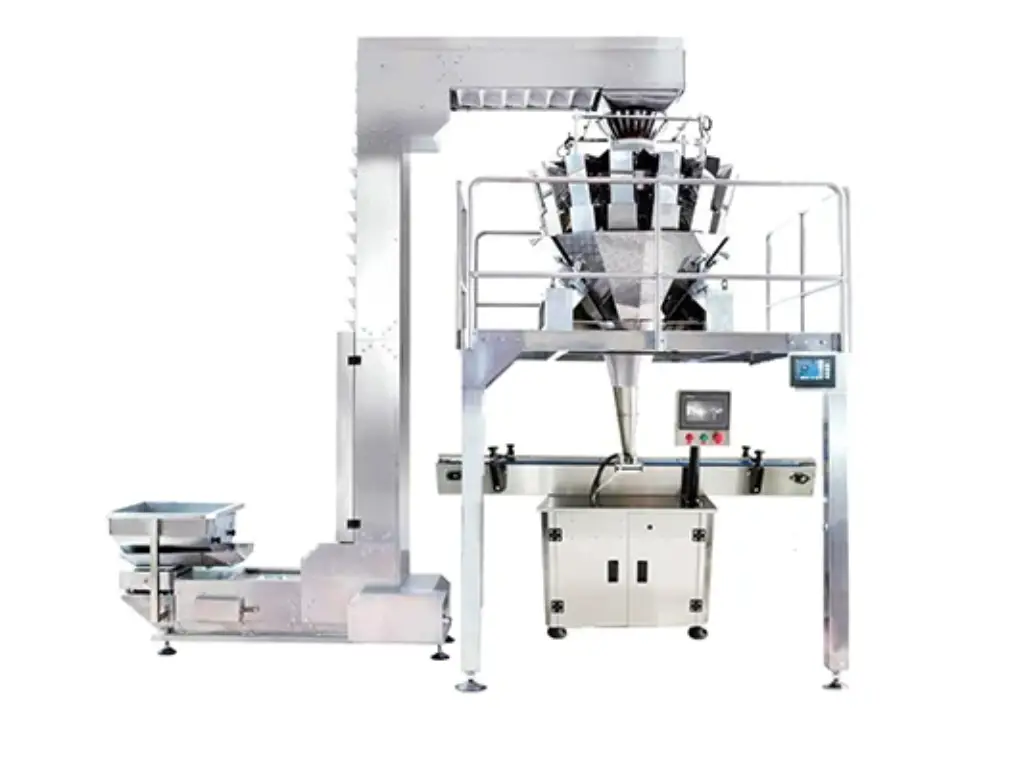
Key Features:
- Model: LPE-SFM014
- Maximum Speed: Up to 60 cans per minute.
- Safety Platform: Thick stainless steel with an anti-slip design for increased safety.Thick stainless steel with an anti-slip design for increased safety.
- Specialized Sensors: High-precision, high-standard special sensors.
- Smart Calibration: Factory parameter reset functionality and multi-level weight calibration support.
- Automatic Refill Control: Pauses operation in case of material shortage.
- Rejection System: Diverts off-weight materials to a separate exit, zero waste.
Flow Meter Fillers: High Speed & Versatility
The flow meter filling machines are high-speed and high-precision machines. They are used to measure the amount of liquid that is passing through a calibrated meter, which makes them suitable in oil filling machines, beverages, and industrial chemicals. This technique keeps the level of liquid under strict control even in the case of low-viscosity or middle-density products.
Flow meter systems are often combined with either pump filling machines or positive displacement pumps to maintain constant performance and results. They are flexible and can be used to deal with glass bottles, plastic containers, or flexible pouches with minimal changes to their setup. Efficiency and ease of use have been put together to come up with a machine that is clean yet has a long life of stainless steel and precision that are technologically advanced, such that these machines are regarded as one of the most advanced types of filling machines that are available in the market today.
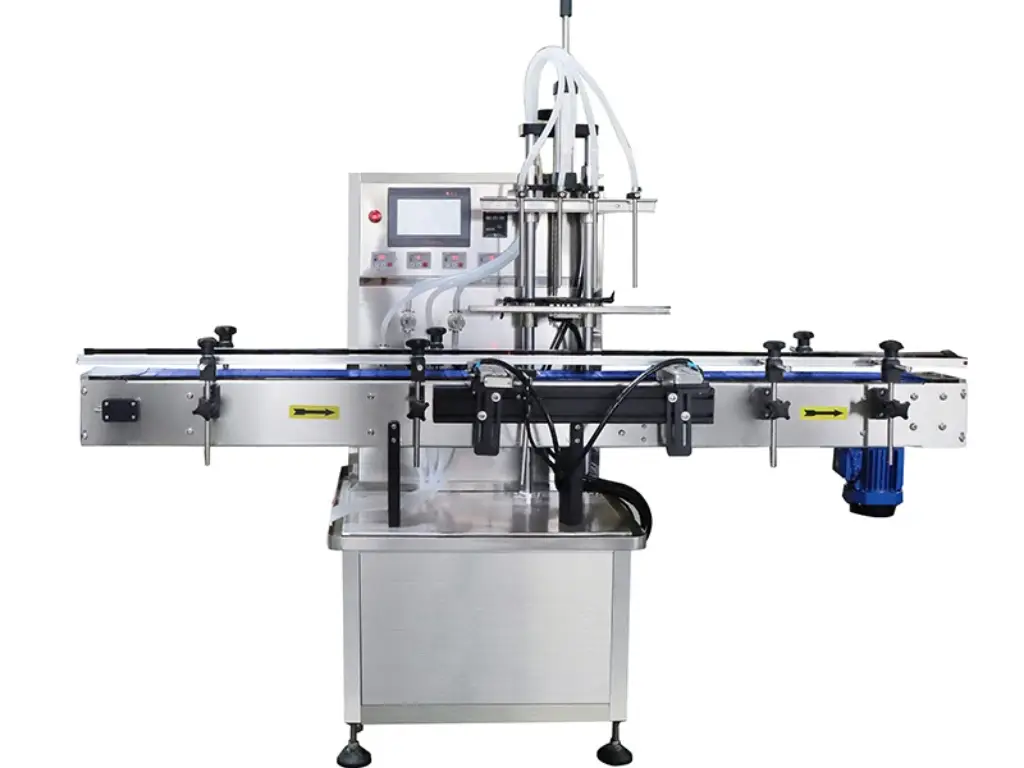
Key Features:
- Model: LPE-LFM006
- Boost Output: 20-35 cans/min with a precision of 1%.
- Custom Fit: Tailor the number of heads to meet specific requirements.
- Enhanced Capacity: 6 filling nozzles for efficient & accurate packaging.
- Flexible: Suitable for filling beverage & other free-flowing non-carbonated liquids into the tin, aluminum & PET round cans.
- Advanced Automation: Adopting automation technology, importing PLC, sensor, pneumatic components, the machine is efficient, intelligent, with wide adaptability and good stability.
Tech Comparison: Which Filler Is Right for You?
Finding the best filling equipment requires you to align your packaging type, filling technique, and volume targets with the appropriate technology. The versatility, accuracy, quickness, and cost of the technology have to be considered, as each type of filling equipment has its own pros and cons. By considering these different variables, companies can streamline production, minimize waste, and improve the overall quality of the finished product.
The guide below seeks to provide a brief, yet thorough, comparative guide to the different filling equipment technologies to aid in your decision-making.
| Principle | Primary Application | Typical Accuracy | Relative Speed | Relative Cost | Changeover / Cleaning |
| Piston Filler | Viscous Liquids, Pastes, Creams | Good to High (±0.5% – 2%) | Low to Medium | Medium | Difficult / Time-Consuming |
| Auger Filler | Powders, Granules | Good (±1% – 3%) | Medium | Medium | Medium (Requires hopper/screw cleaning) |
| Net Weight Filler | High-Value Products, Inconsistent Density | Excellent (±0.1% – 0.5%) | Low to Medium | High | Easy (Hopper/feeder only) |
| Flow Meter Filler | Low-to-Medium Viscosity Liquids | High to Excellent (±0.2% – 1%) | Medium to High | High | Excellent (CIP-capable) |
Looking at cost in isolation can be a costly mistake. For example, while a piston filler may have a lower cost of entry, in dynamic environments with frequent product changeovers, the expensive time savings from fast clean-in-place cycles of a flowmeter filler may deliver greater profits. Likewise, the “cheaper” auger filler that results in 3% product giveaway on a high-value protein powder will be vastly more expensive in the long run than a net weight filler that holds accuracy to 0.2%.
Factors to Consider When Choosing a Quantitative Filling Machine
The choice of the optimal quantitative filling machine is one that should be made with keen interest in several factors that directly influence accuracy, uniformity, and performance. The idea is to match the performance aspects of the machine with the physical nature of your product, the technical requirements of your production lines, and your long-term automation plan. The following list discusses the key factors that will dictate the best system that will support your filling process and business goals.
- 1. Product Characteristics and Liquid Properties
The first step towards identifying the appropriate quantitative filling machine is to know the liquid characteristics of your product. Piston fillers or pneumatic filling machines are best applied with thick materials such as creams or sauces, whereas gravity or flow meter fillers are applied to thin liquids. Auger filling is needed to make powders of a uniform dose. The correct matching of the type of filling, be it volume type, weight type, or liquid level type, to your type of liquid will guarantee correct dispensing and minimize wastage of the product, enhancing the product quality and ensuring efficiency of the production line.
- 2. Hygiene, Construction, and Material Selection
Industries such as food, cosmetics, and pharmaceutical construction require, use of stainless steel is necessary. It offers simple cleaning, resistance to corrosion, and durability. A quantitative filling machine with stainless steel contact components reduces the risks of contamination and makes its maintenance easier. Clean-in-Place (CIP) or quick disassembly systems minimize the time spent in the changeover. The quality of the product and the degree of meeting hygienic standards are directly influenced by the right construction material, which is why it is one of the basic aspects of any automatic filling facility.
- 3. Degree of Automation and Production Scale
The ideal degree of automation for a given process is primarily driven by the production volume. Small operations may still depend on manual systems, but larger production lines have to utilize automatic filling machines because, from a business perspective, it is the only way to reduce labor costs and improve consistency of the product. Precision in control of filling volume is guaranteed through the use of air compressors, sensors, and magnetic switches designed for automated systems. As a business practice, investing in automation of production lines to accommodate future business expansion is to improve the overall efficiency of the filling process.
- 4. Compatibility and Versatility
A contemporary quantitative filling machine is expected to process a large range of products and types of packaging. The filling heads are adjustable, and the modular design of the machine lines facilitates easy transfer between bottle filling machines, tube filling, or oil filling machines. Flexibility in terms of filling machine, as it can be compatible with glass bottles as well as plastic ones. This versatility reduces downtime, facilitates quicker product changeovers, and guarantees the quality of products in varying applications.
- 5. Ease of Use, Maintenance, and Operator Safety
A user-friendly quantitative filling machine will improve productivity and minimize errors. Easy-to-use interfaces, easy to calibrate, and stainless steel surfaces make it efficient to operate and clean. Safety measures such as emergency stops, overload protection, and control of the pneumatic filling enhance the reliability of the workplace. Minimal maintenance and easy access to the main parts decrease the time spent on downtime and increase the lifespan of the equipment, hence stable performance and a consistent output in the daily filling process.
Key Questions to Ask Your Filling Machine Supplier
When solving a problem, one part is the machinery and the other is the supplier. As such, the due diligence process should also include assessing the potential partner’s capabilities.
- Application & Material Testing: “Have you completed one of my exact products successfully before? Can we perform a material test at your location, using our product and our containers?”
- Changeover & Cleaning: “What is the specific, documented procedure for a full product changeover? What is the time required? Are tool-less changeover features available?”
- Acceptance Testing: “Do you perform a comprehensive Factory Acceptance Test (FAT) with our materials before shipping? Will you provide on-site support for a Site Acceptance Test (SAT) during commissioning?”
- Wear Parts & Lead Time: “Please provide a recommended list of critical wear parts (e.g., gaskets, seals, nozzles) and their guaranteed lead times.”
- Construction & Compliance: “What materials are used in all product contact zones? Can you provide mill certificates (e.g., for 316-L Stainless Steel) and compliance documentation (e.g., CE, ISO, CSA)?”
- Integration & Controls: “How will this machine interface with our upstream and downstream equipment? What PLC (e.g., Siemens, Mitsubishi) and HMI (e.g., DELTA) components are used, and are they serviceable in our region?”
- After-Sales Support: “What is the warranty period? What is the structure of your technical support? Do you offer 24/7 remote troubleshooting and regional on-site support?”
Finding Your Ideal Quantitative Filling Solution
Selecting the appropriate quantitative filling machine is not an easy but a complicated job. The process will start with a detailed examination of the physical characteristics of your product and will influence the choice of the fitting principle of fillings. This should then be matched to your operational and financial objectives of your business, with a balance of such factors as the speed of production, flexibility of changeover, and the overall cost of ownership.
The answer to this is rarely a one-size-fits-all product. It is a more personalized system, instead. It is essential to get involved with a manufacturing partner that has previous experience in the industry and is concerned with precision. Find a supplier that has control over the quality of its materials, including in-house CNC machining and utilises reliable and quality brands of important systems (i.e, SEW motors, SMC pneumatics).
An effective partner will provide OEM/ODM customization, whereby their designs will be modified to your specifications, as opposed to making a standard machine fit. Through masterful assistance, design for worldwide after-sales services, this partnership method makes your machine an asset worth retaining.
LevaPack‘s team is available to give you a free consultation and product analysis.


 EN
EN  RU
RU  ES
ES  FR
FR  DE
DE  NL
NL  IT
IT  JA
JA  ID
ID  PT
PT  KO
KO