
Le schéma directeur de la production : Qu'est-ce qu'une machine de remplissage ?
Vous pourriez penser qu'une machine de remplissage n'est qu'un entonnoir industriel perfectionné. En réalité, il s'agit de l'ultime goulot d'étranglement qui dicte le fonctionnement de votre ligne de production. Donner (trop-plein de déchets) et Efficacité globale de l'équipement (OEE). Ce guide évite le jargon commercial pour établir un système de coordonnées de sélection définitif basé directement sur l'état physique de votre matériau et les principes de mesure de base.
Pour établir une compréhension de base : qu'est-ce qu'une machine de remplissage ? Dans le contexte de l'ingénierie industrielle moderne, il s'agit d'un système d'emballage automatisé hautement intégré. Elle utilise des mécanismes mécaniques, pneumatiques ou servo-moteurs sophistiqués pour distribuer de manière cohérente, continue et précise des quantités mesurées de matériaux - qu'il s'agisse de liquides fluides, de pâtes très visqueuses, de poudres volatiles ou de particules solides délicates - dans des contenants tels que des bouteilles, des boîtes, des bocaux ou des sachets. Dans les secteurs alimentaire, chimique, pharmaceutique et nutraceutique, il s'agit de la pierre angulaire irremplaçable d'une fabrication évolutive.
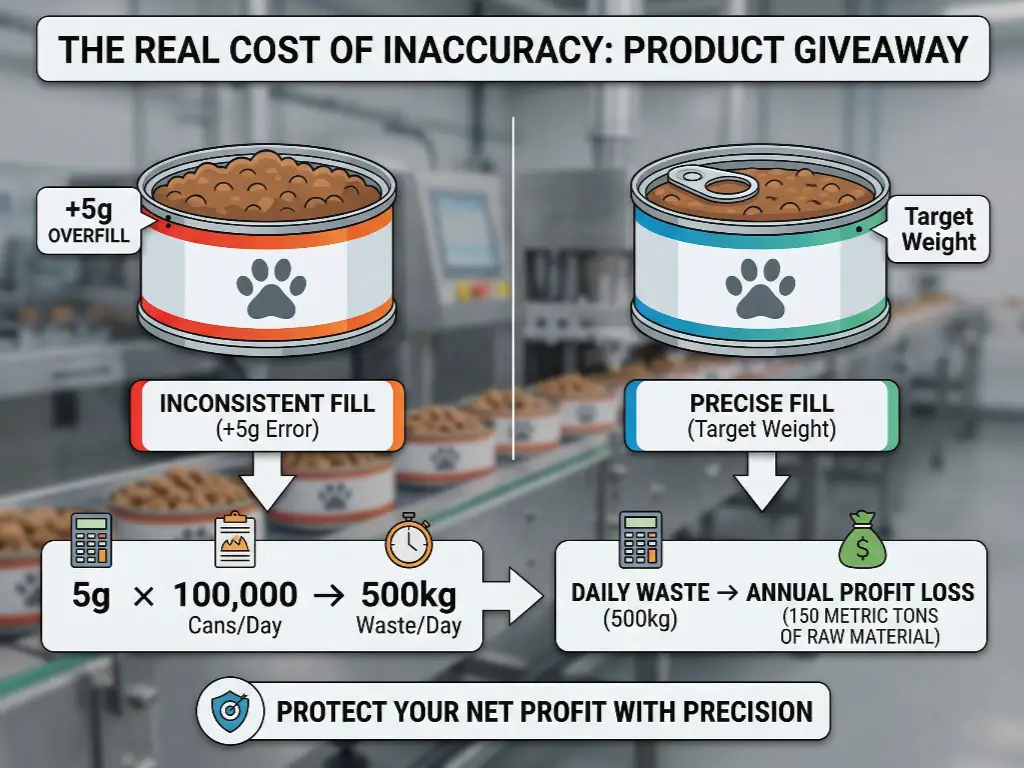
Pourquoi est-il le gardien ultime de la rentabilité ? Nous devons introduire un concept financier essentiel dans l'emballage B2B : Cadeau. De nombreux responsables des achats commettent l'erreur fatale de se concentrer uniquement sur les dépenses d'investissement initiales (CAPEX) de la machine, en ignorant complètement les coûts opérationnels (OPEX) invisibles et hémorragiques qu'elle encourra chaque jour.
Faisons une simulation de bac à sable commercial. Imaginez que votre entreprise produise des aliments humides pour animaux de compagnie de première qualité et à forte teneur en viande. En raison des lois strictes sur la protection des consommateurs, les opérateurs ont naturellement recours au "surremplissage" pour s'assurer que chaque boîte respecte le poids minimum indiqué sur l'étiquette. Si votre machine de remplissage de qualité inférieure manque de précision, il se peut qu'elle remplisse une boîte standard de 200 g de 5 grammes seulement. Si votre ligne de production tourne à 100 000 boîtes par jour, cette erreur de 5 grammes se traduit par 500 kilogrammes de viande crue de première qualité entièrement distribuée gratuitement, chaque jour. Au cours d'une année d'activité de 300 jours, votre établissement subit une hémorragie de 150 tonnes de matières premières de première qualité. Atteindre une précision absolue ne consiste pas seulement à passer un contrôle de qualité ; il s'agit d'un impératif financier fondamental pour protéger farouchement votre bénéfice net.
Volumétrique ou gravimétrique : la bataille pour la précision des mesures
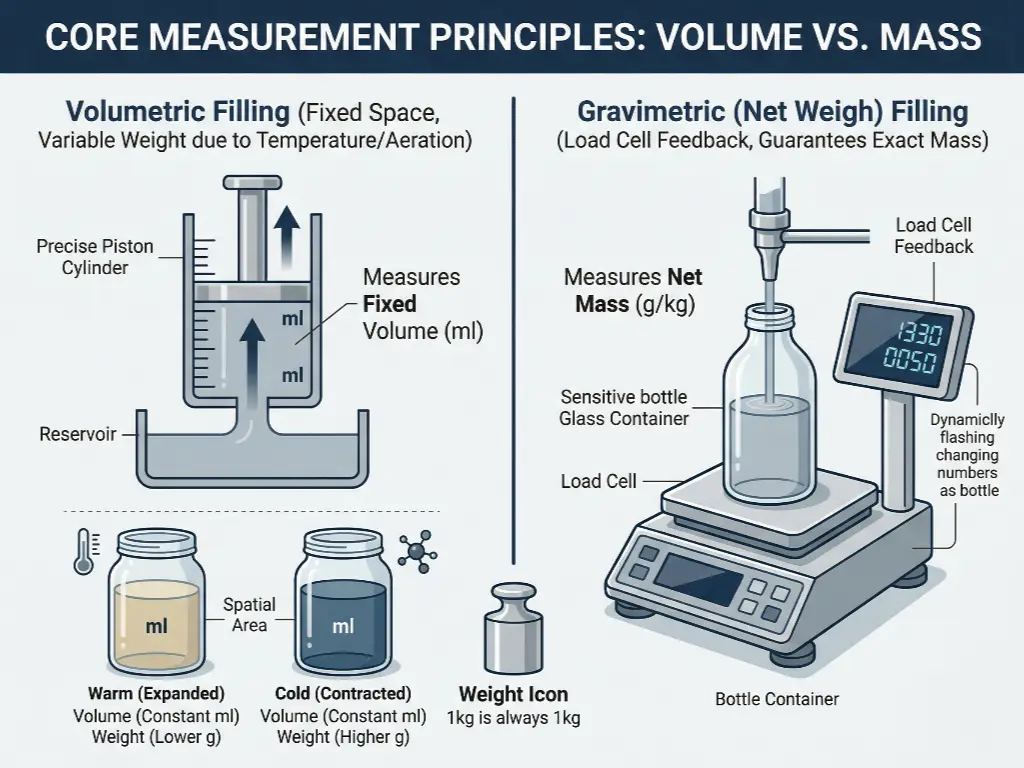
Avant de se pencher sur les types de machines spécifiques aux différents matériaux, il faut comprendre la logique technique sous-jacente de la mesure des machines. Il s'agit du clivage philosophique et mécanique fondamental dans l'industrie de l'emballage : La mesure volumétrique (par volume) et la mesure gravimétrique (par poids). Le choix que vous ferez ici dictera à la fois votre vitesse de production et votre marge d'erreur.
Remplissage volumétrique : Rapidité et simplicité
Remplissage volumétrique est la méthode la plus répandue dans l'industrie manufacturière mondiale. La machine est programmée pour fournir une mesure spatiale spécifique et invariable - par exemple, exactement 500 millilitres d'espace - quel que soit le poids réel du matériau. Son principal avantage est sa rapidité époustouflante et sa relative simplicité mécanique. Sans qu'il soit nécessaire de faire une pause pour que les balances sensibles se stabilisent, une ligne volumétrique peut fonctionner à des vitesses fulgurantes, ce qui en fait le choix incontesté pour les biens de consommation de grand volume.
L'angle mort caché : Le volume est trompeur. La principale vulnérabilité du remplissage volumétrique est sa cécité absolue aux fluctuations de densité des matériaux, en particulier celles causées par l'aération (bulles) et la thermodynamique (changements de température). Par exemple, dans une usine d'embouteillage d'huile alimentaire, l'huile se dilate dans la chaleur estivale de 35°C (la densité baisse) et se contracte dans le froid hivernal de 5°C (la densité augmente). Si votre machine volumétrique est verrouillée pour distribuer exactement 1 000 ml tout au long de l'année, vous mettez beaucoup plus de masse réelle (poids) d'huile dans la bouteille pendant l'hiver. Pour des millions de bouteilles, ce changement de densité dû à la température se traduit par un coût caché stupéfiant.
Remplissage gravimétrique : Précision et conformité absolues
Lorsqu'il s'agit d'emballer des matériaux de très grande valeur (cosmétiques coûteux, produits pharmaceutiques réglementés ou produits agrochimiques de première qualité), un seul gramme d'erreur est intolérable sur le plan financier ou juridique. Dans ces environnements rigoureux, Remplissage gravimétrique (remplissage au poids net) affirme sa domination absolue.
Les systèmes gravimétriques abandonnent le volume spatial et fonctionnent strictement sur la masse, intégrant des systèmes industriels incroyablement sensibles. Cellules de charge sous le conteneur. Au fur et à mesure que le produit s'écoule, la cellule de charge transmet les données de poids en temps réel à l'automate. Dès que la masse cible exacte est atteinte, la vanne se ferme. Un kilogramme est toujours un kilogramme, totalement insensible à la température, aux variations de densité ou aux bulles d'air. En outre, les systèmes gravimétriques haut de gamme exécutent rapidement les opérations de pesage. Étalonnage du poids de tare. Ils pèsent le récipient vide (qui varie intrinsèquement dans la fabrication du verre ou du métal), le remettent à zéro, puis distribuent la masse exacte du produit. Il s'agit de la seule solution technique viable pour une précision à tolérance zéro.
Décodage des technologies de remplissage : Faire correspondre la machine à l'état du matériau
Les principes de mesure fondamentaux étant établis, nous pouvons maintenant aborder la question de la compatibilité des matériaux. Vous devez inverser le processus de sélection en partant exclusivement de l'état physique, de la viscosité et de la dynamique des fluides de votre matériau spécifique.
Remplisseurs par gravité et par débordement pour les liquides à écoulement libre
Pour les liquides à faible viscosité et à écoulement libre (généralement inférieurs à 100 cps comme l'eau, les jus clairs et les solvants légers), Remplisseurs par gravité et les remplisseurs par débordement sont les standards de l'industrie. Les remplisseurs par gravité utilisent simplement un réservoir aérien et des vannes temporisées pour laisser le liquide s'écouler vers le bas. Ils sont rentables et idéaux pour les fluides en vrac non moussants.
Toutefois, pour les produits haut de gamme conditionnés dans des récipients en verre (spiritueux artisanaux, huiles artisanales), les Remplissage du trop-plein (Remplir à niveau) apporte une valeur commerciale visuelle massive. Les bouteilles en verre ont des parois internes d'épaisseur variable en raison des tolérances de fabrication. Si vous les remplissez avec exactement 500 ml (volumétrique), le niveau de liquide semblera inégal dans un rayon de vente au détail, ce qui criera au consommateur "contrôle de qualité médiocre". Les remplisseurs à débordement mesurent plutôt la hauteur physique. Le bec plonge, remplit jusqu'à une ligne cible exacte et aspire l'excédent de liquide dans le réservoir. Chaque bouteille en rayon présente un niveau de liquide identique et parfaitement aligné.
Pour les liquides très moussants tels que les shampooings ou la bière, les machines avancées utilisent les technologies suivantes Buse de plongée La buse plonge au fond du récipient et se rétracte lentement vers le haut. La buse plonge au fond du récipient et se rétracte lentement vers le haut, en maintenant son extrémité immergée sous la surface du liquide qui remonte, tuant ainsi efficacement la production de mousse de bas en haut.
Remplisseurs à piston et à pompe pour les produits de haute viscosité et les particules
Lorsque la viscosité d'un matériau passe de 10 000 cps à plus de 100 000 cps (crèmes épaisses, miel, adhésifs lourds), la gravité ne fonctionne plus. C'est le domaine de la Remplisseurs de pistons et les pompes à lobes rotatifs.
Imaginez une remplisseuse à piston comme une énorme seringue industrielle. Pendant la phase d'aspiration, le piston se retire, créant un vide violent qui entraîne la pâte épaisse dans un cylindre usiné avec précision. Pendant la phase de poussée, il s'inverse, extrudant la pâte épaisse dans le récipient avec une immense force mécanique.
Le piège de l'initié : L'instabilité pneumatique. Bien que les pistons pneumatiques soient omniprésents, ils présentent un point faible critique dans l'industrie : les fluctuations de la pression d'air. Lorsque d'autres équipements de votre usine puisent dans l'alimentation principale en air, la chute de pression soudaine entraîne une dérive de la vitesse de course du piston pneumatique, ce qui nuit à la précision de votre remplissage volumétrique. Pour les lignes de haute précision, il est impératif d'exiger de votre fournisseur qu'il installe un régulateur de pression d'air indépendant à l'entrée de la machine ou, mieux encore, qu'il passe à un système de contrôle absolu de la pression d'air. Piston asservi.
Pour les matériaux avec Particules solides (comme de la confiture de fraises ou des aliments humides pour animaux avec des morceaux de bœuf), les machines à piston équipées d'un système de contrôle de la qualité. Vanne rotative (vanne à trois voies) sont nécessaires. Les pompes à engrenages standard écrasent et réduisent instantanément les fruits et la viande en bouillie. La voie large et dégagée d'une vanne rotative permet aux morceaux entiers de passer à travers les phases de tirage et de poussée sans être pressés ou endommagés, ce qui préserve l'aspect haut de gamme du produit.
Remplisseuses à vis sans fin et à pesée nette pour poudres et granulés
Les poudres sont régies par la friction, l'humidité et la dynamique des particules en suspension dans l'air. Comme établi, vous pouvez les traiter en utilisant des méthodes volumétriques (tarière) ou gravimétriques (pesée nette).
Vous devez d'abord classer votre poudre. Poudres à écoulement libre (sucre, sel de mer, grains de café) s'étalent facilement et peuvent être traités à l'aide de remplisseurs de gobelets volumétriques plus simples ou de peseuses à têtes multiples. Poudres non fluides (farine, préparations pour nourrissons, protéines en poudre) sont très cohésives, sujettes à l'électricité statique et forment des amas profonds. Pour ces produits, le Remplisseur à vis sans fin (un mécanisme à vis volumétrique) est obligatoire. La vis rotative en acier inoxydable mord dans la poudre dense, l'entraînant vers le bas en fonction du nombre de tours.
Cependant, les poudres non fluides présentent souvent les caractéristiques suivantes Ponts (rat-holing), où la poudre forme un arc solide au-dessus de la vis sans fin, provoquant des remplissages vides. Les remplisseuses à vis sans fin professionnelles doivent être dotées d'un Agitateur-une lame d'agitation qui racle continuellement les parois de la trémie pour briser les amas et maintenir une densité uniforme de la poudre. En outre, comme les poudres fines génèrent des poussières explosives qui compromettent l'étanchéité, l'intégration d'un système d'aspiration à haute puissance permet de réduire les émissions de gaz à effet de serre. Système de dépoussiérage directement dans la station de remplissage est une nécessité critique pour la fermeture hermétique et la sécurité de l'usine.
L'ultime matrice de décision de la viscosité à la machine
Pour vous aider à éviter les tactiques de vente agressives et à faire correspondre votre matériau à son équivalent mécanique idéal, consultez cette matrice de décision Viscosité-Machine qui fait autorité :
| Type de matériau | Viscosité typique (Centipoise - cps) | Meilleure correspondance des machines | Non recommandé (à éviter) |
|---|---|---|---|
| Eau, alcool, bouillon clair, parfum | 1 - 100 cps | Remplisseur par gravité / Remplisseur par débordement | Remplisseur à piston (excessif, lent, inefficace pour les liquides semblables à l'eau) |
| Huiles alimentaires, sirops légers, huile moteur | 100 - 1 000 cps | Remplisseur de piston / Remplisseur de pompe à engrenages | Remplissage du trop-plein (peut provoquer un excès de mousse et d'aération lors du retour) |
| Shampooing, lotions, ketchup, moutarde | 1 000 - 10 000 cps | Remplisseur à piston pneumatique/servo | Remplissage par gravité (ne s'écoule pas ; le produit stagne dans le réservoir) |
| Beurre de cacahuète, miel lourd, confiture avec morceaux de fruits | 10 000 - 100 000+ cps | Piston robuste avec vanne rotative / pompe à lobes | Pompe à engrenages (écrase instantanément les morceaux de fruits ; risque de brûler le moteur) |
| Pâte épaisse, silicone lourd, mastic industriel | > 250 000 cps | Presse d'extrusion hydraulique | Tout produit de remplissage liquide/pâteux standard (défaillance mécanique catastrophique garantie) |
Conseil pratique d'ingénierie (le test de la coulée) : Si vous ne disposez pas d'un viscosimètre numérique, utilisez le "test d'écoulement" manuel. Versez votre produit dans un bécher à température ambiante. S'il éclabousse instantanément (eau), c'est que vous êtes dans la bonne voie. < 100 cps. S'il coule en un flux régulier et ininterrompu (sirop d'érable), vous êtes à ~1 000-5 000 cps. S'il refuse de s'écouler sans être pressé ou ramassé (dentifrice épais), vous êtes à plus de 1 000-5 000 cps. 50 000 cps et nécessitent un piston ou une technologie d'extrusion très robuste.
Au-delà du remplissage : conformité sanitaire et intégration de la CIP
Ne vous contentez pas d'évaluer une machine en fonction de son fonctionnement ; évaluez de manière critique son comportement lorsqu'elle est à l'arrêt et en cours de nettoyage. Dans les secteurs de l'alimentation, des boissons et des produits pharmaceutiques, c'est la conformité sanitaire qui détermine l'ouverture de l'établissement.
Conformément aux directives strictes de la FDA et des CGMP (Current Good Manufacturing Practices), chaque millimètre de surface de machine entrant en contact avec le produit consommable doit être parfaitement lisse, non poreux et très résistant à la corrosion.
Les machines bon marché font l'impasse sur la métallurgie. Tout en Acier inoxydable SUS304 est acceptable pour les aliments standard, mais si vous traitez des jus acides, des sels lourds ou des produits pharmaceutiques réglementés, le 304 rouillera et se ternira. Vous devez exiger Acier inoxydable de qualité médicale SUS316Lqui contient du molybdène pour une résistance exceptionnelle aux piqûres de chlorure et à l'acide.
En outre, vous devez éliminer Jambes mortes (angles morts de l'hygiène). Si une machine utilise des raccords filetés traditionnels pour transporter le lait, des résidus de lait microscopiques resteront coincés en permanence dans les filets de vis dentelés, impossibles à éliminer. En quelques jours, ces résidus forment des biofilms mortels (Salmonella, E. coli), ce qui entraîne des rappels massifs. Une véritable machine sanitaire interdit les raccords filetés. Toutes les tuyauteries doivent présenter des soudures orbitales polies comme des miroirs, reliées par des raccords rapides. Raccords tri-clamp (ferrules sanitaires) pour un alésage interne parfaitement affleurant.
L'équipement des zones d'eaux profondes doit impérativement être doté d'un système natif de contrôle de la qualité et d'un système de contrôle de la qualité. CIP (Clean-in-Place) et SIP (Sterilize-in-Place) l'intégration. Au lieu de démonter les tuyaux avec des clés, les opérateurs appuient sur un bouton de l'IHM. Le système fait automatiquement circuler à grande vitesse de la soude caustique chaude, de l'eau douce, des neutralisants acides et de la vapeur stérile dans tout le circuit interne. Si une machine n'est pas intégrée au système CIP, elle ne peut pas survivre dans une installation de traitement moderne et conforme aux normes les plus strictes.
Calculer le retour sur investissement : Passer d'un système semi-automatique à un système entièrement automatique
Du point de vue du conseil d'administration, le dilemme ultime consiste à calculer le point d'inflexion financier exact pour l'expansion : "Quand devons-nous abandonner l'équipement semi-automatique et investir dans une ligne entièrement automatisée ? Nous construisons cette équation en nous concentrant sur l'intersection des coûts de main-d'œuvre et des goulets d'étranglement en matière de capacité, en utilisant deux variables : BPM (bouteilles/canettes par minute) et Temps de changement.
La limite physique d'une remplisseuse semi-automatique est dictée par la biologie humaine. Un opérateur qui prend un pot, appuie sur une pédale et l'enlève atteint sa limite à 10 à 20 BPM avant la fatigue. Un système entièrement automatisé, entraîné par un convoyeur, brise cela sans effort, en passant de 40 BPM à 300+ BPM en continu.
Le bac à sable du retour sur investissement stratégique : Si votre entreprise fabrique un produit de 250 ml à raison de 5 000 unités par jour, deux travailleurs sur des machines semi-automatiques suffisent. Toutefois, si les commandes atteignent 50 000 unités par jour pour trois tailles (100 ml, 250 ml, 500 ml), le cauchemar commence. Vous devez embaucher 10 à 15 travailleurs répartis sur trois équipes, ce qui fait exploser votre masse salariale. Pire encore, la Temps de changement. Le déboulonnage manuel des rails, la rotation des manivelles pour régler les volumes et l'échange des buses prennent 2 à 3 heures de temps mort à l'usine.
Une ligne automatisée moderne utilise une "gestion des recettes" pilotée par automate programmable. Il suffit d'appuyer sur l'écran "Format 500 ml" pour que des capteurs motorisés élargissent les guides, que des servomoteurs ajustent les volumes de remplissage et que des buses de plongée recalibrent la profondeur en 5 minutes. Dans les scénarios de mélange et de volume élevés, la réduction massive des effectifs et la récupération du temps de production perdu permettent à la ligne automatisée de s'amortir en un rien de temps. 12 à 18 mois.
La protection de l'avenir : Intégrer votre machine de remplissage dans une ligne clé en main
Quelle que soit la précision de votre machine de remplissage, elle n'est qu'un organe dans un corps mécanique massif. Les installations qui font leur premier pas dans l'automatisation à grande échelle se heurtent souvent à l'obstacle de l'automatisation à grande échelle. Le cauchemar des "achats au coup par coup"..
L'approvisionnement peut acheter un redresseur au fournisseur A, une remplisseuse au fournisseur B, une sertisseuse au fournisseur C et une étiqueteuse au fournisseur D. Lors du déploiement, le convoyeur de la machine A est trop bas de deux pouces ; l'automate de la machine C refuse de communiquer avec la machine B. Si l'étiqueteuse se bloque, elle ne peut pas signaler à la remplisseuse de s'arrêter. Des centaines de bouteilles s'écrasent, se renversent et paralysent la ligne tandis que les quatre fournisseurs se pointent du doigt.
S'associer à un véritable fabricant clé en main
Pour garantir une décennie d'expansion ininterrompue, vous devez faire appel à un fabricant expérimenté capable de fournir un produit entièrement intégré et testé. Ligne de production clé en main. Cette philosophie d'ingénierie holistique est précisément la raison pour laquelle les PME en expansion à l'échelle mondiale font confiance à leur écosystème d'emballage. Levapack.
Fondée en 2008, Levapack apporte 18 ans d'expérience en ingénierie spécialisée, adaptée aux problèmes des PME. Nous concevons, construisons et livrons un système d'emballage intelligent en boucle fermée, entièrement synchronisé et prêt à l'emploi, optimisé pour les boîtes de conserve, les boîtes en aluminium, les bocaux en plastique et les sachets.
- Un matériel de base sans compromis : Lignes clés en main alimentées par des composants de premier ordre (Siemens, SMC, Schneider), logées dans des cadres robustes en acier inoxydable 304/316L de qualité alimentaire, d'une épaisseur de 1,5 à 2 mm.
- Précision artisanale de l'ordre du micron : Assemblage exécuté par des maîtres ingénieurs ayant plus de 15 ans d'expérience, utilisant un fraisage CNC avancé pour s'assurer que les composants principaux atteignent une précision de fonctionnement absolue de 2μm (deux micromètres).
- Chaîne d'approvisionnement agile pour un déploiement immédiat : Levapack dispose d'un inventaire de plus de 80 machines à configuration standard, ce qui lui permet d'offrir une gamme de produits de qualité supérieure à celle de l'industrie. Livraison rapide en 1 à 7 jours.
- Investissement en capital sans risque : Soutenu par des certifications internationales (CE, ISO, CSA) et une extraordinaire capacité d'innovation. Garantie prolongée de 16 mois.
Au lieu d'épuiser votre équipe à gérer des conflits entre des fournisseurs incompatibles, permettez à Levapack d'élaborer un écosystème d'emballage sans faille et de source unique.


 EN
EN  RU
RU  ES
ES  FR
FR  DE
DE  NL
NL  IT
IT  JA
JA  ID
ID  PT
PT  KO
KO  AR
AR  TH
TH  VI
VI  TR
TR  PL
PL