
Matcha Packaging Decoded: Barrier Materials, Sealing, and Machinery Solutions
The 4 Silent Killers of Matcha Quality
The reality of the matcha business is that the moment the tencha leaves are stone-milled into a fine powder, a ticking clock begins. The fundamental purpose of matcha packaging is not merely to look aesthetically pleasing on a retail shelf; it is to construct an absolute, impenetrable “life support system” for a highly volatile product.
There are four silent killers that will destroy your matcha quality: Light (UV radiation), Oxygen, Moisture, and Heat. When exposed to these elements, two critical chemical degradation processes occur immediately. First, L-theanine—the amino acid responsible for matcha’s signature umami flavor and sweet undertones—breaks down, leaving the powder tasting unbearably bitter and flat. Second, Chlorophyll—the pigment that gives ceremonial grade matcha its vibrant, electric green hue—oxidizes. This physical degradation is irreversible, turning your premium vibrant green powder into a dull, muddy, yellowish-gray dust that consumers will immediately reject and demand refunds for.
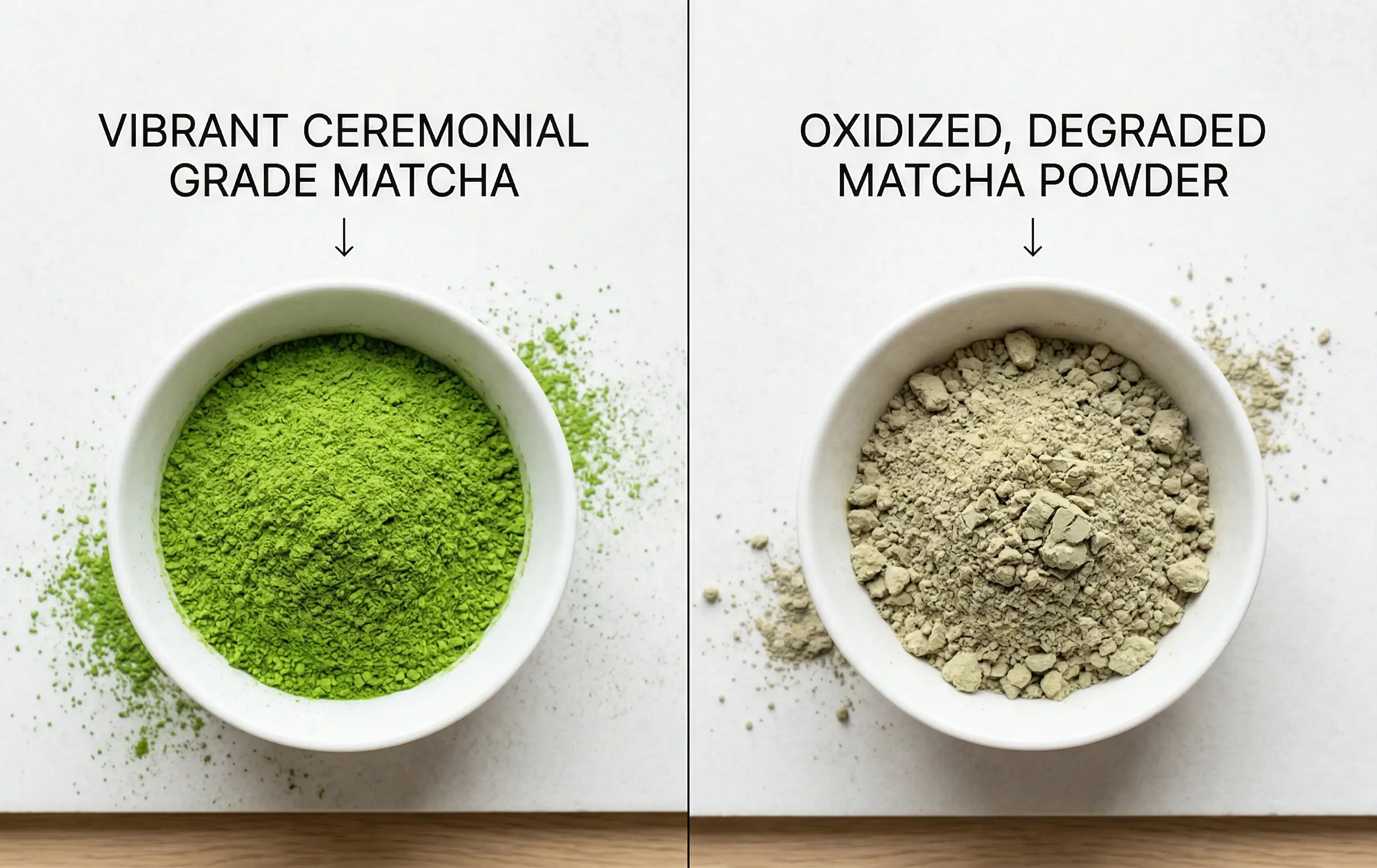
To put this into perspective, consider a simple physical comparison. Standard loose-leaf green tea can comfortably sit exposed to ambient air for several days with only marginal degradation. However, matcha is a deconstructed, micro-milled powder. Because it is ground to such an extreme fineness, its exposed surface area is hundreds of times greater than that of regular tea leaves. If you leave 1000-mesh matcha powder exposed to oxygen and light, it will noticeably begin to degrade and lose its color within a matter of hours. Therefore, choosing the right packaging is not a marketing decision; it is the most critical quality-assurance mechanism in your entire supply chain.
Popular Matcha Packaging Formats Decoded
When sourcing packaging, the market generally presents you with three dominant formats. Before we dive into the granular technical details of each, it is crucial to establish a standardized benchmark to eliminate the fragmented information often found online. As a B2B decision-maker, you must evaluate these formats across four Mutually Exclusive, Collectively Exhaustive (MECE) metrics: Barrier Performance, Cost Per Gram, Minimum Order Quantity (MOQ), and Logistics Volume Ratio.
Below is the ultimate alignment matrix for matcha packaging formats:
| Format | Barrier Performance | Cost Per Gram (Packaging) | MOQ Threshold | Logistics Volume Ratio |
|---|---|---|---|---|
| Traditional Tin (Metal) | Excellent (if flushed/sealed correctly) | Alta | High (often 5,000 – 10,000+) | Poor (High volume, ships empty) |
| Stand-Up Pouch / Flat Bottom | Good to Excellent (depends on film structure) | Bajo a medio | Medium (Digital printing lowers MOQ) | Excellent (Ships flat) |
| Single-Serve Sachet | Excellent (Single exposure) | Más alto | Very High (Requires specialized rollstock) | Good (Dense packing) |
Traditional Tin Packaging
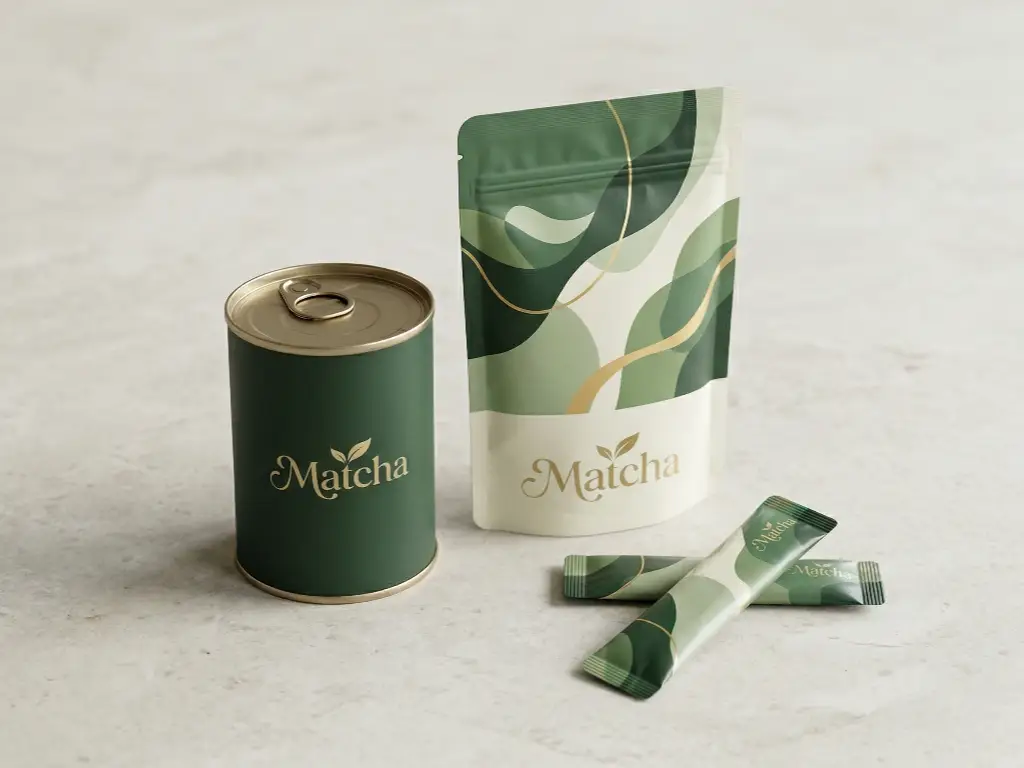
In the realm of Ceremonial Grade matcha, the traditional tin can (usually tinplate or aluminum) maintains an absolute dominance. It visually communicates heritage, premium quality, and justifies a high retail price. However, from an engineering and production standpoint, we must objectively divide tin packaging into two distinct sub-categories, each with its own fatal flaw.
1. Ring-pull sealed tin (Easy-open end)
This format offers the ultimate high-end consumer experience. When the customer pulls the metal ring, they are greeted with a highly satisfying “hiss” sound—the audible proof of nitrogen pressure release, guaranteeing that the powder inside was preserved in a 100% airtight, oxygen-free environment. However, the critical pain point emerges the moment that ring is discarded. Once opened, the secondary sealing performance of the outer plastic or metal lid drops to near zero. It is no longer airtight, leaving the expensive matcha highly vulnerable to ambient kitchen moisture and rapid oxidation.
2. Slip-lid tin with a Foil inner bag
This solves the secondary moisture problem. The consumer opens the tin, cuts open the nitrogen-flushed foil bag, and can fold or clip the bag closed before putting the lid back on. While this protects the matcha better over a 30-day consumption period, the pain point is shifted entirely to the brand and the manufacturer. You are now paying for double packaging (the tin plus the high-barrier pouch), and you have exponentially increased the complexity of your automated filling line. Brands must carefully calculate the trade-off: sacrifice post-opening shelf life, or accept double packaging costs?
Stand-Up Pouches and Flat Bottom Bags
For culinary grade (Culinary Grade) matcha, daily-drinking premium blends, and direct-to-consumer (D2C) e-commerce brands, the stand-up pouch and flat-bottom box pouch have become the undisputed formats of choice. The primary driver behind this dominance is pure, ruthless logistics math.
Consider the extreme difference in warehousing and shipping costs: If you are packaging 100g of matcha, the physical volume required to store and transport 1,000 empty stand-up pouches is roughly one-twentieth (1/20th) of the space required to store 1,000 empty 100g tin cans. For D2C brands navigating expensive international maritime shipping or cross-border trade, shipping “empty air” inside tins destroys profit margins. Pouches ship flat and lightweight.
However, pouches carry a hidden risk that many brands discover too late: Pinholing. During long, turbulent sea freight journeys, the constant microscopic flexing and vibrating of the pouch material can cause the inner aluminum foil layer to fracture, creating microscopic pinholes. These invisible holes completely compromise the barrier, allowing oxygen and moisture to seep in, silently ruining the matcha before it even reaches the Amazon fulfillment center.
Single-Serve Sachets
Single-serve sachets (or stick packs) are rapidly gaining market share, driven by the fast-moving consumer goods (FMCG) sector, modern office workers, and massive coffee chain supply chains (such as Starbucks).
The operational advantages are undeniable. Each sachet represents a single, isolated consumption event. This means zero risk of secondary contamination—the powder is never repeatedly exposed to the air when a consumer opens a jar every morning. Furthermore, it eliminates the need for traditional bamboo whisks (chasen) or precise measuring spoons; the consumer simply tears it open and pours. It is the ultimate convenience format.
The glaring disadvantage, however, is the financial reality. When you calculate the packaging cost per gram of matcha, single-serve sachets are by far the most expensive format. You are using significantly more flexible film, more ink, and requiring much more complex, high-speed multi-lane packaging machinery to deliver the same net weight of tea compared to a single bulk pouch.
The Matcha Packaging Decision Tree
With so many variables, selecting the right format can cause decision paralysis. To alleviate this cognitive load, we have engineered a high-density, logic-driven procurement decision tree. Stop agonizing over aesthetics and simply map your business model to the correct coordinates below.
- Step 1: Determine Your Primary Target Audience (B2B vs. B2C)
- If you are supplying B2B bulk ingredients (e.g., to bubble tea chains, bakeries, or industrial food manufacturers): Aesthetics do not matter. Focus entirely on Cost and Barrier.
- Decision: Choose large, 500g – 1kg High-Barrier Flat Bottom Pouches with no retail frills.
- If you are selling to C-End Retail Consumers: Proceed to Step 2.
- If you are supplying B2B bulk ingredients (e.g., to bubble tea chains, bakeries, or industrial food manufacturers): Aesthetics do not matter. Focus entirely on Cost and Barrier.
- Step 2: Establish Your Retail Price Benchmark (The $30 Threshold)
- Is your target retail price Greater than $30 per 30g (Premium/Ceremonial)?
- Decision: Route to the Tin Format (with nitrogen-flushed inner foil). Consumers at this price point demand the heritage aesthetic and will feel shortchanged by flexible plastic.
- Is your target retail price between $15 and $30 per 30g (Premium Daily/Latte Grade)?
- Decision: Route to the High-Barrier Stand-Up Pouch. This maximizes your profit margins while still offering excellent protection and a broad canvas for premium branding.
- Are you targeting the On-the-go, Convenience, or Mass Market?
- Decision: Route to Single-Serve Sachets. Perfect for gym-goers, office workers, and trial-size marketing strategies.
- Is your target retail price Greater than $30 per 30g (Premium/Ceremonial)?
The Barrier Spectrum: Multi-layer Plastics vs. Absolute Metal
A fatal cognitive trap that many modern brand owners fall into is trusting the generic marketing term “High-Barrier” when purchasing flexible plastic packaging. The protective performance of any packaging material in the world is measured by two universal, uncompromising international laboratory metrics: OTR (Oxygen Transmission Rate) y WVTR (Water Vapor Transmission Rate).
Here is the brutal, objective truth about flexible pouches: Even the most advanced, expensive, multi-layer co-extruded plastic films (such as complex PET/AL/PE structures) have an OTR greater than zero. Over a 12-month or 18-month shelf life, oxygen will slowly permeate through the microscopic pores of the polymer chains. The barrier is good, but it is not absolute.
Furthermore, if you make the critical error of prioritizing “rustic aesthetics” by using single-layer Kraft paper pouches without a pure aluminum foil core, the OTR is catastrophic. Kraft paper is essentially a microscopic sieve. Within 30 days of warehouse storage, oxygen will pour through the paper fibers, turning tens of thousands of dollars of vibrant green matcha into a sad, dead, hay-colored powder.
This fundamental limitation of plastic is precisely why the global elite of the matcha industry rely exclusively on rigid metal cans.
Tinplate and aluminum cans possess an OTR and WVTR of exactly ZERO. Metal is completely impermeable at the molecular level. Light cannot penetrate it. Oxygen cannot diffuse through it. Moisture cannot permeate it. When you package ceremonial matcha in a rigid metal tin, the walls of the container provide an absolute, flawless defense. The only potential point of failure is the mechanical seal at the lid. If that lid is engineered and seamed correctly by professional machinery, the tin becomes an absolute time capsule, halting the degradation of Chlorophyll and L-theanine indefinitely.
From Material to Production: The Machinability Factor
At this point, you have successfully navigated the procurement phase. You have purchased the perfect, high-barrier, visually stunning tin or pouch. However, a perfect packaging solution on paper means nothing if it cannot survive the brutal realities of the factory floor. We must now shift our perspective from “packaging material procurement” to “packaging machinery selection.” How does your chosen material actually perform when running on a high-speed line?
Dealing with 1000-Mesh Static and Dust
To understand the machinal challenges, we must deeply expose the “temperament” of high-value powders in a production environment. Matcha is not like sugar or coffee beans; it is milled to an incredibly fine particle size, often reaching 1000-mesh or even finer. At this microscopic scale, physics changes.
When this ultra-fine powder drops through the filling tubes and into the packaging containers, friction generates massive amounts of static electricity. This static adhesion causes the matcha to behave more like smoke than a solid. It billows, floats, and violently clings to the inner walls of the pouch or tin, refusing to settle quickly.
The commercial cost of this uncontrolled dust is staggering. First, it completely destroys weight accuracy. If the powder is floating out of the bag during the weighing process, the machine compensates by adding more, leading to massive “giveaway costs.” Over a year of production, giving away an extra 2 grams of premium matcha per tin will devour your profit margins. Secondly, this green “smoke” coats the entire cleanroom, getting into machinery bearings and requiring intense, highly expensive labor hours for sanitation and cleanup.
Preventing Seam Contamination and Oxidation
For brands that choose the premium physical protection of rigid tins, the ultimate disaster caused by flying 1000-mesh dust in a canning line is “Seam Contamination.” While many focus on the material of the tin itself, the real failure happens at the mechanical junction. If even a microscopic layer of matcha dust settles on the can flange (the rim) or the lid just milliseconds before the seaming rollers engage, the integrity of the airtight seal is compromised.
In metal packaging, this dust prevents the double-seam from interlocking with absolute precision. Under microscopic inspection, this creates “micro-paths”—invisible channels through which oxygen will slowly seep back into the container. Consequently, that premium, high-barrier tin you invested in is rendered useless, failing to protect the matcha from the “Silent Killers” mentioned above. Furthermore, if the residual oxygen inside the tin isn’t aggressively evacuated before sealing, the matcha will oxidize from the inside out, turning that vibrant green into a dull yellow before it even reaches the consumer.
As experts with over 18 years of deep engineering experience in the rigid packaging and canning machinery sector, Levapack intimately understands the agonizing pain points of handling high-value, volatile powders. For SMEs and co-packers looking to bridge the perilous gap between premium metal packaging materials and flawless production, we provide specialized powder canning lines engineered specifically to defeat dust and oxidation at the source:
- Precision Anti-Static Filling: Our stations utilize top-tier servo-motor driven Sinfines de llenado. Unlike standard vibration fillers that exacerbate dust clouds, the servo-driven auger provides absolute volumetric precision with minimal agitation. More importantly, we integrate independent dust extraction and recovery systems directly at the filling nozzle. This localized vacuum instantly sucks away the billowing “green smoke” before it can ever settle on the can flange, ensuring an immaculately clean seaming zone.
- High-Vacuum Nitrogen Flushing: For ceremonial grade matcha, the sealing process must be absolute. Levapack equips our lines with high-precision lavado con nitrógeno and vacuum seaming technology. Our systems aggressively pull the ambient air out of the tin and replace it with inert nitrogen, strictly controlling the residual oxygen levels to below 3%—the critical threshold for maintaining peak freshness.
- Uncompromising Mechanical Tolerance: Every core mechanical component in our seaming heads undergoes 2μm-level CNC precision machining and is meticulously hand-assembled by engineers with over 15 years of experience.
If you have decided that rigid tins are the right path for your premium matcha, securing your product quality with world-class canning technology is the next step.
The Challenge for Fine Powders
While canning presents its own unique mechanical requirements, a massive portion of the market relies on flexible packaging. When dealing with micrometer-level matcha powder in pouches, brand owners are essentially fighting a war on two fronts. It is a dual challenge. The first battle takes place in the consumer’s kitchen pantry, where the physical attributes of the packaging itself are put to the test. The second battle rages on the factory floor, where automated equipment must wrestle with the physical limitations of the bags being fed into it. Let us break down both dimensions.
Why Standard Zippers Fail
If you look at “People Also Ask” (PAA) queries and Reddit threads regarding matcha, one of the most high-frequency, infuriating consumer complaints is: “The zipper on my matcha bag won’t close anymore.” This is the ultimate consumer-facing packaging failure.
The engineering failure mechanism is quite simple. Most brands procure bags equipped with standard press-to-close zippers. These zippers rely on two interlocking plastic tracks. When the consumer dips their spoon into the bag to scoop out the matcha, the microscopic powder inevitably coats the inside of the bag. As they press the zipper closed, the micrometer-level particles become packed tightly into the grooves of the plastic tracks. Because the powder is so fine and dense, it acts like cement, physically preventing the male and female tracks from locking completely.
The result is a catastrophic, invisible gap. The consumer thinks the bag is sealed, but air is freely flowing through the compromised zipper. Within days, the surface of the matcha inside the bag begins to oxidize, binding with moisture to form hard, yellowish-gray lumps. The brand receives furious customer service emails and 1-star reviews.
The engineering solution to this must be implemented during the procurement phase. You must strictly specify the integration of a “Powder-proof zipper” (often called a Flange zipper) or utilize Hook-to-hook closures (similar to Velcro technology). These specialized closures are specifically designed to push powder out of the way during the locking mechanism, ensuring a hermetic seal even in the dustiest environments.
The Process Challenge: Air Deflation & Zipper Handling
Solving the consumer’s problem by upgrading to a powder-proof zipper, unfortunately, introduces a new, highly complex set of physical challenges for the machinery on your production line. This is where many brands experience catastrophic equipment incompatibility.
The first major process challenge is the “Poof Effect” during deflation. Before a pouch can be heat-sealed, the machine must expel the excess air from the top of the bag to ensure it is compact and ready for shipping. In standard machines, this is often done by physical deflator bars that squeeze the bag. However, if you squeeze a bag full of 1000-mesh matcha too quickly, the air rushing out will carry the ultra-fine powder with it, creating a “mushroom cloud” or volcano effect. This green eruption immediately coats the inside of your newly purchased powder-proof zipper, guaranteeing a failed heat seal and a rejected bag.
The second challenge is zipper handling compatibility. Powder-proof zippers are structurally thicker, stiffer, and require significantly more mechanical force to pry open compared to standard zippers. If your co-packer is running older or poorly calibrated rotary premade tea packaging machines, the vacuum suction cups and mechanical grippers may lack the necessary torque and precision to reliably open the stiff flange zippers. This leads to missed fills, torn bags, and unacceptable downtime.
The critical takeaway for buyers is this: When you upgrade your packaging materials to solve a consumer pain point, you must simultaneously audit your machinery’s capabilities. Ensure your equipment utilizes gentle, vacuum-based air deflation rather than violent physical squeezing, and verify that the mechanical grippers are rated to handle the stiffness of advanced powder-proof closures. A brilliant bag on the wrong machine is nothing more than expensive garbage.
Sustainability Without Compromise
There is a harsh, unavoidable commercial compromise between “Absolute High Barrier” and “100% Recyclability” in the flexible plastics industry. Many well-intentioned brands demand pouches made of 100% pure PE (Polyethylene) because it is widely accepted in global recycling streams. However, pure PE possesses highly unstable OTRs. It is too porous. It will absolutely fail to protect ceremonial matcha. To make a plastic pouch work, you must use complex co-extruded structures (like MDO-PE/EVOH/PE) to barely meet recycling standards while maintaining a functional barrier. These plastic structures are incredibly difficult for municipal recycling facilities to separate and process. They often end up in landfills regardless of the logo printed on the bag.
Aluminum and tinplate are, by a massive margin, the most recycled materials on the planet. They boast a near 100% recycling rate in advanced global economies. More importantly, unlike plastic which degrades in quality every time it is melted down, metal can be infinitely recycled without any loss of quality, barrier performance, or structural integrity. A metal can recycled today can be back on a retail shelf as a new metal can in 60 days.
Mastering matcha packaging requires aligning chemistry, material science, and precision mechanical engineering. If you have decided that rigid tins are the right path to protect your premium brand equity, securing your product quality with world-class canning technology is the next step.


 EN
EN  RU
RU  ES
ES  FR
FR  DE
DE  NL
NL  IT
IT  JA
JA  ID
ID  PT
PT  KO
KO