
What is a Multihead Weigher in Packaging?
Multihead Weighers are high-speed, quality, and quantitative weighing in which a microcontroller manages several weighing units and uses combinatorial math to determine and release the optimal weight of a product. In contrast to linear scales, which are quantitative and fill a single bucket until a set weight is achieved, multihead weighing machines break bulk product into smaller portions, weigh them in different hoppers, and select a set of hoppers to match the target weight of a production run.
In automated food packaging facilities across a variety of industries, a multihead weigher acts as the main distribution center for materials and as the main control processor for the entire product flow. It is more than a weighing machine; multihead weighers control the flow, speed, and precision of the production lines. The packaging machine in Vertical Form Fill and Seal and high-speed canning systems can only work as fast and as accurately as the multihead weighers.
Global small and medium enterprises (SMEs) in the packaging industry are likely to prioritize intentional and strategic investments, while fully automating to high-precision manufacturing, and transitioning from manual operations to semi-automated operations. The most significant financial advantage of a multihead weigher is the ability to minimize “giveaway.” Giveaway is the excess amount of product included in a pack to comply with national regulations, in which each pack must have a certain, legally defined, minimum weight. In the case of manual weighing, employees fill the pack by several grams more to avoid being penalized for weighing under. Over the course of millions of packs, it can become devastating. A multihead weigher will reduce this overfilling range to fractions of a gram. This is why it’s so cost-efficient, as it converts saved giveaway directly into profit, and it provides an outstandingly quick payback period for the capital invested.
Core Components of a Multihead Weigher System
For Plant Managers, as part of their evaluation of the reliability of the equipment and the equipment’s ability to meet sanitation standards, it is helpful to have a basic understanding of the structural engineering of the device to fully grasp the multihead weigher working principle. In a high-quality multihead weigher, the many different individual components can be a good example of physical and electronic components being tightly integrated.
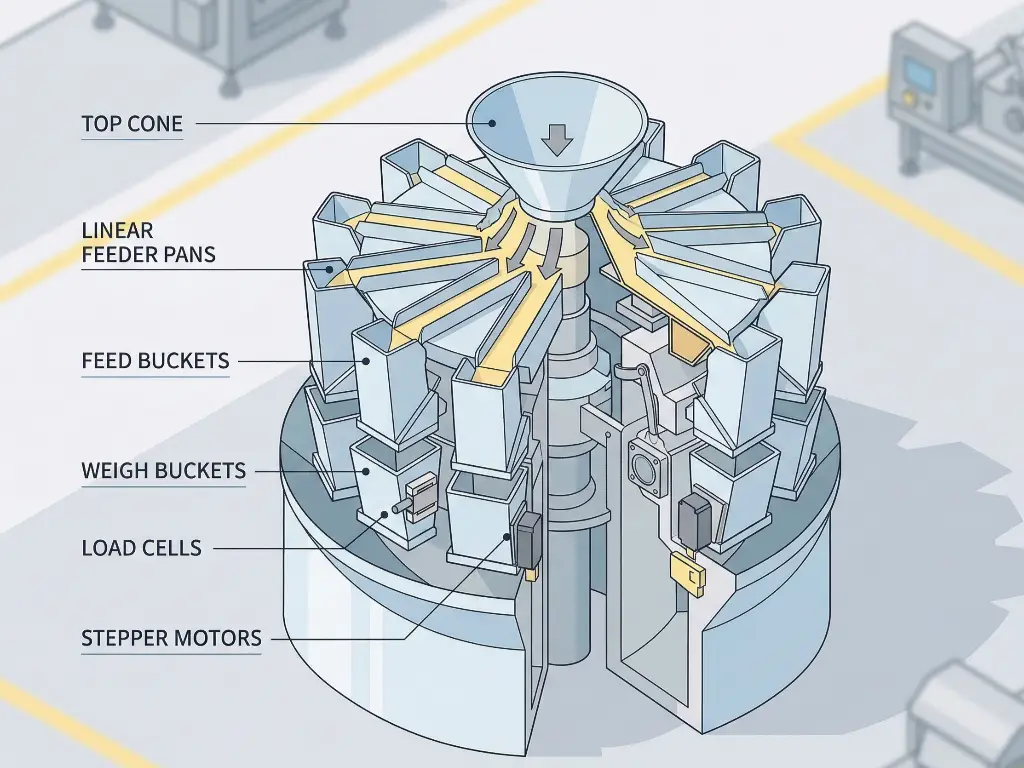
- Top Cone: Being the topmost section of the machine, the top cone serves as the first point of contact and receives bulk material from an upstream incline conveyor or Z-bucket elevator. The top cone uses continuous controlled vibration, adjusting its amplitude, to aid in the outward, 360-degree radial dispersion of the bulk product to the linear feeders.
- Linear Voederautomaat Pans: These feed pans, which are located radially around the top cone and infeed funnel, collect the product that has been spread. Each pan has an independent vibratory system, the parameters of which are controlled to create a continuous, uniform flow of product to the individual feeding units. The design of each of these pans is adjusted to match the particular flow characteristics of the product being handled.
- Feed Buckets (Holding Buckets): These buckets are located immediately under the linear feed pans and, as temporary storage units, serve to stage the material. The moment the weigh hopper below one of its settings drops, the feed bucket opens its gates to give that weigh bucket a refill. This system of staging keeps the top cone from waiting for each bucket to cycle, thus facilitating continuous operation.
- Weigh Buckets: In this part of the weighing process, the most important thing that happens is mass measurement. Food-grade 304 or 316 stainless steel of 1.5mm to 2mm thickness is used in the frames of the machines, along with all parts that come in contact with the food. The unique specification of these materials ensures that micro-cracking does not occur during years of continuous, high-frequency vibrations. In addition, materials used are safe and have the highest resistance to corrosion caused by contact with Acids or Salts.
- Load Cells: Load cell technology provides the most important sensor parts in this machine. Each of the weigh buckets has 1 strain gauge load cell that measures the downward force exerted by the item and translates it to a weight measurement. The sensors are able to detect changes in weight in 1 millisecond and can measure items to an accuracy of 0.1g – 1.5g, depending on the volume or weight of individual pieces.
- Stepper Motors: Each bucket gate is opened and closed with specific control of angle, speed, and closure force by stepper motors. Compared to the other option of using pneumatic cylinders, stepper motors allow better control as they are able to control and adjust the position of the bucket gate to avoid crushing the product.
Multihead Weigher Working Principle Step-by-Step
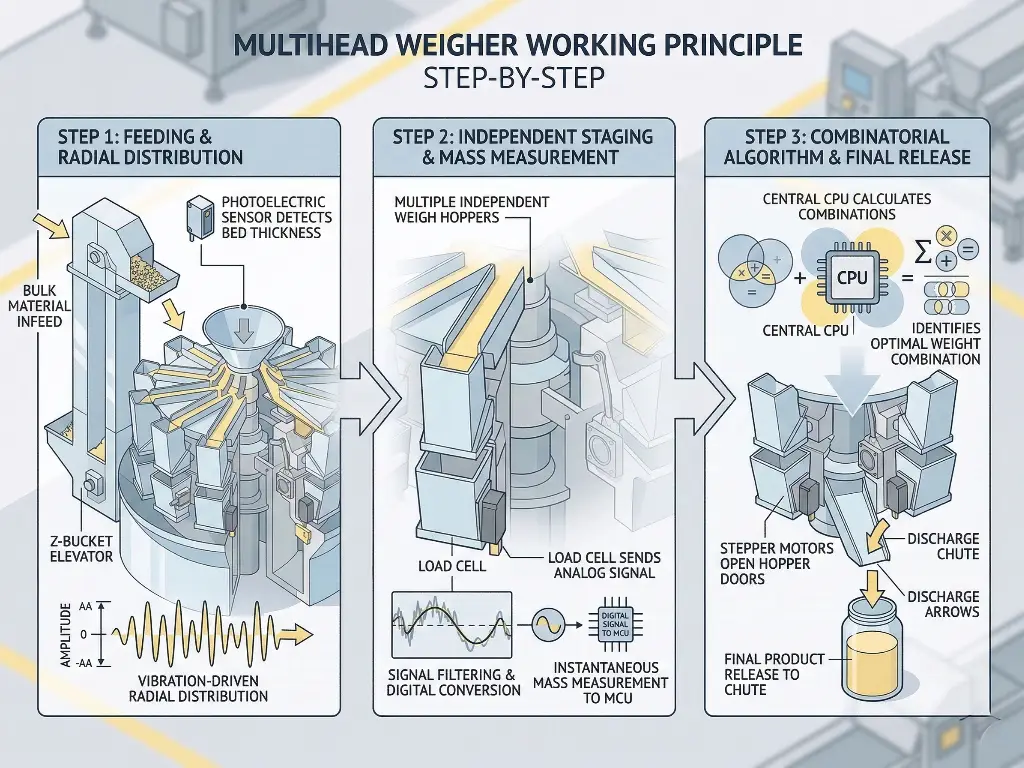
To truly master packaging, one must understand the multihead weigher working principle in action.
Step 1: Material Feeding and Distributing
The process begins with an upstream Z-elevator releasing raw materials onto the top cone. A photoelectric sensor located above the top cone determines the thickness of the product bed. If the thickness is too thin, the sensor will command the elevator to dispense more product, optimizing the feeding speed. If the thickness is too overloaded, the sensor will command the elevator to stop. This feedback loop prevents structural damage and consistent material pressure. With the aid of vibrations, the top cone spreads the product to the linear feeder pans. These pans, through the use of specific vibrational frequencies, evenly distribute and separate the product, creating a consistent flow. The pan vibrations cause the material to be scraped off the edge, allowing it to be dropped through a funnel or direct drop into the feed buckets’ staging area.
Step 2: Independent Weighing in Hoppers
When the feed buckets contain the staged material, their bottom gates open at the same time, releasing the product into the weigh hopper modules located directly underneath. This is where they actually measure the product. Each weigh hopper has high-precision load cells that measure the value of the material in the hoppers instantly. The sensors go through a process called stabilization in a fraction of a second. The process filters any surrounding mechanical vibration noise from the factory floor through a mechanism called a digital low-pass filter. Then the sensors send the mass value to the central MCU’s main board. Example: the system detects that Hopper A has 25g, Hopper B has 32g, Hopper C has 18g, etc., over the entire head count. The more sophisticated systems have an autostop feature. If the sensors notice that too many hoppers are empty, the system will stop the weighing cycle to allow the flow to stabilize to avoid partial mixes.
Step 3: The Combination Algorithm Magic
The real magic of the multihead weigher working principle comes from the power of its computer combination weighing algorithms. Let’s say the production line has a target pack weight of 100g. The central CPU sends weights of all hoppers to the head controller, and the microcomputer doesn’t attempt to fill a single hopper to exactly 100g. Instead, the microcomputer instantly computes all the possible mathematical combinations of the hoppers.
For a typical 14-head weigher, in under a tenth of a second, the microcontroller evaluates thousands of weight combinations. The microcontroller seeks to identify the combination that yields 100g, or the closest weight possible over 100g (e.g., 100.2g), while strictly avoiding and rejecting any combinations that go under the target weight for compliance with consumer protection laws. When the system computes that Hopper A (25g) + Hopper D (31g) + Hopper G (44g) is 100g, the microcontroller has a perfect mathematical solution. The microcontroller sends a control signal to the stepper motors of Hoppers A, D, and G, and the shutters open. The 100g of material undergoes a clean discharge through the middle discharge chute to the waiting tin can, larger containers, composite paper tube, or premade pouch that is ready to go with a rotary packing machine.
Multihead Weigher Types for Different Materials
Because factories process a wide range of products, combination scales offer immense versatility.
High-Speed Models for Granules & Dry Snacks
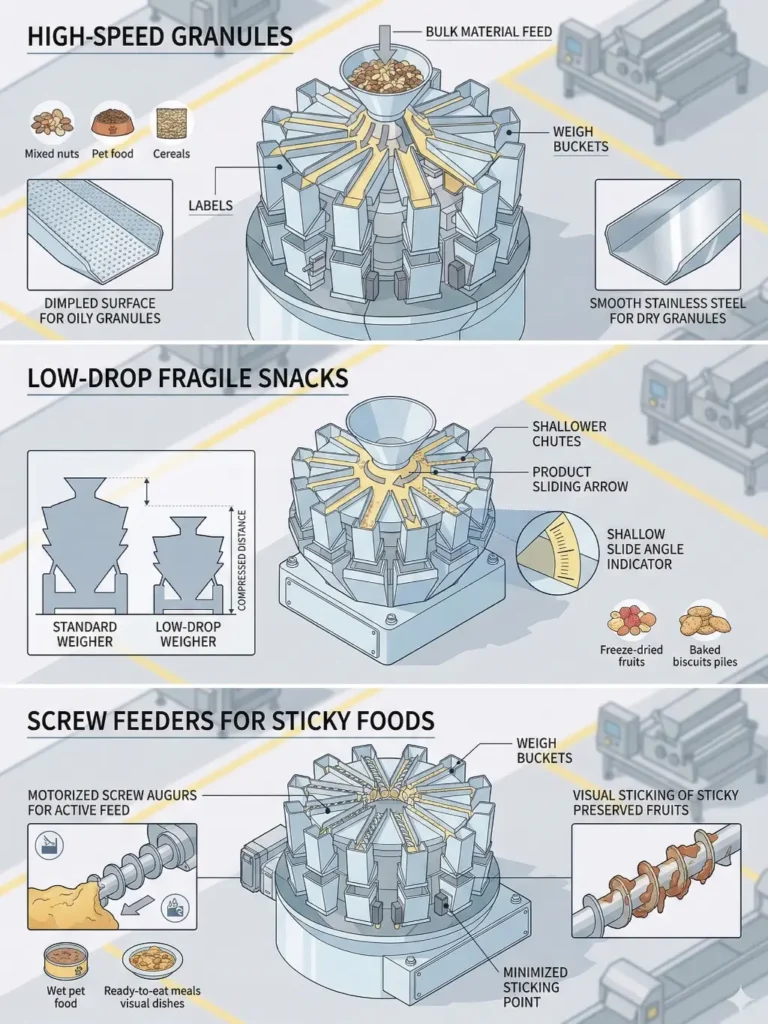
Designed for precision and speed, these models excel in high-volume and high-accuracy environments handling granules. Products include mixed nuts, dry pet food, extruded snacks, cereals, coffee, and rice. The contact surfaces of the linear pans and hoppers are made of either standard micro-dimpled surfaces or standard smooth stainless steel, depending on the friction coefficient of the product. The dimpled surface will reduce the contact area and therefore ensure that oily or damp granules do not get sticky. The overall design ensures rapid product flow and instantaneous stabilization of the load cells. This type of head weigher is designed to match the speed of high-speed can seaming machines or VFFS baggers to ensure that the downstream equipment is fully utilized and operating at optimal performance.
Low-Drop Models for Fragile Snacks
Packaging products like freeze-dried fruits, baked biscuits, and potato chips can lose their integrity and break easily when packaging. Common gravity drops lead the product to break when touching the metal walls in the packaging hopper, leading to unacceptable breaks and dust in the packaging area. Low-drop multi-head weighers feed the product in a way that lowers the kinetic energy in the product. In essence, the engineering design alters the internal geometry of the machine. The slide angles of the discharge chutes are rendered much shallower, and the distance vertically is compressed to amaximum of the top cone, feed buckets, and the weigh buckets. In this way, the design of the machine is to help the product to slide and not free-fall. This design is aimed at protecting the product throughout the different stages, from the bulk feed to the packaging.
Screw Feeders for Sticky Foods
Most standard vibration-based multi-head weighers fail when handling sticky products or wet, fresh products that are viscous or heavily marinated. Applicable products in this category are wet pet food chunks, ready-to-eat meals, fresh diced meat, and sticky preserved fruits. These products stick to the stainless-steel pans, and vibration only causes them to compress and stick in the pan instead of moving forward. To solve this fluid dynamics issue, screw systems are integrated to replace the linear vibration feeding. Instead, motorized screw augers are installed in the feed troughs. These screws actively push and take the sticky product out, ensuring that the feed buckets are completely filled and the amount of product supplied is the same, regardless of how wet or sticky the product is.
How to Choose: 10 vs 14 vs 24 Heads
When choosing the right configuration of combination scales, it is important to fit the technical parameters of the machine to the expected output of the factory, the available budget, and the specific types of material to be handled.
| Machine Configuration | Maximale snelheid | Accuracy Range | Primary Application Scenarios |
| 10-Head Weigher | 60 – 70 packages/cans per minute | Hoog | Engineered for highly advanced, custom production lines. Used for extremely high-speed single product lines, or precisely mixing two to four distinct materials (e.g., a specific ratio of almonds, cashews, and raisins) into a single container simultaneously. |
| 14-Head Weigher | 100 – 120 packages/cans per minute | Zeer hoog | Recognized as the industry standard and the most versatile option. Delivers the optimal mathematical balance between combinatorial accuracy and production speed for the vast majority of dry goods and granular foods. |
| 24-Head Weigher | 200+ packages/cans per minute | Ultra High | Engineered for highly advanced, custom production lines. Used for extreme high-speed single product lines, or precisely mixing two to four distinct materials (e.g., a specific ratio of almonds, cashews, and raisins) into a single container simultaneously. |
When talking about SME production facilities, the most logical capital investment is the 14-head multihead weigher. Weighing 14-head models are industrial standard models designed to weigh with high precision. They weigh in a single range starting from 10g to 3000g, with a weighing accuracy range variance of only 0.1g to 2g. Depending on the piece weight of the product, the 14-head multihead weighers have 1.6L or 2.5L hopper capacities, and support continuous filling up to 60 to 120 packages per minute. The 14-head is equipped with active servos and an intelligent MCU control system with a 7 inch touch panel. The 14-head multihead weigher is designed for production lines to be changed quickly. The system allows the production of multiple products without manual changes. Production lines can be changed from 50g coffee to 500g rice in seconds.
Common Troubleshooting Guide for Engineers
Even high-level equipment with MCU systems experiences common issues. Troubleshooting, maintenance, and operational protocols are key to improvement and user experience.
- Inaccurate Weighing: Do not remove the weighing sensors just yet. Use the software zero calibration feature from the MCU touch screen to push the zero calibration to begin.
- Check the factory floor. Load cells are very sensitive and can be affected by air pressure. Make sure there are no strong air currents from things like HVAC systems or big industrial fans blowing onto the weighing buckets.
- Look into physical vibration. Make sure the multihead weigher is placed on its own support structure that is not connected to the downstream packaging machine or seamer so that it can be as free from large vibrations as possible.
- Load Cell Dust & Sensor Errors: In places that deal with pharmaceuticals, powdery, or dusty materials, fine dust particles are going to get stuck in the little gaps around the load cell and cause the sensors to get stuck and show error messages.
- Cleaning is very important. If the equipment is not given a high-level IP waterproof rating that is above wash-down levels, sanitation crews cannot use high-pressure washing anywhere in the equipment.
- Engineers have to use dry compressed air and antistatic brushes to remove dust from the sensor gaps.
- Material Blockage in Hoppers: If product consistently fails to discharge fully when the bucket gates open, first access the MCU panel and verify the stepper motor parameters. Ensure the programmed opening angle and the door-open dwell time are sufficient for the volume and flow rate of the product.
- If the mechanical setup is correct but the material (gummy bears or heavily salted snack items) is sticking to the steel, then your 304 standard stainless steel is not going to cut it. The engineering answer is to substitute the standard hoppers for those that are plated with Teflon (PTFE) or have specialized patterns with dimples that reduce surface friction and stickiness.
Summary and Next Steps
The first step to finding a suitable multihead weigher is understanding your specific material handling requirements and floor space constraints. A weigher achieves maximum efficiency only when it is flawlessly integrated into a broader, high-performance ecosystem.
Op Levapack, we specialize in engineering precise, automated packaging solutions tailored specifically for SMEs globally. Rather than offering rigid, off-the-shelf machines, we provide solutions that align exactly with your production needs:
- Custom Engineered Systems: Whether you require a standalone LPE-SFM014 high-speed weigher of a fully integrated canning en premade pouch packaging line, we tailor the machine structure, speed, and layout to your factory.
- Uncompromising Precisie & Durability: Our equipment is built using advanced CNC machining to achieve micro-level precision. By utilizing premium stainless steel and top-tier international components (like Siemens and Schneider), we ensure long-term mechanical reliability.
- Comprehensive Lifecycle Support: Alongside any machinery you procure, we provide invaluable operator training, detailed manuals, and proactive spare parts management to empower your workforce and maximize production uptime.
- Industry-Leading Protection: We secure your capital investment with an extended 16-month comprehensive warranty, backed by a global service network offering 24/7 technical response and remote diagnostics.
To speak to our engineering team about your specific multihead weighing needs and find the perfect integration package for your plant, get in touch with us today. You can also send your material samples to our facility for rigorous, free machine testing to validate performance before implementation.


 EN
EN  RU
RU  ES
ES  FR
FR  DE
DE  NL
NL  IT
IT  JA
JA  ID
ID  PT
PT  KO
KO